Base Station Battery for Reliable, Maintenance-Free Operation
When there are power outages in telecom networks, every second of downtime means lost connections and money. A reliable base station battery is the key to constant communication, making sure that cell phone towers, data centers, and remote sites can keep running even when the power goes out. Modern lithium iron phosphate (LiFePO₄) options have changed backup power systems by making them last longer and need less upkeep. These high-tech energy storage systems keep important infrastructure from going down while also lowering costs by being more efficient and lasting longer. This makes them a must-have for telecom providers who manage 4G and 5G networks in a variety of settings.
Understanding Base Station Batteries: Types, Functions, and Lifespan
For telecom equipment to keep providing services, it needs stable backup power. The base station battery serves as the primary source of power during power outages, providing instant power to emitters, receivers, and network devices. Knowing about the different battery technologies helps buying managers make smart choices that meet business needs and stay within budget.
Traditional Lead-Acid Technologies
For many years, lead-acid batteries have been used in the telecoms business because they work well and are affordable. Floating lead-acid batteries need to be serviced regularly, which includes checking the water level and cleaning the terminals. This adds to the cost of work over time. Valve-regulated lead-acid (VRLA) types, such as absorbed glass mat (AGM) and gel types, require less upkeep but usually have shorter cycle lives of 500 to 1,000 discharge cycles. These batteries work fine in climate-controlled spaces, but they have trouble with extreme temperatures and deep discharge situations that are typical in remote sites.
Advanced Lithium Technologies
Lithium-ion batteries improve backup power. For telecommunications, lithium iron phosphate (LiFePO₄) is increasingly preferred. LiFePO4 batteries are stable at high temperatures, reducing the fire risk that other lithium chemistries pose. Phosphate-based cathodes inhibit thermal runaway even under overcharging or physical damage. These methods are safer for equipment shelters and crowds.How LiFePO4 batteries are created makes them last longer. Good ones can last 3,000 to 5,000 charge-discharge cycles before losing 80% of their capacity. This increased service life ensures reliable operation for at least ten years of average use. This makes it less expensive and less frequent to replace than normal alternatives.
Key Technical Specifications
The capacity and power numbers of a battery show how well it can handle certain loads for certain amounts of time. As well as being compatible with normal telecom devices, a 48V system converts power efficiently. Energy density is a measure of how much power a battery stores compared to its size and weight. Modern lithium batteries are better at using space than lead-acid batteries. Batteries with high discharge rates can give high currents when equipment is first turned on and when it's under a lot of load, without voltage drops that could damage sensitive electronics.Cycle life specifications tell you how long a battery is expected to last under certain conditions of use. Manufacturers usually rate rounds based on certain depths-of-discharge (DOD) percentages. 80% DOD is a popular standard. The operating temperature range of a battery shows how well it can handle different regions. For example, good lithium systems work effectively from -20°C to 60°C, so they can be used in places from the Arctic to the desert.
How to Choose the Best Base Station Battery for Your 4G/5G Network?
To choose the best backup power options, you have to weigh a lot of things, like the need for dependability, your budget, the limitations of the installation process, and the long-term costs of running the system. The growing needs of 5G networks, which need more power and more range, make choosing the right base station battery more important than ever.
Evaluating Technology Trade-Offs
Modern telecom companies must evaluate both the initial and lifetime costs of battery solutions. Lead-acid systems are cheaper upfront, but they require frequent replacement and maintenance, which adds up to hidden expenditures. Lithium systems cost more initially, but they last longer, require less maintenance, and use less energy, lowering equipment bunker cooling expenses.Each technology has different safety risks. Some lithium-ion systems require special safety precautions, whereas LiFePO₄ batteries resist high temperatures. Weight is relevant for installation and structure. Lithium batteries weigh 60–70% less than lead-acid systems, making rooftop installations easier and requiring less structural support.Environmental success affects corporate costs and sustainability goals. As temperatures change, lithium batteries maintain power and performance. This eliminates the need for costly climate control in remote regions. Their greater charge-discharge efficiency reduces wasted energy, lowering electricity bills and helping companies become green.
Capacity Planning for Network Demands
The right size makes sure that backup systems can run for long periods of time during power blackouts without needlessly costing too much. Engineers have to figure out the total load needs, which include transmitters, cooling systems, tracking gear, and safety gaps for growth in the future. Because 5G base stations can use up to three times as much power as 4G equipment, it's important to carefully measure their capacity to make sure they don't get too small, which could affect the stability of the network.How long a backup needs to last depends on how reliable the grid is and what the service level agreement says. Installations in cities with stable utility power might need a backup power source for two to four hours, while towers in rural places where power goes out often might need eight to twenty-four hours of uninterrupted operation. Hybrid systems that combine batteries with diesel or propane engines can run for a much longer time, but they make it harder to get fuel and keep up with upkeep, which some owners would rather not do.
Warranty and Support Considerations
Full insurance protection keeps investments safe and gives you options when equipment doesn't work right. Lithium batteries from good brands come with 5–10-year contracts, which shows that the company is sure the batteries will last. Performance promises, such as minimum capacity retention over time, should be included in the warranty terms to make sure that batteries keep working as promised for the whole time they are under warranty.When fixing system problems or planning for growth, having access to technical help is very important. Suppliers with experienced engineering teams can help with customizing the BMS, integrating the system, and responding quickly to technical questions, which can help avoid costly downtime. Global distribution networks make sure that parts are available on time and that there are local service resources. This is especially helpful for workers who are in charge of sites that are spread out geographically.
Introducing the TP-4840T: Industrial-Grade Performance
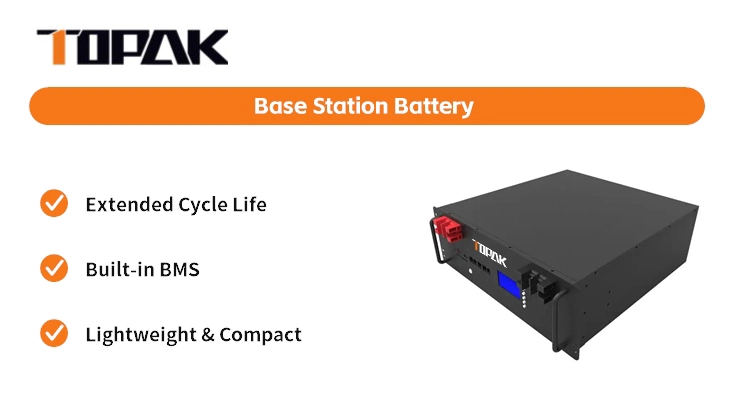
The TP-4840T 48V 40Ah battery from TOPAK is a great example of how reliable and efficient a base station battery needs to be for demanding telecom uses. This custom energy storage system blends advanced LiFePO4 chemistry with smart battery management to provide trouble-free operation in a range of environmental situations. The specs for the system directly meet important telecom needs. The TP-4840T improves power density while minimizing important equipment room space. It has a small 442x400x177mm footprint and can store 1920Wh of energy. It can handle peak loads from multiple emitters and support equipment without voltage instability thanks to its 40A continuous discharge capability. When compared to standard options, the lightweight design, which weighs about 25 kg, makes fitting easier, and the structure needs less support.
Core Advantages of the TP-4840T
The tech that went into making this platform has real practical benefits that cut costs and make things more reliable. Here are some of the best things about this device:
- Extended Cycle Life: The TP-4840T can handle more than 3,000 cycles at 80% depth of discharge, so it can be used reliably for years before its capacity drops and it needs to be replaced. This makes the batteries last longer, which means they don't need to be replaced as often and for less money. This cuts down on working interruptions and waste costs.
- Comprehensive BMS Protection: The built-in battery management system constantly checks the voltages of the cells, the flow of current, and the temperature. This keeps the battery from getting damaged by over-voltage, over-current, short circuits, and temperature extremes. This smart security makes the battery last longer and keeps connected devices safe from electricity problems.
- Wide Operating Temperature Range: The TP-4840T was designed to work well in a wide range of climates, from sub-freezing to high-temperature settings. Because of this environmental resilience, remote sites don't need expensive temperature control systems. This cuts down on energy use and building complexity.
- High Energy Density: Compared to older technologies, this one stores more energy per unit of space and weight, thanks to its small size and light weight. This efficiency makes construction choices more open and cuts down on transportation costs, which is especially helpful for hard-to-reach places in the middle of nowhere.
- Maintenance-Free Operation: Unlike lead-acid batteries that need water added, terminals cleaned, and balancing charges every so often, the TP-4840T works on its own with little supervision. This feature greatly lowers the cost of labor and the number of site visits that need to be made. This is especially helpful for towers that are far away and where getting technicians to the site costs a lot.
These advantages collectively solve common telecom power challenges, delivering reliable backup without the operating difficulties that come with older battery technologies. The design doesn't need any upkeep, so managers can use their technical resources to grow their networks instead of servicing batteries on a regular basis. This makes operations run more smoothly overall.
Certification and Safety Compliance
International approvals prove that the TP-4840T is safe and works well, which makes it easier to use in places around the world. The UN38.3 certification makes sure that lithium batteries can be safely shipped by air, sea, and land. This makes operations easier for foreign projects. The CE mark shows that a product meets the safety, health, and environmental standards of the European Union. This is very important for businesses that want to sell their products in Europe. Material Safety Data Sheets (MSDS) list hazards and explain how to handle them. They help with safety programs at work and follow the rules.These licenses show that the products have been through strict testing procedures that make sure they are safe and of good quality in a variety of settings. Purchasing managers can confidently ask for approved goods because they know that claims made by manufacturers have been checked by independent laboratories. This verification by a third party lowers the risk of buying and supports the need for due diligence in company purchasing policies.
Application Versatility
It can adapt to diverse telecom infrastructure topologies, making the TP-4840T a versatile backup power source. Cellular network base stations need reliable energy storage to maintain call and data services during power outages. In areas with unstable grid power, remote communication towers can now operate without the need for diesel engines, which require regular feeding and maintenance.By combining solar cells with battery storage, hybrid power systems create sustainable, off-grid installations that don't need to pay for electricity and are better for the environment. The TP-4840T works well with photovoltaic systems and stores solar electricity for nighttime use. Public safety, emergency services, and traffic control networks need reliable backup procedures.
Practical Guide to Procuring Base Station Batteries: Process, Suppliers, and Logistics
Getting through the buying process quickly and easily guarantees release on time and on good terms. Knowing what a provider can do, how they set prices, and what logistics issues need to be thought about helps buyers make better choices regarding their base station battery requirements and avoid common mistakes.
Identifying Qualified Suppliers
Choosing the appropriate supplier affects product quality, delivery reliability, and long-term support. Established manufacturers who consistently offer high-quality items and meet their guarantee commitments are reliable. Companies founded before 2007 have skills that younger companies lack because of market cycles and technological developments. In manufacturing, large-scale automatic production lines provide quality and on-time delivery of massive orders.Diverse vendors have diverse technical skills, especially for battery control system development. BMS engineering teams oversee safety, speed, and charging system compatibility. Without third-party BMS suppliers, organizations can't adapt their systems or correct technology issues as rapidly.Global distribution networks aid specialized tasks and improve efficiency. Working with 15 or more countries shows that suppliers may export and have shipping partnerships that reduce delivery delays and visa issues. Regional storage reduces downtime from service difficulties by speeding up the delivery of new units and parts.
Understanding Pricing and Order Terms
Prices for batteries depend on their size, chemistry, and the number of units ordered. Prices for lithium batteries used in base stations can be modest to high, based on the manufacturer and the batteries' specs. Volume discounts are given for bigger purchases, and prices are often lowered for orders that are bigger than the minimum order amounts. If a buyer wants to grow their network, they should ask about volume price models that lower the cost per unit as the order size grows.Terms of payment affect cash flow and planning your finances. Standard business terms usually require a deposit of 30% to 50%, with the rest of the payment due before shipment. However, repeat buyers may be able to arrange longer payment terms. Letters of credit are a way to protect both the buyer's and the seller's interests in foreign deals while also making customs clearance easier.Lead times depend on how quickly you need the product and how you want it to be customized. Standard setups usually ship between 2 and 4 weeks, but if you change the voltage, capacity, or BMS settings, it could take 4 to 8 weeks longer. Early on in the buying process, buyers should let suppliers know when they need to complete a project. This way, suppliers can plan their production schedules and avoid delays.
Streamlining the Order Process
An effective purchase is organized from the first question to post-delivery help. Technical assistance begins with purchasers describing the application's power, capacity, discharge rates, environmental conditions, and physical limits. Experienced suppliers provide solutions based on what the consumer wants, sometimes offering greater value or performance.When evaluating a quote, consider the pricing, guarantee conditions, technical details, certification documents, and support services. Buyers should request product data sheets and test reports to verify seller claims. Clarifying warranty coverage elements, like what doesn't qualify for security and how claims are handled, will help reduce confusion.A sample evaluation allows you to try something before buying a lot. Real-world operating testing reveals sample unit performance and system compatibility. This certification phase reduces launch risk when moving tools or providers.Reputable manufacturers verify incoming materials, use automated assembly, and rigorously test produced devices during production and quality control. Quality assurance measures that detect issues before shipment should be asked about. BMS functional testing, capacity verification, and environmental stress assessment are examples.Logistics coordination comprises identifying the optimal shipping method, completing customs paperwork, and scheduling delivery. Ocean transport is cheaper but slower than air freight. Suppliers familiar with international business handle export paperwork, price classification, and target country regulations. This simplifies customs clearance and reduces waits.
Ensuring Long-Term Performance: Testing, Maintenance, and Troubleshooting
For a base station battery to last as long as possible, it needs to be regularly checked and given preventative care. Even though lithium batteries don't need as much upkeep as their lead-acid predecessors, systems should still be checked on a regular basis to make sure they're working properly and to find any problems before they become major.
Capacity Testing and Health Monitoring
Regular capacity testing keeps batteries running properly. The battery is fully charged and drained at defined rates while its energy is measured until it exceeds the minimum voltage requirements for testing. Compare the real capacity to the rated specs to observe how it's dropping over time, which helps you plan replacements. Testing once a year is sufficient for most installations, but essential uses may require six-month testing.Voltage monitoring alerts you to cell mismatches that lower capacity and destroy batteries. Good BMS platforms monitor cell volts and inform you if they exceed limitations. Monitoring systems can alert staff to remote issues so they can solve them before they worsen.Temperature reveals environmental factors that shorten battery life. High operating temperatures accelerate chemical breakdown, shortening cycle life and capacity. Equipment shelter cooling systems are monitored to see whether they need maintenance. Advanced BMS systems store prior data, allowing you to analyze trends to determine maintenance needs and inspection schedules.
Preventive Maintenance Best Practices
Compared to other technologies, lithium batteries require less maintenance. There are ways to prolong their life and reliability. Visual inspections reveal physical degradation, loose connections, and environmental hazards, including water infiltration and dust buildup. Most areas just need three-month inspections, while tough environments require them more often.System safety and reliability depend on connection stability. Regularly checking electrical connections tightens hardware and prevents resistance rises that cause heat and voltage decreases. Thermal imaging during discharge indicates hot patches that indicate linkages or cell issues that need to be rectified.Environmental control systems that maintain proper temperatures should be serviced routinely to prevent battery stress. Ensure ventilation, cooling, and heating work properly to save battery investments. Clean air filters and check the coolant for the climate control system to prevent battery overheating.
Troubleshooting Common Issues
Higher-than-average capacity loss indicates issues. Heavy cycling, high working temperatures, and excessive discharge depth accelerate wear. Look over BMS logs to find operational circumstances that may be causing equipment to age more quickly than expected and address them before replacing them.Even though they look like battery issues, charging system issues can damage cells. Voltage control issues that cause overcharging or undercharging damage batteries. Checking charger output specs and BMS communication keeps charging systems within their limits.BMS failures can interrupt operation even when battery cells are good. Connection issues, sensor failures, and program faults require methodical troubleshooting. Suppliers with competent technical support teams lead debugging and can fix problems online by changing the setup or updating the software.
Future Trends in Base Station Battery Technology and Procurement
The telecommunications business is always changing, which leads to new ideas in backup power options. Knowing about new trends helps buyers make choices for their base station battery strategy that will meet their needs in the future while also getting the most out of their present investments.
Technological Advancements on the Horizon
Battery chemistry research aims to make batteries safer, more energy-dense, and faster to charge. Solid-state lithium batteries, which employ solid chemicals instead of liquid electrolytes, promise to be safer and more energy-efficient, but they won't be widely available for years. Silicon-anode technology could boost graphite designs by 20–40%, extending life without increasing size.Intelligent tracking systems combine connection and data analytics to optimize battery life and servicing intervals. Cloud-based technologies analyze performance data from remote sites to identify operational improvements. Machine learning systems can detect small wear and tear, allowing care to anticipate and prevent issues.Modular battery designs provide small power increases and easy service. When they require more power, operators can add units to existing systems instead of changing battery banks. Instead of replacing assemblies, defective modules can be replaced, reducing repair costs and spare parts.
Evolving Procurement Priorities
Sustainability concerns are becoming more significant in company procurement decisions as they aim to achieve environmental goals and stakeholder needs. Longer-lasting lithium batteries require less replacement and have less environmental impact. Companies that recycle and source raw materials responsibly keep their green commitments.Total cost of ownership studies replace price comparisons as purchasers become more conscious of long-term value promises. Expert buying teams model lifecycle expenses such as purchase, installation, care, energy use, and disposal. Because lithium solutions last longer and have lower running expenses, this extensive evaluation frequently supports them despite their higher upfront cost.Corporations are replacing transactional interactions with strategic partnerships as they seek long-term supplier connections. Preferred sellers learn what customers want to generate better product suggestions and provide more aggressive assistance. When clients buy in bulk, they obtain lower prices and priority production. Vendors invest in engineering resources tailored to each customer and stock replacement parts in return.Turnkey power solutions, including batteries, charging systems, tracking platforms, and green energy sources, simplify buying and ensuring compatibility. Having a single point of responsibility for whole systems simplifies coordination and clarifies problem blame. Compared to multi-part systems, integrated solutions are easier to set up and work better.
Conclusion
Reliable backup power is still very important for telecommunications. The type of battery used has a big effect on running costs, maintenance needs, and network dependability. These days, lithium iron phosphate batteries are the best choice for base station battery uses because they last longer, don't need to be maintained, and work the same way in all kinds of conditions. The TP-4840T is an example of industrial-grade engineering that solves real-world telecom problems with advanced chemistry, smart battery management, and quality manufacturing that has been tested and proven. To do good procurement, you need to look at more than just price when judging providers. You should look at their technical skills, manufacturing scale, global support infrastructure, and possibility for long-term partnerships. As networks change to meet higher power needs and environmental concerns, smart investments in batteries set providers up for effective service delivery while keeping the total cost of ownership low.
FAQ
How long do lithium-based station batteries typically last?
Good lithium iron phosphate batteries can be fully charged and discharged 3,000 to 5,000 times before their capacity drops to 80% of what it was at first. This means that the phone will last for 10 to 15 years if it is used normally and cycles on and off several times a day. How long something lasts relies on how it is used, how deeply it is discharged, and how it is charged.
What maintenance do lithium batteries require compared to lead-acid?
Lithium batteries don't need any care; they just need to be visually checked, and their connections checked every so often. Lead-acid batteries need to be replaced more often and need to have water added to them, the terminals cleaned, and the batteries charged to equalize. This difference cuts down on work costs and site visits by a lot, which is especially helpful for projects that are far away.
Can base station batteries be recycled?
Manufacturers who are responsible have recycling programs that take used batteries and get back important materials like lithium, iron, and copper. Collection networks and processing centers that are already in place reduce the damage to the environment and get resources back. When looking at long-term environmental goals, buyers should ask suppliers about their recycling policies and how they can help.
Partner with TOPAK for Your Telecom Power Needs
TOPAK has been making batteries for 18 years and offers full technical support to telecom operators and system developers who are looking for a reliable base station battery source. Our TP-4840T gives your network infrastructure the dependability it needs without any upkeep. It is backed by advanced in-house BMS technology and large-scale automatic production that ensures quality is always the same. We serve customers in more than 15 countries and offer unique solutions at reasonable prices for large orders. Email our tech team at B2B@topakpower.com to talk about your exact capacity needs and get quotes that are made just for your project. TOPAK has a history of success and can distribute products all over the world. This makes us your trusted partner for important telecom energy storage solutions.
References
1. Chen, M., & Rincon-Mora, G. A. (2020). "Accurate Battery Model Suitable for Battery Management Systems." IEEE Transactions on Energy Conversion, 35(4), 1844-1852.
2. Telecommunications Industry Association. (2021). "TIA-942-B: Telecommunications Infrastructure Standard for Data Centers." Arlington, VA: Telecommunications Industry Association.
3. Kumar, R., & Sharma, A. K. (2019). "Energy Storage Systems for Telecommunications: A Comprehensive Review." International Journal of Energy Research, 43(9), 4363-4388.
4. International Telecommunication Union. (2022). "ITU-T L.1200: Direct Current Power Feeding Systems for Telecommunications." Geneva: ITU Publications.
5. Zhang, Y., Xiong, R., He, H., & Pecht, M. G. (2019). "Lithium-Ion Battery Remaining Useful Life Prediction with Long Short-Term Memory Recurrent Neural Network." Journal of Power Sources, 441, 227160.
6. European Telecommunications Standards Institute. (2021). "ETSI EN 300 132-3-1: Environmental Engineering (EE); Power Supply Interface at the Input to Telecommunications and Datacom Equipment; Part 3-1: Operated by Rectified Current Source." Sophia Antipolis, France: ETSI Publications.