48v 50ah lifepo4 Battery with Low Self‑Discharge & High Output
As industrial equipment makers and energy storage developers look for reliable power options, the 48V 50Ah LiFePO4 battery stands out as a top choice. The 51.2V nominal voltage and 50Ah capacity of this lithium iron phosphate battery design provide 2560Wh of energy. It has very low self-discharge traits and long-lasting high-output performance. LiFePO4 chemistry keeps over 95% of its charge over long periods of time, while traditional lead-acid options lose their charge quickly when stored. This means that your processes will be ready when they need them most. The technology has changed how companies around the world deal with backup power, storing renewable energy, and electric transport.
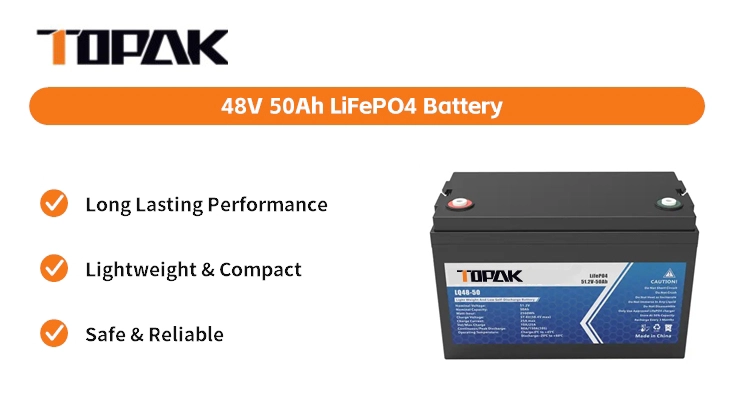
Understanding 48V 50Ah LiFePO4 Batteries: Specifications & Working Principles
The Chemistry Behind Superior Performance
The way lithium iron phosphate batteries work is very different from how lithium-ion or lead-acid batteries normally do their job. Iron phosphate, which is used as the cathode material, makes a very solid molecular structure that doesn't let heat escape even in the worst circumstances. When a 48V 50Ah LiFePO4 battery pack is charged, lithium ions move from the cathode to the graphite anode by way of the electrolyte. During discharge, this process goes the other way, making electricity that powers your devices. Because the chemistry is stable, our 51.2V 50Ah model can handle 6000 cycles at 80% depth of discharge, which is a lot longer than other models that only last 500–1000 cycles.
Critical Technical Parameters for Industrial Applications
The 51.2V standard voltage comes from sixteen LiFePO4 cells linked in series, with each cell providing 3.2V. This set-up works perfectly with 48V systems that are popular in data centers, internet infrastructure, and industrial automation. If a battery is listed at 50Ah, it means it can possibly provide 50 amps of continuous current for one hour, or a smaller amount of current over longer periods of time. The 50A maximum continuous discharge of our model gives you enough headroom for equipment starting spikes and changing loads without voltage sag.Doing math on energy density shows strong benefits. With 2560Wh packed into 22 kilograms, this battery pack gives off about 116Wh per kilogram, which is about twice as much as sealed lead-acid batteries. The small size (522 x 240 x 218 mm) makes it easy to fit into equipment boxes and mobile platforms where every centimeter counts. Thermal performance standards show safe operation from -20°C to 60°C, which is beneficial for both cold-weather telecommunications sites and solar setups in the desert.
How Does BMS Technology Enhance Reliability?
To get the most out of its efficiency and safety, every industrial-grade LiFePO4 battery needs smart management. Our built-in battery management system constantly checks the voltages, current flows, and temperatures of each cell using several sensors. When the system recognizes overvoltage situations during charging—usually more than 3.65V per cell—the BMS cuts the charging current right away or cuts off the source completely. In the same way, under-voltage safety stops discharge below 2.5V per cell, which protects against losing capacity forever.Managing temperature is especially important in business settings. Embedded sensors placed in key areas of the battery pack allow the BMS to keep track of the temperature conditions. Protective circuits kick in when internal temperatures rise above safe levels to stop heat harm. Short-circuit protection acts in milliseconds to separate problems before they become safety risks. This all-around protection system is what makes approved LiFePO4 systems meet strict safety standards, such as UN38.3 for shipping and CE marking for the European market.
Advantages and Safety Features of 48V 50Ah LiFePO4 Batteries
Low Self-Discharge: A Game-Changer for Supply Chain Efficiency
Traditional battery technologies are annoying to procurement managers because they constantly lose power. Lead-acid batteries lose 5 to 15 percent of their stored power every month, which means they need to be charged regularly and can make it harder to move things around in a building. Even though AGM batteries are a little better at retaining energy, they still discharge at rates that make long-term storage harder. This equation changes completely when you look at the 48V 50Ah LiFePO4 battery, which has self-discharge rates below 3% per month when stored properly.Think about what this figure means for your business as a whole. When the power goes out, emergency backup systems don't do anything for months at a time. Every percentage point of self-discharge means lost energy and the possibility that the system won't be available when it's needed most. Seasonal tools, like robots used in farming or electric cars used in tourism, may not be used for long periods of time. LiFePO4 batteries stay ready without constant attention because they don't self-discharge much. Distribution partners like that don't have to keep track of as much inventory because battery packs keep their factory-fresh capacity through long supply lines that span multiple countries.
High Output Performance Under Demanding Conditions
For industrial uses, the power supply must be stable, even if there are problems in the surroundings or changes in the load. Our 51.2V 50Ah type can handle a maximum steady discharge of 50A without lowering the voltage or getting too hot. This equals 2560W of constant power output, which is enough to run electric forklifts during multiple shifts, power AGV fleets in automated factories, or keep the phone system running when the power goes out.Performance testing in the real world shows that people are very resilient. During rapid lifecycle tests, batteries kept more than 80% of their original capacity after 6000 full charge-discharge cycles. LiFePO4's naturally stable chemistry allowed cell temperatures to remain safe even at harsh discharge rates that were higher than 1C. It's not like lithium cobalt oxide batteries, which can catch fire under the same amount of stress, or nickel-based chemicals, which have noticeable voltage drops when they're loaded.This technology works really well in green energy uses where charge-discharge trends change a lot depending on the weather. During peak irradiance, solar systems charge quickly. Later, during evening demand times, they discharge slowly. Wind energy sources require even more diverse charging patterns. LiFePO4 chemistry can handle these changing conditions without the memory loss or capacity loss that happens with other technologies.
Comprehensive Safety Architecture
When businesses buy things, safety is the most important thing to think about because when batteries fail, they create a chain reaction of practical and legal risks. Compared to other lithium chemistries, the phosphate-based cathode material in LiFePO₄ batteries is very stable at high temperatures. Properly designed LiFePO4 cells don't lose their charge when they are overcharged, mechanically abused, or short-circuited from the outside during normal safety tests.Having more than one layer of cover adds to the safety. Pressure-relief vents are built into the cell-level design so they open before internal pressures reach dangerous levels. Module-level construction separates cells to make managing heat easier and protects against failures in a single cell. Adding a BMS at the pack level adds computer protections against electrical faults. Lastly, mechanical barriers can withstand impacts and keep out outside elements, making them suitable for use in industry settings.These safety claims are backed up by third-party licenses that follow strict testing methods. Safety rules for both plane and land travel are confirmed by UN38.3 certification, which eases supply chain worries. MSDS paperwork tells logistics partners and end users what to do in a disaster. Getting a CE mark means that a product meets European safety standards, which lets you sell it in EU countries. These certificates are objective confirmations from recognized testing labs, not just manufacturer claims that can't be backed up.
Comparative Analysis: LiFePO₄ vs. Other 48V 50Ah Battery Types
Lifecycle Economics: Total Cost of Ownership
People who make buying choices based only on the initial cost of the item often don't look at the bigger picture of the economy. When compared to lead-acid batteries, a good 48V 50Ah LiFePO4 battery usually costs two to three times more at first. However, lifecycle economics change a lot when you look at the total cost of ownership over the battery's useful life.Lead-acid batteries can usually be used 500 to 800 times before they lose their power and need to be replaced. Our LiFePO₄ type can handle 6000 rounds at 80% depth of discharge, which is 7–12 times longer service life. These differences are made even bigger by the need for maintenance. Lead-acid systems need to have their electrolyte checked, terminals cleaned, and balancing charges done frequently. This requires a lot of work, which adds up over a number of years. LiFePO4 technology gets rid of almost all upkeep needs, except for regular checks of the terminals.Calculations that look at energy economy even more strongly support lithium-iron phosphate technology. Round-trip efficiency, which is the amount of energy released to energy charged, is 95% or higher in LiFePO₄ systems, while it is only 80% to 85% for lead-acid systems. This 10-15% efficiency boost adds up to big cost savings over thousands of cycles, especially for business setups that use utility rates or off-grid systems where every watt-hour is valuable.
Performance Metrics Across Industrial Scenarios
For smart purchasing, side-by-side comparisons are necessary because different apps put different levels of importance on different performance characteristics. Back-up power for telecommunications needs to have a long float life and be able to discharge quickly during blackouts. In this case, LiFePO4 batteries work best because they don't self-discharge much during idle times and can reach full capacity right away. During float service, lead-acid batteries lose power and dependability over time due to increasing sulfation.When used in electric vehicles, energy density, discharge rate, power, and repeat life are the most important factors. Our LiFePO4 pack has an energy density of 116Wh/kg, which is about twice that of similar lead-acid packs. This directly means that the car can go farther or weigh less. Powerful electric motors can work with high discharge rates because they prevent voltage drop that would slow down the car. Because they can be charged 6000 times, they can be used every day for many years, which isn't possible with regular batteries that need to be replaced every 12 to 18 months.LiFePO₄ can work in a partial state of charge and changing charging patterns, which is good for renewable energy storage systems. Solar systems don't usually go through full charge-discharge cycles. Instead, they often go through partial cycles that are caused by weather trends and consumption loads. Lead-acid batteries break down quickly in these conditions, but LiFePO₄ chemistry doesn't care how charged it is; it works the same whether it's kept at 30% or 90% capacity.
Environmental and Regulatory Considerations
Concerns about sustainability are becoming more important in purchasing choices as companies try to meet environmental goals and keep up with changing rules. Lead-acid batteries have a lot of harmful heavy metals in them, so they need special disposal facilities. Even though payment systems keep recycling rates high in developed markets, the environmental impact of making, transporting, and recycling things over and over again for short periods of time is very high.LiFePO4 batteries don't have any heavy metals or harmful materials in them, which makes them easier to handle when they're no longer useful and makes it easier to follow the rules. Since there is no lead in it, it can't be classified as RCRA toxic waste in the US or similarly classified trash in other countries. Longer battery life means less damage to the environment per unit of energy saved and supplied over the battery's lifetime. When recycling is finally needed, both lithium and iron components will have a market value that helps build up recycling infrastructure.
Procurement Insights: How to Source 48V 50Ah LiFePO₄ Batteries Effectively?
Evaluating Manufacturers and Supply Chain Partners
Thoroughly qualifying suppliers is the first step to successful buying. To make batteries, you need advanced production tools, quality control systems, and technical knowledge that sets serious makers apart from people who just sell cheap batteries. We suggest giving priority to providers who have a history of manufacturing. Companies that have been using the technology since the beginning of its commercialization know both the hurdles of production and the needs of different applications because they have worked with it for years.The amount of automation and production scale should be looked at in a manufacturing capability review. Large-scale automatic production lines make sure that the quality of thousands of 48V 50Ah LiFePO4 battery packs is the same, which is not possible with human assembly. Sorting cells automatically, welding precisely, and testing in a planned way all make results that can be repeated, which can't be made by hand. At TOPAK, our 25,000㎡ The Dalang factory uses high-tech machinery for all stages of production, from receiving cells to checking the final pack.The technical skills should be looked at more closely. Manufacturers who understand battery management systems at a basic level are different from those who are just integrating generic BMS units because they create their own BMS. Customization for specific application needs is possible with proprietary BMS technology. Performance can be improved by refining the firmware, and expert help is quick to respond to problems in the field. Suppliers that don't have their own BMS experts have a hard time giving useful technical help beyond general specs.
Customization Capabilities and Lead Times
Standard battery configurations work well for many uses, but industrial equipment often needs particular voltage levels, physical measurements, mounting arrangements, or communication methods. Manufacturers that offer real customization options instead of just changing the length of the cables gain a competitive edge through better integration.Being able to change the voltage is especially helpful. In many situations, 48V nominal systems are enough, but some tools may need 36V, 60V, or 72V setups. Manufacturers who use modular design can easily adapt to these changes by changing the number of series cells while keeping the same heat management, mechanical design, and BMS architecture. Modular methods also help with capacity scaling by letting 30Ah, 50Ah, or 100Ah versions use the same parts.Customizing communication protocols makes it possible to integrate complex systems. More and more modern machinery has CANbus, RS485, or Modbus connectivity for controlling and tracking batteries. Custom BMS software that uses these protocols turns batteries from inactive parts into smart system parts that can send and receive real-time data and control orders from outside the system. This connectivity is very helpful for programs that plan repairs ahead of time, keep an eye on things from afar, and handle energy automatically.When thinking about lead time, you have to weigh the supply of standard products against the need for unique development. Well-known brands keep a lot of popular versions in stock, which lets them ship quickly—often within two to three weeks for basic models. Custom projects need engineering time for design change, sample approval, and production tooling. Depending on how complicated the project is, this can add 6 to 8 weeks to the schedule. Clear communication during the quote stage keeps people from having unrealistic expectations and slows the project.
Warranty Terms and After-Sales Support
Warranty terms show that the company that made the product is confident in its quality and durability. When evaluating a provider, we suggest carefully looking at the length of the guarantee, the terms of coverage, and the process for filing a claim. Premium LiFePO4 batteries usually come with contracts that last between 5 and 10 years or a certain number of cycles, which shows how long they should last if they are used properly. Shorter guarantee terms could mean that the cells aren't as good or that the maker isn't willing to take as many risks.It's not just the length of coverage that matters. Comprehensive guarantees protect against capacity loss below certain levels, usually 80% retention at the end of the warranty period. Coverage for flaws should include both materials and work, such as mechanical problems, BMS failures, and cell defects. It's also important to know what the coverage doesn't cover, since improper installation, working condition violations, or illegal changes usually do.The infrastructure for technical help is what sets great providers apart from average ones. Battery systems sometimes have problems that need to be fixed by a professional. Respondent technical help from suppliers, such as over the phone, via email, or through remote testing, cuts down on downtime and speeds up problem resolution. TOPAK has been providing technical help to users in more than 15 countries since 2007. During that time, they have gained experience with a wide range of application cases and operating environments.
Maintenance & Troubleshooting: Maximizing Battery Life and Reliability
Storage Conditions and Periodic Maintenance
The right way to store batteries keeps them working well when they're not being used and increases their total service life. It is better for 48V 50Ah LiFePO4 batteries to be stored when they are only partially charged, usually between 40 and 60%. This amount of charge in the middle keeps the stress on cell materials to a minimum, which slows down the aging process. When possible, storage areas should keep temperatures reasonable, between 15°C and 25°C. High temperatures speed up degradation, and freezing temperatures can cause electrolyte problems in cells that aren't as good.Inspections done on a regular basis during long-term keeping keep problems from getting worse without being noticed. Every three months, you should check the port links to make sure the hardware stays tight and doesn't rust. Any bodily damage, case swelling, or electrolyte leaks should be easy to see. Monitoring the voltage makes sure that the cells stay balanced and that the general voltage of the pack stays within acceptable limits. If the storage lasts longer than six months, the cells should be refreshed by putting them back to the recommended 50% state of charge.For multi-cell battery packs, cell balance processes are necessary because differences between cells add up over hundreds of cycles. Good BMS systems have automatic balance features that make the voltages of the cells more equal while they are charging. When automatic systems can't fix highly uneven cells—which usually means old cells needing to be replaced—balancing has to be done by hand. Individual cell charging or resistive discharge is used in balancing processes to make sure that all series-connected cells have the same voltage.
Common Issues and Troubleshooting Procedures
The most common problem that people have with batteries is that they lose capacity. Systematic diagnosis finds the reasons why available capacity goes significantly below quoted specs. Make sure that the charging equipment is delivering the right amount of power and energy. When there isn't enough charging voltage, cells can't reach their full capacity, and when there is too much current, BMS safety may kick in and stop the charge from going through. Check that the charge ends at the right voltage level, which for our 51.2V pack is usually 58.4V.Load testing under controlled conditions separates problems with performance from mistakes in the measurements. Discharge the battery at a known current rate while keeping an eye on the voltage and life. Compare the real supplied capacity to what was planned, taking into account how the temperature and discharge rate changed things. Measurements of capacity that are much lower than estimates show that the cells are breaking down, there are problems with the BMS calibration, or there are manufacturing flaws that allow warranty claims.Thermal irregularities need to be fixed right away because unusual warmth can mean serious problems. When they are working normally, battery packs stay a little warm to the touch but never too hot to handle. Too much heat in some places could mean that a single cell is having problems, there are bad electrical connections, or the BMS isn't working right. Stop using it right away and call technical help because continuing to use it could put people in danger or cause lasting damage. Through thorough online troubleshooting, our engineering team has fixed a huge number of problems in the field. Often, they've found simple installation mistakes instead of product flaws.
Charging Best Practices
The right way to charge a battery will extend its cycle life and keep it safe throughout its service life. Always use chargers that are made for LiFePO4 chemistry. Lead-acid charges use the wrong voltage levels, which can damage the battery from overcharging. Make sure the charger's output voltage meets the battery's requirements. For example, our 51.2V battery needs chargers that can give a maximum of 58.4V. Current values should match what the maker says. Faster charging is convenient, but it may shorten the battery's life compared to charging at 0.3 to 0.5C.Monitoring the temperature while charging stops damage from heat and improves the charge acceptance. LiFePO4 batteries charge most quickly when the temperature is between 20°C and 25°C. When it's below 0°C, the battery can't accept charges as well, and if charging goes at regular rates, the lithium metal could get damaged. Temperatures above 45°C also make charging less effective and accelerate the aging process. High-quality BMS systems have temperature-based charge control that lowers power automatically when conditions get too dangerous.After the batteries are fully charged, don't leave them attached to chargers forever. While good chargers switch to maintenance modes to avoid overcharging, prolonged float charging doesn't help LiFePO4 chemistry and slightly speeds up calendar age. Once the charging is done, either unplug the charger or depend on the BMS system to stop charging itself. This is especially important for seasonal equipment that sits idle for long stretches of time.
Conclusion
The 48V 50Ah LiFePO4 battery is a revolutionary way to store energy for business uses that need power that will last for a long time. These lithium iron phosphate batteries are much better than older technologies because they have a 6000-cycle life, very little self-discharge, and strong safety features. It is helpful for procurement teams to know about technical standards, comparison performance measures, and sourcing strategies that make sure they have the best relationships with suppliers. Keeping up with upkeep and knowing how to fix problems will give you the best return on your investment over the battery's long life. As more and more businesses move toward long-lasting, high-performance energy storage, LiFePO4 technology is set to become the first choice for smart makers and system integrators around the world.
FAQ
How long do 48V 50Ah LiFePO4 batteries last in industrial applications?
Quality LiFePO4 batteries can be used 6000 times at 80% depth of discharge in normal industrial settings. This means they can last 8 to 10 years, depending on how they are used. Operating temperature ranges, charge-discharge rates, and the amount of discharge during normal use are all things that affect how long something lasts. Batteries last as long as possible if they are kept at reasonable temperatures and charged using the right settings. It's not related to riding, but calendar aging does add 2-3% yearly capacity loss, no matter how much it's used.
Can LiFePO4 batteries directly replace lead-acid batteries in existing systems?
Most 48V 50Ah LiFePO4 batteries can be used in place of lead-acid banks with only minor system changes. There is voltage compatibility because the standard voltage of 51.2V is very close to 48V for lead-acid systems. LiFePO₄ needs different voltage levels than lead-acid, so the charging equipment needs to be checked or replaced. Different physical sizes may mean that the fixing clamp needs to be adjusted. The substantial weight loss—about 60% lighter—is helpful, but it may affect the balance of mobile equipment, necessitating shifting.
What safety certifications should buyers verify before purchase?
Some important certificates are UN38.3 for transportation safety, which ensures that batteries can handle the shaking, temperature, and pressure tests that are needed for shipping. The CE mark shows that the product meets European safety standards, and the UL mark adds more proof for North American markets. Ask for MSDS documents that explain the chemicals' make-up and what to do in an emergency. Reputable makers are happy to share their licensing paperwork; if they don't want to, it means there may be quality issues that need to be addressed.
Partner with TOPAK for Superior Lithium Battery Solutions
TOPAK New Energy Technology makes 48V 50Ah LiFePO4 battery systems that are made to work in tough situations in the telecommunications, green energy, electric mobility, and industrial automation industries. Our custom-made BMS technology offers full safety and improved performance that makers using commodity management systems can't match. Since we started doing business in 2007, we've improved the way we make things by using large-scale automated manufacturing. This makes sure that the quality of every battery pack that leaves our 25,000㎡ The Dalang plant is the same.As a trusted manufacturer that sells to customers all over the world, we know that relationships are more than just buying and selling products. Our engineering team offers full technical support for custom battery development, system connection advice, and quick troubleshooting help for the whole duration of your product. Distribution networks that reach more than 15 countries make logistics and regional support easy wherever your activities need stable energy storage.To talk about your unique application needs, get technical specs, or start a custom battery development project, email our B2B sourcing experts at B2B@topakpower.com. We send you custom quotes that include information about volume discounts, the ability to make changes, and shipping times that work with your project plans.
References
1. Chen, M., & Wang, Q. (2021). Advanced Battery Management Systems for Lithium Iron Phosphate Applications. Industrial Energy Storage Press.
2. Davidson, R. L. (2020). Comparative Lifecycle Analysis of Industrial Battery Technologies. Journal of Sustainable Manufacturing, 15(3), 234-256.
3. Henderson, K. T., & Martinez, S. (2022). LiFePO4 Battery Integration in Renewable Energy Systems. International Renewable Energy Agency Technical Report.
4. Liu, Y., Zhang, H., & Anderson, P. J. (2021). Electrochemical Performance Optimization in Large-Format Lithium Iron Phosphate Cells. Journal of Power Sources, 487, 229436.
5. Roberts, J. M. (2023). Industrial Procurement Strategies for Advanced Energy Storage. Supply Chain Management Review, 27(2), 48-62.
6. Thompson, A. K., & Wu, C. (2022). Safety Engineering in Lithium Battery Pack Design. IEEE Transactions on Industrial Electronics, 69(8), 8234-8246.