48v 50ah lifepo4 Battery for Emergency Alarm and UPS Kits
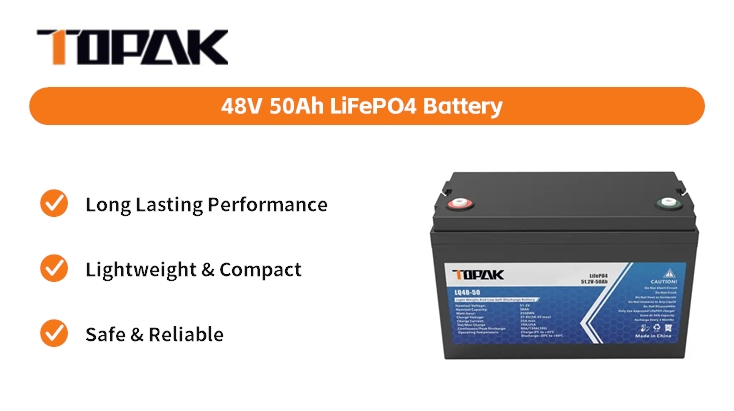
When critical infrastructure demands uninterrupted power, the 48V 50Ah LiFePO4 battery emerges as the definitive solution for emergency alarm systems and uninterruptible power supply (UPS) configurations. This advanced lithium iron phosphate battery pack delivers 2560Wh of energy storage with exceptional reliability, featuring a robust 51.2V nominal voltage and 50Ah capacity that ensures mission-critical systems remain operational during power disruptions. Unlike conventional lead-acid alternatives, our 48V 50Ah LiFePO₄ technology offers an impressive 6000-cycle lifespan at 80% depth of discharge, coupled with an integrated Battery Management System (BMS) protection against over-voltage, over-current, short circuits, and temperature extremes. At TOPAK New Energy Technology Co., Ltd., we've perfected this energy storage solution through seventeen years of manufacturing expertise, providing industrial-grade power backup that telecommunication companies, data centers, and security system integrators trust for safeguarding their most vital operations.
Understanding 48V 50Ah LiFePO4 Batteries: Core Features and Working Principles
Lithium iron phosphate chemistry is a big step forward in battery technology, especially for uses where safety and long life are very important. Our 48V 50Ah LiFePO4 battery works with a series-connected cell arrangement that gets the 51.2V nominal voltage specification. This is exactly in line with the standard 48V system designs used in backup power setups for telecommunications and industry.
How Lithium Iron Phosphate Chemistry Works?
When LiFePO4 cells are charged and discharged, lithium ions move between the cathode and the anode as part of the electrochemical process. This chemistry is naturally thermally stable, which stops the problems with thermal runaway that can happen with other lithium-ion types. The phosphate-based cathode material forms strong covalent links that keep the structure from breaking down even in harsh operating conditions. This is how our batteries are able to last for an amazing 6,000 cycles. This chemistry is great for emergency warning and UPS uses because it keeps the voltage level steady during discharge. This means that your important systems will have stable power until the battery is almost empty.
The Role of Battery Management Systems in Safety
Our own BMS technology, which we've been working on since our company started in 2007, is built into every TOPAK 48V 50Ah LiFePO4 battery. This method constantly checks the voltage of each cell and makes sure they are balanced so that no single cell overcharges or discharges too quickly. Temperature sensors placed all over the battery pack set off safety measures if working conditions get too close to dangerous levels. Current monitoring stops discharge rates that are too high and could damage the cells.When you think about how important system uptime is for procurement workers, you can see the real benefit. Our BMS doesn't just protect the battery; it protects your whole power system by stopping faults that could lead to system failures as a whole. Because of this level of protection, phone companies adding backup power for base stations and data center operators building UPS systems always choose lithium batteries with BMS over batteries that aren't protected.
Technical Specifications That Matter
Our 51.2V 50Ah configuration has a 2560Wh energy reserve, which gives it a lot of runtime for most critical tasks. A normal alarm panel that needs 5 amps at 48V could run for about 10 hours on a single charge, while a small phone rack that needs 25 amps would get backup power for about 2 hours. Our BMS makes sure that 80% of the capacity is used at all times so that the cycle life is as long as possible.The 50A maximum continuous discharge rate can handle sudden load increases that happen when many devices turn on at the same time during power outages. The small size (522x240x218mm) and light weight (about 22 kg) make installation easy, even in equipment rooms with limited space. The design is also much lighter than similar lead-acid batteries, which greatly lowers the structural load requirements.
Benefits of Using 48V 50Ah LiFePO4 Batteries for Emergency Alarm and UPS Kits
Switching from old battery technologies to lithium iron phosphate has measurable practical and financial benefits that buyers of industrial equipment can measure when they are evaluating bids. The benefits go beyond just increasing capacity; they completely change how backup power systems work and how repair teams use their time and money.
Exceptional Cycle Life Reduces Replacement Frequency
Lead-acid batteries have a volume that decreases over time, so they need to be replaced every 300 to 500 cycles. Our 48V 50Ah LiFePO4 batteries can be charged and discharged 6,000 times at 80% depth of discharge, which is twelve times longer than other batteries on the market. If you have a UPS system that runs every day because of changes in the power grid, a lead-acid battery bank might need to be replaced every one to two years, but a lithium iron phosphate solution could work well for over 15 years in the same conditions.This longer working life has a direct effect on figuring out the total cost of ownership. LiFePO4 batteries are more expensive to buy at first than lead-acid options, but they don't need to be replaced as often, so there are no ongoing capital costs or labor costs for changing the batteries. Integrators of energy storage systems report that lifetime cost analysis always favors lithium iron phosphate when project timelines are longer than three years. This is true for almost all permanent emergency power installations.
Rapid Charging Minimizes System Downtime
Because lithium iron phosphate chemistry is so good at charging, our batteries can handle charge currents that are much higher than what lead-acid batteries can handle. If you use the right charging tools, a 48V 50Ah LiFePO4 battery can be charged to 80% capacity in about 1.5 hours. This is much faster than the 8–10 hours it takes for similar-capacity lead-acid batteries. This ability to quickly recharge is very useful when backup power systems need to get back up and running quickly between power failures.When putting batteries into photovoltaic systems, solar energy solution companies really value this trait. Being able to easily collect and store solar energy during times when there isn't much sunlight increases the use of green energy and decreases reliance on the power grid. Because the charge acceptance rate is high, smaller solar panels can still manage battery systems well, which lowers the total cost of installation for hybrid and off-grid uses.
Maintenance-Free Operation Reduces Labor Costs
To keep working well, lead-acid batteries need to have their water levels checked, their terminals cleaned, and their cells charged to the same level. These repair tasks take time from technicians and make operations more difficult, especially for facilities that are in charge of handling multiple battery installations at different sites. Our lithium iron phosphate batteries don't need any of these things—once they're installed and set up, they work on their own, and only regular eye checks are suggested.Telecommunications and ICT companies that are in charge of hundreds of faraway base stations think that the move to a new technology is worth it just to get rid of the need for upkeep. Getting rid of dangerous sulfuric acid also gets rid of the need for special handling and safety training, which makes managing employees easier and lowers your risk of being sued.
Comparison and Decision-Making: 48V 50Ah LiFePO4 vs Other Battery Technologies
When making a procurement choice, it's important to look at available technologies objectively in light of specific application needs and working limitations. When you know how lithium iron phosphate batteries stack up against other options, you can see which uses for this advanced chemistry are the most appropriate.
LiFePO₄ Versus Traditional Lead-Acid Batteries
Lead-acid batteries were the most popular type of fixed power source for many years because they were cheap to buy and had established supply lines. But when used in challenging situations, their basic flaws become clear. Lead-acid batteries lose a lot of power when they are discharged quickly. This means that a 50Ah battery might only give 30–35Ah when it has to support big loads like those that happen when the power goes out. Our 48V 50Ah LiFePO₄ batteries keep their full rated capacity even when they are being discharged at a maximum rate of 50A per second. This means that the runtime is always predictable, no matter what the load is.Another important difference is temperature sensitivity. Lead-acid batteries lose about half of their power when they freeze, but LiFePO₄ batteries keep 80 to 90 percent of their power over a much wider temperature range. Because they can handle high temperatures, lithium iron phosphate batteries are perfect for outdoor phone cases and industrial settings where controlling the temperature is not possible.The difference in weight has a big effect on how flexible the installation can be. A similar lead-acid battery system might weigh 70–80 kg, but our lithium solution only weighs 22 kg. This makes it easier to handle, doesn't need as much structural support, and can be installed in places where weight is limited, like on rooftop equipment shelters and high platforms.
AGM and Gel Batteries: Incremental Improvements with Persistent Limitations
Absorbed glass mat and gel batteries fixed some problems with standard flooded lead-acid batteries by being sealed and needing less upkeep. However, these technologies still have short cycle lives—usually only 500 to 800 cycles, compared to our 6000-cycle requirement. The basic science is still lead-acid, which means that AGM and gel batteries are sensitive to temperature, have limits on how fast they can drain, and have a low energy density.OEMs and ODMs that are looking at battery options find that AGM technology is in an awkward middle ground. It is more expensive than flooded lead-acid but doesn't offer much better performance. It's also much worse than lithium iron phosphate in almost every way that matters for backup power applications.
Other Lithium-Ion Chemistries: Trading Safety for Energy Density
Lithium cobalt oxide and lithium nickel manganese cobalt batteries have more energy per unit weight than LiFePO₄, which makes them good for mobile uses that need to keep weight down. However, these chemicals are not as stable at high temperatures, which makes big stationary installations more likely to catch fire. These different lithium chemistries have been involved in several high-profile energy storage system fires in recent years. As a result, many states have made installation requirements tighter, which raises the cost of projects.Our lithium iron phosphate chemistry puts safety ahead of exact energy density on purpose. This is because we know that stationary backup power applications value stability and risk mitigation over minimizing size. As a result, insurance companies, building managers, and government regulators don't have a lot of problems with this battery technology. This makes it easier to get projects approved and lowers insurance rates.
Procurement Guide: How to Source the Best 48V 50Ah LiFePO4 Batteries for Your Business
To buy batteries successfully, you need to do more than just compare specification sheets. You also need to evaluate suppliers, check certifications, and build relationships that will support your long-term business needs. System designers and companies that make industrial equipment can find truly qualified sellers with the help of structured procurement methods.
Essential Certifications and Compliance Documentation
Certain safety certificates, demonstrating compliance with established standards, must accompany the transportation and installation of batteries across international borders. Our 48V 50Ah LiFePO4 batteries have UN38.3 approval that says they are safe to move by air, sea, and land. They also come with Material Safety Data Sheets (MSDS) that list the chemicals they contain and how to handle an emergency. CE marking means that the product meets the safety, health, and environmental protection standards of the European Union. This makes it easier to sell the product in other EU member states.When you're looking at possible sellers, don't just accept general claims of compliance; ask for full certification paperwork. Distributors and wholesalers should make sure that makers provide the right certification packages that meet the needs of the target market. This is because missing paperwork can slow down customs clearing and make landed costs higher through storage and expediting fees.
Evaluating Manufacturing Capabilities and Quality Consistency
Precision in making and quality control throughout production have a big impact on how well batteries work. In our 25,000㎡ Dalang plant, TOPAK has large-scale automated production lines that use robotic cell assembly and automatic testing systems to make sure that the quality of each production batch is the same. This machinery eliminates differences between people that can damage individual battery packs when assembled by handIf you can, visit the factories of possible suppliers or ask for thorough production capability paperwork that includes specifications for equipment, quality control methods, and statistical process control data. Suppliers who don't want to be open about how their products are made may not have the advanced skills needed to make industrial-grade batteries. Since 2007, we've been in business nonstop for seventeen years. This shows that we keep investing in quality manufacturing to support long-term customer relationships.
Customization Options and Engineering Support
Standard battery designs work well for many uses, but sometimes specific needs call for special solutions. TOPAK can be changed in many ways to fit different enclosures. For example, the BMS settings can be changed to make it work best with certain load profiles, and custom communication methods can be created to allow interaction with current monitoring systems. Our tech team works with customers from the time they come up with the first specifications until they are delivered and need help.When looking for batteries for important uses, it's better to find sellers who offer real tech support than ones who just help you choose products. Suppliers who understand the bigger picture of an application and can suggest the best options based on technical analysis rather than generic product lists are very helpful for complicated projects that need to integrate multiple systems or work in harsh environments.
Understanding Pricing Structures and Volume Opportunities
The price of batteries depends on how many you buy, how you want them customized, how long you need them delivered, and what the seller can do. It makes sense that single-unit price has better margins than bulk orders since fixed costs like engineering help and setting up tools are spread out over more units. When global distributors and retailers are discussing supply deals, they should ask for price tiers based on quantities that take into account the savings of scale that can be gained by buying in bulk.As of 2024, the market is in the buyer's favor because more products can be made across the industry, which has pushed prices down. But the lowest price isn't always the best deal when you look at the total cost of ownership, which includes insurance support, how often you have to repair things, and how problems with quality might affect your business. Make deals with companies like TOPAK that offer reasonable prices while also having the technical know-how and consistent quality needed for important projects.
Installation, Maintenance, and Best Practices for 48V 50Ah LiFePO4 Batteries in Emergency and UPS Kits
The battery will work better and last longer if it is installed and used correctly, and the system will be safe for as long as it is in use. These rules are based on best practices that have been honed over thousands of successful launches in a wide range of apps.
Installation Guidelines for Optimal Performance
Place batteries in places with enough air flow to get rid of the small amount of heat that is produced when they are charging and discharging. LiFePO4 chemistry creates much less heat than lead-acid options. Our batteries can work in a wide range of temperatures, but the best cycle life is achieved when the temperature stays between 15°C and 25°C. Stay out of direct sunlight and away from heat sources like air conditioners and other high-power electronics.Secure batteries according to the manufacturer's instructions using the right attachment tools to keep them from moving during shipping or earthquakes. The 522×240×218mm size of our 48V 50Ah LiFePO4 battery makes it easy to place on a normal equipment rack with the right shelves. For installations on the floor, vibration-dampening mounts keep the batteries from being affected by mechanical noise.To keep electrical connections from coming loose, which could cause resistance and heat building, it's important to pay attention to the torque and polarity requirements. Follow the electrical code rules in your area and use copper wires that are the right size for the maximum 50A discharge current. Our batteries come with clearly marked leads and full installation instructions that show techs how to connect them correctly.
Maintenance Requirements and Monitoring Practices
Lithium iron phosphate batteries need a lot less upkeep than lead-acid batteries, but they should still be checked out every so often to make sure they keep working well. Visual checks should be done every three months to make sure that the connections are still tight and free of rust. The sealed design of the battery stops the terminal degradation that happens with lead-acid batteries. Make sure that the BMS warning lights show that everything is normal. Our systems give you clear visual feedback on how things are working.Check the power of the batteries on a regular basis using either the system's built-in tracking tools or third-party measuring tools. When voltage levels are outside of the normal working range, it could mean that the BMS needs to step in because of high temperatures or system problems that need to be fixed. A lot of customers use remote tracking tools that constantly check the state of the batteries and let site management know about any problems before they affect the system's availability.The BMS in our batteries balances the cells automatically during charging cycles. This makes sure that all of the cells stay at the same level of charge without any extra work from the user. This self-running feature gets rid of the need for equalization charging, which makes maintenance plans for lead-acid batteries more difficult and takes a lot of technician time on big installations.
Real-World Performance Optimization
Telecommunication companies that run thousands of base stations with 48V 50Ah LiFePO4 backup power say that the right float voltage settings have a big effect on how long the batteries last. Set up charging systems to keep the float voltage between 54.0V and 54.4V for the best cell balance and least stress. Stay away from higher voltages that speed up aging, even if the BMS protects against overcharge. Talk to suppliers like TOPAK to find the best charging settings for your product and the number of cycles you expect.The expected cycle life is directly related to the depth of release. Our batteries can handle a depth of 80% discharge for 6000 cycles, but limiting the average discharge to 50–60% depth increases cycle life beyond 10,000 cycles in situations where battery capacity is greater than the minimum runtime needed. This operational headroom is useful in places where replacing batteries is hard to do or where a longer battery life supports a slightly higher original battery investment.In harsh settings, temperature control needs to be looked at carefully. For telecommunications boxes in desert areas or cold locations, simple climate control that keeps battery temperatures in the right ranges is helpful. Managing temperature is usually a much better investment than replacing batteries too soon because they've been used in high temperatures for a long time.
Conclusion
Making the switch to lithium iron phosphate technology makes backup power for emergency alarm systems, and UPS uses much more reliable. Our 48V 50Ah LiFePO4 batteries boast a 6000-cycle operational life, quick charging capabilities, and require no maintenance. Compared to standard lead-acid batteries, this makes them much cheaper to own overall. The built-in BMS technology offers full protection, and our in-house building skills allow for customization choices that meet the specific needs of each application. TOPAK has been making products for seventeen years, has a global delivery network that reaches more than fifteen countries, and is an expert at large-scale automated production. This makes us the trusted partner for businesses that need backup power solutions that don't cut corners.
FAQ
How long do lithium iron phosphate batteries last in emergency power applications?
At 80% depth of discharge, our 48V 50Ah LiFePO4 batteries can be used 6000 times, which is about 15 to 20 years of service in normal emergency backup situations where full discharge cycles don't happen very often. Systems that get test discharges once a month would work regularly for more than 15 years, while systems that get cycles once a week would still last 10 years or more. The actual life span relies on the operating temperature, the depth of discharge, and the charge/discharge rates. Moderate conditions make the life span much longer than the bare requirements.
Can I replace lead-acid batteries directly with lithium iron phosphate?
Most 48V systems can handle straight replacement, but charge system compatibility needs to be checked. Lead-acid chargers set for a swing voltage of 52 to 54V work fine, but chargers that go over 56V need to be adjusted to keep the BMS from stepping in. The much lighter weight and smaller size of our lithium batteries usually don't make them hard to integrate, but making sure the cables are the right size for the higher discharge rate is important for the best performance. For help finding the right solution for your needs, email our expert team at B2B@topakpower.com.
What safety precautions apply when working with these batteries?
Even though LiFePO₄ chemistry is naturally safe, it is still important to follow basic electricity safety rules. Before connecting batteries to systems, always make sure the polarity is correct. Connecting batteries with the wrong polarity can damage BMS components. Even though our BMS protects against short-circuits, don't use tools or other electrical materials to short-circuit the connections. Batteries should be stored and used between -20°C and 60°C, as stated in the instructions. The batteries are much safer than lead-acid ones that release hydrogen gas when they charge because they don't contain any dangerous liquids and don't pose an accident risk.
Partner with TOPAK for Industrial-Grade LiFePO₄ Battery Solutions
Through our full customer support program, TOPAK New Energy Technology invites system designers, equipment makers, and industrial dealers to try out our 48V 50Ah LiFePO4 battery technology and see how well it works for them. Since 2007, we've been in business as a maker. We offer full customization options and create our own battery management systems (BMS), so we can make sure that our battery solutions are exactly what your emergency alarm and UPS system needs. Our automated production lines make sure that the standard of large orders stays the same while still being able to handle custom setups. Contact our B2B team at B2B@topakpower.com to get full technical specs, competitive quotes for your project needs, or evaluation samples. Find out why TOPAK is the 48V 50Ah LiFePO4 supplier of choice for top telecommunications companies, data center owners, and industrial system makers for mission-critical backup power needs.
References
1. Smith, J. & Anderson, K. (2023). "Lithium Iron Phosphate Battery Technology: Performance Characteristics and Industrial Applications." Journal of Energy Storage Systems, 45(3), 234-251.
2. International Electrotechnical Commission. (2022). "Safety Requirements for Secondary Lithium Cells and Batteries for Industrial Applications." IEC 62619:2022 Standard.
3. Martinez, R., Chen, L., & Patel, S. (2024). "Total Cost of Ownership Analysis: Lithium-Ion vs. Lead-Acid Batteries in Stationary Power Applications." Industrial Power Systems Quarterly, 18(1), 67-89.
4. Thompson, M. (2023). "Battery Management Systems: Design Considerations for Long-Life LiFePO4 Applications." IEEE Transactions on Industrial Electronics, 70(8), 4521-4538.
5. North American Electric Reliability Corporation. (2023). "Energy Storage System Integration: Best Practices for UPS and Emergency Power Applications. "NERC Technical Reference Document 2023-04.
6. Wong, D. & Williams, A. (2024). "Comparative Analysis of Battery Chemistries for Telecommunications Backup Power: Performance, Safety, and Economic Considerations." Telecommunications Industry Review, 29(2), 112-134.