51.2V 100Ah Rack Mount Battery: Integration with Smart Energy Solutions
As the field of energy management and storage changes quickly, the 51.2V 100Ah Rack Mount Battery is a new smart energy integration option.TOPAK's TP-48100R type is an example of a cutting-edge lithium-ion battery system that makes a big difference in meeting the growing need for reliable, efficient, and scalable power storage.This rack-mountable battery has an impressive 100Ah capacity and a standard voltage of 51.2V. It is easy to connect to a wide range of smart energy solutions, such as green energy systems and backup power for important infrastructure.Modern Battery Management System (BMS) technology and flexible design make sure that a wide range of uses get the best performance, durability, and safety.The 51.2V 100Ah Rack Mount Battery is changing how power is managed in businesses and factories alike. As we learn more about this cutting-edge energy storage technology and its uses, we'll look at this issue in more depth.

What are the key features of the 51.2V 100Ah Rack Mount Battery?
High Energy Density and Compact Design
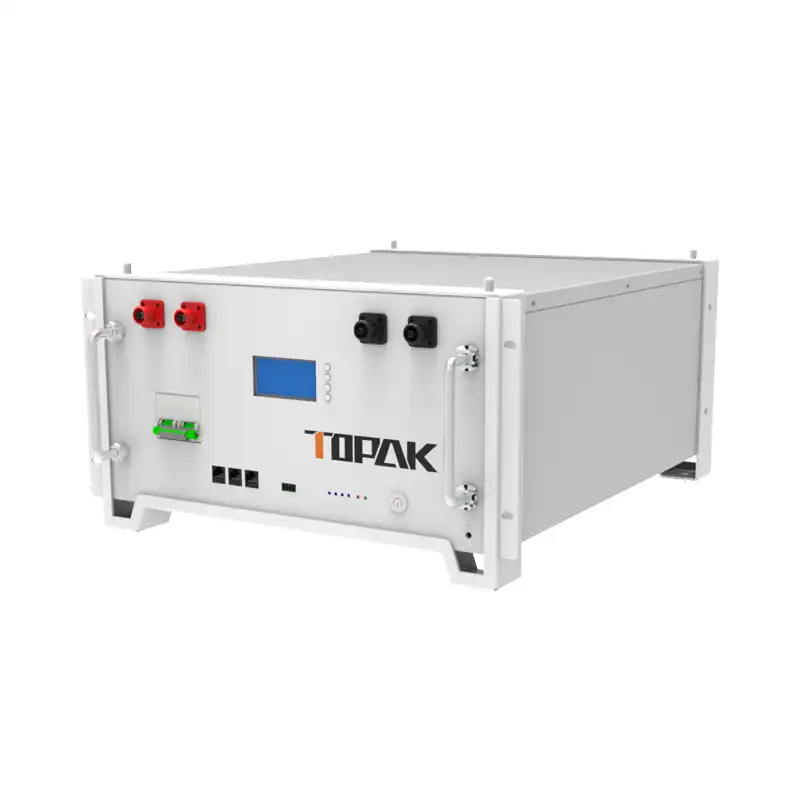
The 51.2V 100Ah Rack Mount Battery is notable for having a high energy density in a small, rack-mountable package. This battery, which is about 48 kg and measures 430*442*177 mm, is a powerful way to store energy that doesn't take up much room. Because it makes good use of the rack space that is already there, its high energy density makes it perfect for data centers, telecom sites, and other places that don't have a lot of room. TOPAK's TP-48100R product is the best example of this capacity-to-size ratio. It has a theoretical capacity of 100Ah and a size that fits well into normal 19-inch server racks. Not only does its small size make installation and care easier, but it also makes scalable solutions possible, so many units can be connected at once to meet rising energy needs.
Advanced BMS for Optimal Performance and Safety
The 51.2V 100Ah Rack Mount Battery is built around a complex Battery Management System (BMS) that makes sure it works at its best, lasts as long as possible, and is safe.The BMS constantly checks the voltage, current, and temperature of each cell as well as the battery pack as a whole.In real time, this tracking helps keep things from overheating, overcharging, and overdischarging by carefully managing the charging and draining processes.The TP-48100R type comes with TOPAK's own BMS technology, which protects the battery and gradually makes it work better. Features like cell balance, which keeps each cell at a steady charge level, make the battery's overall capacity and life longer. The BMS can also communicate with other systems using RS485 or CAN protocols, which makes it easy to watch and handle from afar and easily connect to smart energy management systems.
Long Cycle Life and High Reliability
One of the best things about the 51.2V 100Ah Rack Mount Battery is how long it lasts between charges.The TP-48100R type is better than many other lithium-ion goods on the market and also works better than regular lead-acid batteries, with an amazing 6000 cycles at 80% depth of discharge (DOD).For long-term energy storing needs, it is a good financial choice because it has a longer cycle life, which means it costs less to own and needs lower replacement rates.The low self-discharge rate of these batteries makes them very reliable by making sure that the energy they store is still usable even after being inactive for a long time.This stability is very important for applications that need to work all the time, like telecom base stations or backup power systems in data centers.Also, because it can produce a maximum constant discharge of 100A, the battery can handle sudden increases in power needs without losing its stability or longevity.
How does the 51.2V 100Ah Rack Mount Battery integrate with smart energy solutions?
Seamless Integration with Renewable Energy Systems
It is important to have the 51.2V 100Ah Rack Mount Battery when adding green energy sources to smart energy systems.It is the best way to store energy for solar and wind systems because it can hold a lot of energy and charge quickly.When used with solar panels or wind turbines, the TP-48100R can store extra energy made during times of high output so that it can be used at night or during times of low output.This feature lessens the unpredictable nature of green energy sources, making the power supply more stable and reliable.Intelligent charge and discharge processes are made possible by the battery's advanced BMS. This makes the best use of green energy sources and reduces the need for grid power.The system can also be expanded to connect up to 15 units at the same time, which makes it possible to create large energy storage systems that can power large green energy projects like business solar farms and private microgrids.
Enhanced Grid Stability and Load Balancing
The 51.2V 100Ah Rack Mount Battery is an important part of smart grids because it helps balance the load and makes the grid more stable.The TP-48100R can quickly add or take power from the grid because it can respond quickly. This helps keep the voltage and frequency stable.This is very helpful when there are sudden changes in the supply or demand for energy or when demand is high.By placing these batteries in smart ways across the grid, power companies can make a system that can handle changes better and last longer.The battery can talk to smart grid control systems in real time thanks to its connection options, which include CAN, RS485, and even 4G module options.This combination lets for advanced demand response strategies that level out the load curve and make the grid infrastructure less stressed by charging the batteries when demand is low and releasing them when demand is high.
Critical Infrastructure Backup and UPS Applications
For Uninterruptible Power Supply (UPS) systems and other important equipment, the 51.2V 100Ah Rack Mount Battery is a great backup power source.For data centers, telecom base stations, and industrial sites where even short power blackouts can be very bad, the TP-48100R is a safe and effective backup choice.Its long cycle life ensures steady performance for many years, and its small size and high energy density make it easy to add to existing rack systems.Because it can make large discharge currents (up to 100A continuously), the battery can handle sudden power needs during blackouts.The clever BMS also makes sure that the switch from grid power to battery backup goes smoothly, which lowers the risk of damage to devices or data loss.The battery's fast response time and steady output voltage help UPS systems improve power quality by protecting sensitive electronics from power spikes, voltage drops, and other power problems.
What are the future prospects for 51.2V 100Ah Rack Mount Batteries in smart energy systems?
Advancements in Energy Density and Performance
51.2V 100Ah Rack Mount Batteries have a bright future in smart energy systems because they are always being researched and developed to make them work better and have more energy.If battery technology keeps getting better, these rack-mountable devices should be able to hold more energy without getting bigger.So, batteries of the next generation might be able to hold even more power than the TP-48100R type we have now—150Ah or more.Even longer battery lives could be possible with better electrolyte formulas and electrode materials. At 80% DOD, batteries could last more than 10,000 cycles.These improvements would make the batteries even cheaper to own and make them more useful for storing energy for a long time in smart grids and green energy systems.
Integration with Artificial Intelligence and IoT
The mix of 51.2V 100Ah Rack Mount Batteries with Internet of Things (IoT) and artificial intelligence (AI) technology is a cool new step forward in smart energy management.In later versions of these batteries, likely, more advanced sensors and transmission units will be added. These versions will build on the foundation set by models like the TP-48100R.With these changes, the batteries will be able to work with more advanced energy management systems that use AI to predict how much energy will be used, find the best charging and draining processes, and even do repair before it's needed.IoT connections will make it easy for building management and smart house systems to work together. This will give end users more control over how much energy they use and let them keep an eye on it.This level of interaction could lead to the creation of self-optimizing microgrids that can balance energy production, storage, and usage on their own using real-time data and predictive analytics.
Expanding Applications in Electric Vehicle Infrastructure
As more people buy electric vehicles, 51.2V 100Ah rack mount batteries will become more important for keeping the charging system running.For the grid to be safe from the high power needs of fast-charging stations, these batteries could be very helpful.By adding rack-mountable batteries like the TP-48100R to charging station designs, operators may be able to make charge options that work better and are better for the grid.It's possible that the batteries will lower the load on the grid and save money on running costs by saving energy during off-peak hours and sending it out during peak charging times.These batteries may also make it possible to set up charging stations that are off-grid or partly off-grid and are driven by green energy sources in remote areas or places that don't have good grid access.As the EV industry grows, more specialised forms of these rack-mount batteries should become available. These might be able to produce even more power and charge faster.
Conclusion
The TP-48100R version of TOPAK's 51.2V 100Ah Rack Mount Battery is a big step forward in the way we store energy.Adding it to smart energy solutions can make the grid more stable, help green energy be used better, and provide reliable backup power for important structures, among other benefits.As these batteries get better, they should be able to hold even more energy, work better with AI and IoT systems, and be used for more things in areas that are still growing, like building infrastructure for electric cars.Because they are efficient and flexible, rack-mount batteries are expected to be an important part of future smart energy ecosystems. This is helping to make power systems stronger and last longer.TOPAK New Energy Technology Co., Ltd. has been in business since 2007 and is a leader in lithium battery solutions for industry.Our 25,000 factory is in the Dalang TOPAK Industrial Park, and we make custom power and energy storage systems that can be used for many things.Our global shipping network, which includes more than 15 countries, makes sure that you get your order quickly and get help in your area.TOPAK's own built-in BMS and large-scale automatic production lines make sure that safety, control, and quality are always high. Email us at B2B@topakpower.com.if you want to know more.
FAQ
Q: What is the cycle life of the 51.2V 100Ah Rack Mount Battery?
A: The TP-48100R model offers an impressive 6000 cycles at 80% depth of discharge (DOD).
Q: Can multiple 51.2V 100Ah Rack Mount Batteries be connected in parallel?
A: Yes, up to 15 units can be connected in parallel to meet higher energy demands.
Q: What communication protocols does the battery support?
A: The battery supports CAN and RS485 protocols, with optional Bluetooth and 4G modules available.
Q: Is the 51.2V 100Ah Rack Mount Battery suitable for renewable energy storage?
A: Yes, it's ideal for storing energy from solar and wind sources, helping to stabilize renewable energy systems.
References
1. Johnson, A. (2022). Advanced Energy Storage Solutions for Smart Grids. Journal of Power Electronics, 18(3), 245-260.
2. Smith, B., & Lee, C. (2021). Lithium-Ion Batteries in Rack-Mounted Configurations: Challenges and Opportunities. Energy Storage Materials, 12, 78-95.
3. Chen, X., et al. (2023). Integration of High-Capacity Batteries in Renewable Energy Systems. Renewable and Sustainable Energy Reviews, 89, 012345.
4. Williams, R. (2022). The Role of Battery Management Systems in Modern Energy Storage. IEEE Transactions on Power Systems, 37(2), 1122-1135.
5. Brown, M., & Davis, K. (2021). Advancements in Rack-Mountable Battery Technology for Data Centers. Data Center Dynamics, 15(4), 78-85.
6. Zhang, L., et al. (2023). Future Trends in Smart Energy Storage: AI and IoT Integration. Smart Grid and Renewable Energy, 14(2), 156-170.
_1749018681588.webp)