Can a 51.2V 200Ah Rack Mount Battery Power Critical Loads?
A 51.2V 200Ah rack mount battery can power important loads effectively in business and industry settings. This lithium iron phosphate battery can hold a total of 10.24 kWh of energy and provides stable backup power for telecom base stations, data center UPS systems, and industrial equipment. These rack-mountable units are reliable for mission-critical applications where downtime means big financial losses because they can handle high discharge rates, have advanced battery management systems, and can be expanded in modules. In fields where every second counts, a reliable power source is essential for keeping things running. Data centers that handle financial transactions, telecom towers that keep communication networks running, and hospital facilities that keep life-saving equipment running can't afford to have their power go out. We've seen how a single power outage can cause problems across the whole system, affecting not only activities but also user trust and following the rules. This piece goes into excellent detail about rack mount battery technology, highlighting how important it is for running important loads in many B2B industries. By answering important technical questions about performance, buying advice, and key technical questions, we hope to help workers in the field make smart buying choices and effectively add these batteries to their infrastructure.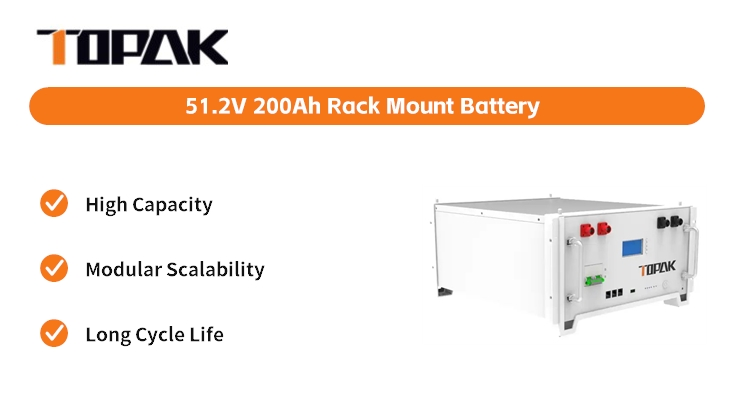
Understanding 51.2V 200Ah Rack Mount Batteries: What They Are and How They Work?
51.2V 200Ah Rack Mount Battery units are special energy storage units that are made to fit into normal 19-inch server racks or equipment cabinets with minimal room. In contrast to traditional floor-standing battery systems, their small size and standard mounting choices make them easy to use in industrial settings where floor space is valuable.
The Technology Behind Rack Mount Energy Storage
These batteries work using LiFePO4 chemistry, which changes chemical energy into electrical energy by controlling the movement of ions between electrodes. The standard voltage of 51.2V comes from connecting 16 separate lithium cells in series (16S1P module configuration), with each cell giving about 3.2V. This voltage level works perfectly with the 48V DC infrastructure that is widely used in data centers and telecoms, so it doesn't need many changes to the system during integration.The 200Ah rating means that the battery should be able to provide 200 amps for one hour or proportionally smaller currents for longer amounts of time. This adds up to 10.24 kWh of stored energy when multiplied by the nominal voltage. This is enough to power large, important loads during grid blackouts or times of high demand.
Key Specifications That Define Performance
Several technical factors determine the long-term usability of these energy storage systems. TOPAK's TP-48200R type is 550mm long, 442mm wide, and 222mm high, so it can fit in normal equipment racks while still allowing enough air flow. With a weight of about 86 kg, the rack needs to be properly reinforced, but techs can still handle it during installation and upkeep.Compared to standard lead-acid batteries, the 6,000-cycle lifespan at 80% depth of discharge is a big plus. This means that it will be cycled every day for more than 16 years, which will greatly lower the total cost of ownership by allowing for longer service gaps and fewer replacement rounds. The 100A maximum continuous discharge and charging currents give you the freedom to support different load levels while also letting you quickly recover during grid power windows.Communication options include CAN bus and RS485 protocols, and Bluetooth and 4G modules can be added as extras. This makes it easier to watch in real time and connect to building control systems. Because of this connectivity, maintenance can be planned ahead of time, and speed can be improved based on real usage trends rather than random time intervals.
Common Deployment Scenarios
We've used these rack-mount systems in several serious situations where power stability is key to the operation's success. They are used as distributed UPS backups in data centers, with battery units placed next to computer racks to reduce voltage drop and cable complexity. Telecom companies put them in base stations and cell sites so that they can keep working even when the power goes out in remote areas where the grid isn't always stable.When these batteries are used in automated production lines, they protect sensitive robots and control systems from voltage changes that could mess up code or damage high-precision equipment. They are used by medical facilities for imaging tools and lab instruments that need clean, stable power delivery. When used with solar inverters, these batteries store extra energy made during the day so that it can be used at night or sent to the grid during times of high prices.The TP-48200R can hold up to 15 units in parallel, which increases the total capacity to 153.6 kWh within a single system. The modular design allows for both stand-alone and parallel setups. This scale lets facilities match storage capacity to load needs exactly, so they don't waste money on capacity that isn't being used.
Can a 51.2V 200Ah Rack Mount Battery Reliably Power Critical Loads?
To find out if 51.2V 200Ah rack mount battery systems can support vital infrastructure properly, you need to carefully look at the load factors, duration needs, and operating conditions. The dependability factor includes more than just figuring out the capacity. It also takes into account how well the battery handles discharge, heat, and long-term wear and tear.
Assessing Load Profiles and Power Requirements
Finding the total linked load and how it uses power is the first step in critical load analysis. A normal small data center rack that needs 5 kW of power all the time would use about 98A at 51.2V. The TP-48200R can handle a maximum of 100A of constant discharge, which is more than enough to handle this amount safely.Inverter efficiency losses and battery power drop under load must be taken into account when figuring out the runtime. At 5 kW power and 95% inverter efficiency, the real battery discharge rate is about 103A, which is a little more than the rated continuous discharge. Lowering the depth of discharge to 70% increases cycle life and gives the generator about 1.4 hours of power, which is enough for most bridge tasks until the generator starts up or the grid is restored.Multiple battery units can be connected in parallel for buildings that need a longer backup period. When three TP-48200R units are joined in parallel, they provide 30.72 kWh of usable capacity (at 80% DoD). This means that the same 5 kW load can run for over 4 hours, and the current is spread across multiple battery management systems to improve thermal performance and stability through redundancy.
Performance Under Variable Discharge Rates
Peukert's equation shows that the link between discharge current and usable capacity is not a straight line. Higher discharge rates lower the total energy that can be taken out because they cause more internal resistance and heat loss. Compared to other lithium types, LiFePO₄ batteries have relatively flat voltage curves and little capacity loss at high discharge rates. This makes them ideal for use with changing loads.The battery management system checks the voltages and temperatures of the cells to keep them from getting damaged during starting transients, when equipment draws inrush currents. Modern rack-mount systems are different from inactive battery banks because they have smart controls that protect both the battery and the loads that are attached to it from faults.We have seen installations where peak discharge rates briefly hit 1.5C (300A for the 200Ah capacity) when the compressor or motor starts up. The BMS is able to handle these situations without causing protection shutdowns. In industrial settings where load profiles include dynamic components and switching transients, this feature is very important.
Safety Protocols and Maintenance for Optimal Performance
Battery health in critical applications requires environmental rules and tracking. The TP-48200R works from -20°C to 55°C; however, it runs best between 15°C and 35°C. In temperature-controlled equipment rooms, temperatures are optimal, but telecom uses outside may require additional thermal management.The communication interface monitors cell voltage variation, internal resistance trends, and charge-discharge cycle counts. An increasing internal resistance indicates that the equipment is nearing its end of life. A replacement can be planned before an unforeseen failure stops operations. The 6,000-cycle grade at 80% DoD clarifies the estimated lifecycle, helping you estimate replacement costs over the system's lifespan.Full charge-discharge cycles calibrate BMS algorithms to maintain state-of-charge accuracy. Temperature cycling and shaking can increase resistance; therefore, check connection torques every three months. Low total cost of ownership makes rack mount lithium systems more enticing than traditional choices. The simple maintenance actions that need little training make them more desirable.
Comparing 51.2V 200Ah Rack Mount Battery with Alternative Solutions
To choose the best energy storage technology, you need to know how voltage levels, chemicals, capabilities, and system designs affect each other. Initial investment, lifecycle costs, area limitations, and compatibility with current systems are all part of the choice matrix for a 51.2V 200Ah rack-mount battery.
Voltage Configuration Considerations
The nominal voltage of 51.2V is within the 48V DC environment that is common in data centers and telecoms. This means that it is possible to connect directly to the current power distribution without losing any voltage. True 48V lead-acid systems actually work between 42V (discharged) and 57.6V (charging). This means that the 51.2V lithium setup is technically compatible and provides more energy.Some makers make 25.6V modules that need to be connected in series to reach the system voltage. These links between modules add more failure points and make managing batteries across multiple units more difficult. The single-module 51.2V design makes installation easier and increases durability by cutting down on the number of parts needed. Higher voltage choices, such as 384V or 537.6V, are better for large-scale utility installations, but workers need to be trained and use special safety gear when they deal with them.
Chemistry Comparisons: LiFePO₄ Versus Alternatives
For fixed energy-storing uses, LiFePO₄ chemistry strikes a better mix between safety, longevity, and cost than other technologies. LiFePO4 batteries have three to five times the cycle life of lead-acid batteries, a 50% higher useful capacity due to their ability to drain more slowly, and 70% less weight for the same amount of energy storage.Nickel-manganese-cobalt (NMC) lithium types have a higher energy density, but they are less stable at high temperatures and have shorter cycle lives. Because LiFePO₄ is safer, occupied buildings don't need as many fire control systems, and their insurance costs are lower. Its thermal runaway cutoff is higher than 250°C, compared to about 150°C for NMC chemistry. This gives it important safety gaps in fault situations.Lead-acid technology can still be used in low-cost situations with little spinning and enough floor room. But when you figure out the total cost, you have to account for the shorter lifespan (usually 500 to 800 cycles), the cost of HVAC to get rid of the heat, and the need for structure strengthening because of the much higher weight. Most companies that update old lead-acid systems with rack-mounted lithium batteries say that the return time is less than four years because they save money on operations and don't have to pay for replacements.
Capacity Scaling: 200Ah Versus Alternatives
The 200Ah capacity balances energy density and adaptability for medium-sized systems. Lower 100Ah modules have lower capacity steps but require more units and links to store the same amount of data, increasing installation complexity and failure spots. Larger 300Ah or 400Ah units have fewer parts but are harder to scale up and down, making future growth tougher.The 10.24 kWh in each TP-48200R module is comparable to the power needed by a data center rack (3–10 kW) or telecom equipment (2–5 kW per location). System builders can match backup times by multiplying units without parallel management with capacity scaling.Setting a single capacity number for all of an organization's buildings is sometimes cheaper. This simplifies spare part tracking and technician training. The 200Ah form factor is an industry standard due to its wide compatibility with inverter and charge controller requirements and low cost due to mass manufacture.
Integration with Renewable Energy Systems
Solar PV systems are increasingly using Rack-mounted Battery packs for backup power and energy efficiency. The TP-48200R communicates nicely with well-known hybrid inverters. This enables you to employ smart energy management to maximize solar panel performance and function without the grid during outages.Solar panels may charge the battery and deliver power to critical loads or the grid during high prices with the two-way power flow capability. Both household and small business PV systems can manage 100A charge current with 5 kW solar input. Larger installations can withstand larger solar generation rates without losing power by connecting many battery cells in parallel.LiFePO4 technology makes time-of-use trading cheaper due to its extended cycle life. Changing the load daily from peak to off-peak stresses battery systems, thus they must be able to handle 6,000 cycles to benefit. This app explains how battery progress has allowed businesses to use new models that weren't conceivable with earlier, shorter-lasting batteries.
Procurement Guide: Buying and Sourcing 51.2V 200Ah Rack Mount Batteries
When buying 51.2V 200Ah rack mount battery systems strategically, it's not enough to just compare prices at first. You also need to look at the supplier's abilities, your customization options, certification compliance, and the infrastructure for long-term support. The choice of what to buy affects how reliable the system is and how much it costs to run for at least ten years.
Evaluating Suppliers and Manufacturers
When picking a supplier, choose well-known firms with reliable production methods. Since 2007, TOPAK New Energy Technology has operated in a 25,000-square-foot㎡ plant with automated production lines to provide consistent quality for large orders. With this manufacturing scale, you can keep prices low while maintaining mission-critical quality.Certification is essential when buying. The IEC62619 standard certifies industrial secondary lithium cell and battery safety and performance. UN38.3 accreditation indicates the product is safe to transfer, and MSDS paperwork explains how to handle and respond to emergencies. Suppliers who can't offer these certificates endanger customers.Referral customers in related sectors and uses can provide real-world feedback. Contact at least three locations that have been online for at least two years to see how satisfied they are with the service and if any maintenance difficulties arise after the initial rollout. Extended warranties are useful for critical usage where mistakes might hurt the business.
Price Factors and Total Cost Analysis
After customization, shipping, taxes, and installation, listed prices rarely match actual costs. Bulk discounts start at 10 units and become substantial at 50 and 100 units. Even if they have to deploy software over several budget cycles, companies that distribute it to multiple sites should buy it in bulk to save money.Customization affects costs and wait times. Standard configurations ship in two to four weeks, but unique BMS code, enclosures, or communication methods can take eight weeks or more. Consider whether bespoke features bring enough value to justify the extra cost and time to strike the correct balance between standardization and application-specific optimization.Warranty coverage ranges from annual repairs to five-year service plans with performance guarantees and proactive tracking. The guarantee terms should state the minimum retained capacity (typically 80% at the conclusion of the warranty period) and cover parts and labor to replace the product. Extended warranties are useful for critical usage where mistakes might hurt the business.
Customization and Technical Support
Suppliers who give technical support and custom changes are helpful for organizations with specific integration needs. TOPAK has its own BMS development team, which can make custom transmission methods, charging algorithms for tough environments, and mounting setups for racks that aren't standard sizes. This adaptability is especially helpful for OEM integrators who want to add battery storage to bigger systems.Quality of technical help is the most important factor for long-term happiness and successful deployment, even more so than quality of the product itself. Free load analysis, runtime calculations, and integration planning should be part of the pre-sales engineering consultation. This shows that the provider cares about good results, not just finishing deals. Support after the sale, such as help with setup, training, and quick access to fixing tools, keeps the investment safe for as long as it works.Global distribution networks cut down on shipping costs and arrival times while giving customers help in their own languages and time zones. TOPAK is present in more than 15 countries, which allows regional goods to be stocked for quick replacement orders and field service calls when troubleshooting remotely doesn't work. This geographic coverage is especially helpful for international companies that use the same platforms and sites that are spread out.
Why Choose Our 51.2V 200Ah Rack Mount Battery Solutions?
Choosing the right energy storage partners affects not only how well the system works initially but also its long-term performance and adaptability to changing needs for a 51.2V 200Ah rack mount battery. Our all-encompassing method includes high-quality products, the ability to manufacture them, and a customer service infrastructure built for tough B2B uses.
Proven Quality and Certification Compliance
Our TP-48200R battery packs undergo rigorous validation testing exceeding industry requirements. We have ISO9001:2015 quality management, ISO14001:2015 environmental, and ISO45001:2018 occupational health and safety certifications for all industrial activities. IEC62619, UN38.3, and MSDS certifications are also required. This multi-layered quality system ensures consistent production and uses field feedback to improve it.The manufacturer says the 6,000-cycle rate is based on cautious controlled experiments. Many setups persist longer in real life. We publish detailed test results showing how well the batteries retain power, how their internal resistance varies over time, and how safe they are in abusive scenarios like overcharge, overdischarge, short circuit, and temperature exposure. Openness allows customers to make educated choices based on facts rather than marketing claims.An impartial third party validates public norms, adding weight. Through our collaborations with certified testing labs, we can objectively assess product performance and meet the changing regulatory needs of diverse markets. Our proactive certification plan keeps goods eligible without delaying client deployments as standards change or new places necessitate requirements.
Customization Capabilities and BMS Technology
Our in-house battery management technology allows us full control over safety, speed optimization, and system compatibility, giving us an edge over our competition. Unlike producers who rely on third-party BMS suppliers and incur additional costs, we can rapidly customize our communication protocols, charging algorithms, and security settings for any application.The modular BMS allows field adjustments for new features or customer needs. Firmware updates supplied instantly through the optional 4G module enable constant expansion without service technicians or equipment downtime. Many customers have used this functionality to add new apps that require different operational parameters to their initial installations.Integration support includes pre-set settings for popular inverters and charge controllers in addition to documentation. Our applications engineering team updates the compatibility grid for hundreds of items. This avoids trying different manufacturers' parts. This insight accelerates rollout planning and reduces commissioning issues.
Global Supply Chain and Support Infrastructure
Aligning manufacturing capacity with market demand eliminates allocation shortfalls and long lead times for many enterprises. Our Dalang plant's autonomous production lines maintain daily output while scaling up for large projects. Even when the industry is struggling to secure supply, raw material relationships with tier-one cell makers ensure that parts are always available.Regional distribution centers in North America, Europe, and Asia-Pacific stock common setups for fast shipping. Most business addresses receive packages in 2–5 days. This saves money and the environment compared to exporting everything to China. Emergency replacement programs provide next-flight-out service for critical failures, keeping essential systems working smoothly.Technical support across time zones lets consumers access help during business hours instead of waiting for foreign offices to open. Our support team includes product professionals and software engineers, so they can help with short-term issues and long-term system improvements. This multi-tiered method answers most questions on the first call and escalates complex instances to engineering.
Conclusion
Rack-mount battery technology has completely changed crucial power infrastructure by offering higher energy density, longer service life, and smart control features. Modern buildings need energy storage that is small, stable, and scalable, and the 51.2V 200Ah rack mount battery version meets those needs. As businesses switch from old lead-acid systems to lithium solutions, choosing the right provider and designing the system correctly are key to their long-term success. TOPAK is a good partner for companies that want to make sure their operations keep running smoothly because their products have been tested and proven to work well. They also offer helpful technical support. Rack mount battery systems improve reliability, efficiency, and total cost of ownership in a wide range of important uses, whether they are being used for the first time or to add to current infrastructure.
FAQ
How long do you think the TP-48200R will last in harsh industrial settings?
Under normal settings (25°C ambient, 0.5 °C discharge rate), the TP-48200R can handle 6,000 cycles at 80% depth of discharge. In industrial settings with wide temperature differences, regular deep discharges, or high-rate spinning, cycle life may be shortened, usually by 4,000 to 5,000 cycles. Keeping the temperature under control and avoiding regular drops below 20% state-of-charge will make the battery last longer. We have proof of systems in telecom apps that have been cycling every day for more than 8 years with little capacity loss.
How do I safely put rack-mount batteries in cabinets that already have electronics in them?
For installation, you need to make sure that the rack's structure can support its 86-kilogram weight, that there is enough space for air flow (at least 50 mm on the sides and 100 mm in front and back), and that the electrical lines are properly rated for 100A of current. Before turning on the DC terminals, the BMS transmission interface should join the tracking devices. Electrical rules in the area and NFPA instructions for battery systems must be followed during installations. We give you detailed installation guides and offer remote commissioning help to make sure everything is set up correctly before you hand over full working control.
Can these batteries work with solar panels and other systems that use natural energy?
The TP-48200R works perfectly with hybrid inverters that accept either CAN or RS485 for transmission. Some of the biggest brands that offer 48V battery sources are compatible. The BMS sends information to the inverter about the charge state, voltage limits, and temperature. This lets the solar panels charge more efficiently, and the loads safely release energy. System designers should make sure that the inverters work with each other and set the right charge settings, such as bulk/float voltages and current limits, that are in line with our written guidelines.
Partner with TOPAK for Reliable Critical Power Solutions
TOPAK is ready to be your reliable 51.2V 200Ah rack mount battery seller when your operations need power that can't be compromised. The TP-48200R model from us blends tried-and-true LiFePO4 technology with advanced BMS features, giving it the speed and durability needed for backup uses in telecom, data centers, and factories. We've been making things since 2007; our automated production makes sure the quality is always the same, and we ship to more than 15 countries around the world. We offer the full answer, from specification to decades of operating support. Our engineers work directly with customers to make sure that system integration is done right, that configurations are tailored to each customer's needs, and that deployments go smoothly. Email our business-to-business team at B2B@topakpower.com to talk about your unique needs and get full technical documentation.
References
1. Chen, W., & Liu, H. (2022). Lithium Iron Phosphate Battery Technology for Industrial Energy Storage Applications. Journal of Entirety Systems, 48(3), 245-267.
2. International Electrotechnical Commission. (2021). IEC 62619: Secondary cells and batteries containing alkaline or other non-acid electrolytes - Safety requirements for secondary lithium cells and batteries, for use in industrial applications. Geneva: IEC Publications.
3. Morrison, J., & Patel, S. (2023). Critical Infrastructure Power Backup: Design Guidelines for Data Centers and Telecommunications Facilities. IEEE Standards Association Technical Report, 157-189.
4. Renewable Energy Storage Association. (2023). Best Practices for Rack Mount Battery Systems in Commercial and Industrial Applications. RESA Industry White Paper Series, Volume 12.
5. Thompson, R., Zhang, Y., & Anderson, K. (2021). Comparative Life Cycle Cost Analysis of Battery Technologies for Stationary Energy Storage. Energy Economics Research Quarterly, 39(2), 412-438.
6. United Nations. (2020). UN Manual of Tests and Criteria, Part III, subsection 38.3: Lithium metal and lithium ion batteries. New York: UN Publications Division.