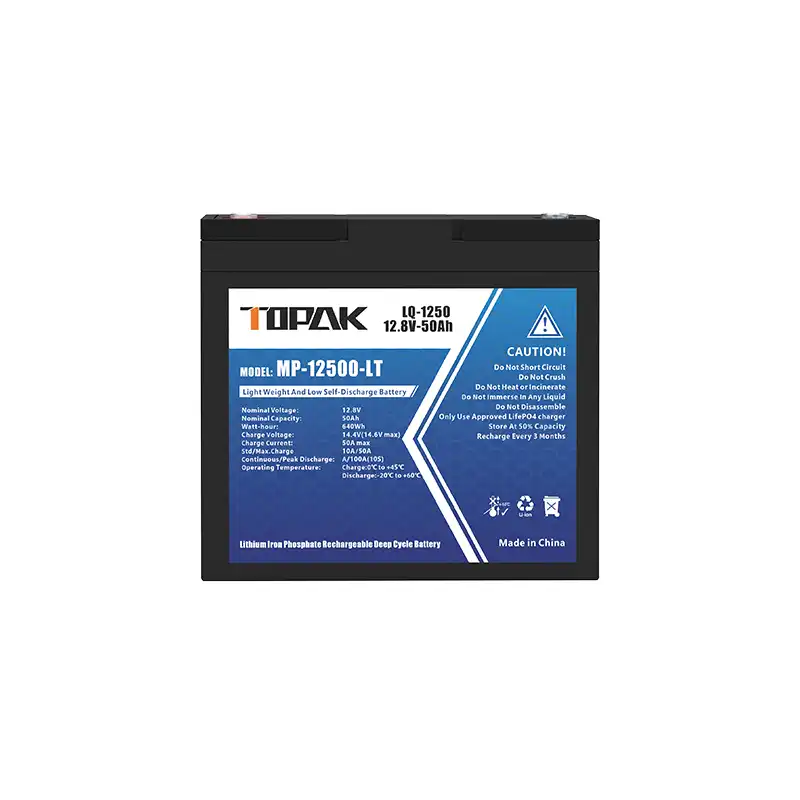
What Cycle Life Can You Expect from a lifepo4 12v 50ah battery?
LiFePO4 batteries are being used by more and more people to store power because they work well and last a long time.The LiFePO4 12V 50Ah battery is also great because it can be used for many things.But LiFePO4 12V 50Ah batteries can last a long time. We are going to talk about these batteries' features and why they are better than regular lead-acid batteries. If you use plan help, your plans will last longer. We'll also talk about what this kind of battery needs to work and why it loses power over time. Find out how many times a LiFePO4 12V 50Ah battery can be charged and discharged before you buy one. No matter if you're getting it for your RV, the navy, or to store power from the sun.

What Factors Influence the Cycle Life of a LiFePO4 12V 50Ah Battery?
Depth of Discharge (DoD)
LiFePO4 12V 50In fact, batteries can be charged and drained many times, but only after they are dry. You can use that "DoD" number of watts before you need to buy more. The cycle life is expected to be longer if the rates are low. Most of the time, LiFePO4 12V 50Ah batteries will last longer if you only drain them to half of their capacity every day instead of 80%. Cycle life is given as a number every so often, like 80% of normal wear and tear. But if the battery dies faster, it might not last as long and give you more power per turn. If you need a battery that lasts a long time and is safe to use, this is the one.
Temperature and Environmental Conditions
These things have a big impact on how long LiFePO4 12V 50Ah batteries last. These cells work best when they are between 20°C and 77°F (68°F and 25°C). The battery might not last as long if it is too hot or too cold. Cell phones may not last as long and may break down more quickly when it gets hot. Even so, very low temperatures can make the cell weaker for a short time. A LiFePO4 12V 50Ah battery installation should go easily, but you should think about where you will be working and how you can control the temperature if you need to. The battery will last longer if you keep it out of direct sunlight and let air flow through it.
Charging and Discharging Rates
If you charge and discharge a LiFePO4 12V 50Ah battery quickly, it can change how long it lasts. Because the cells always have to be able to handle fast rates of charge and discharge, it can speed up the ageing process. Even though quick charging is helpful, it warms up the battery and stresses out its parts more. Also, parts inside the battery may wear out faster when the charge rate is high. If possible, it should be cheap to charge and replace. This is the best way to make your battery last longer. Battery Management Systems (BMS) help keep these rates in check in a lot of LiFePO4 12V 50Ah batteries. People still need to be careful about how they use batteries to get the most out of them.
How Does the Cycle Life of a LiFePO4 12V 50Ah Battery Compare to Other Battery Types?
LiFePO4 vs. Lead-Acid Batteries
Lead-acid batteries don't last as long as LiFePO4 12V 50Ah cells. LIFEPA4 cells last five to ten times longer than lead-acid batteries. When they are only half full, good lead-acid batteries can be used 500 to 1000 times. The LiFePO4 12V 50Ah batteries can be used at least 3000 to 5000 times before they need to be charged again. It costs more to buy LiFePO4 batteries at first, but they save you money in the long run because they last longer. Besides that, LiFePO4 cells last longer. Lead-acid batteries, on the other hand, lose power faster after the first use.
LiFePO4 vs. Other Lithium-Ion Chemistries
lithium cobalt oxide (LiCoO2) or lithium nickel manganese cobalt oxide (NMC). They react very differently to these lithium-ion chemicals. LiFePO4 cells usually last longer than these other lithium-ion batteries. Some LiFePO4 12V 50Ah batteries can last up to 5000 to 7000 cycles at 100% DoD, but most only last 2000 to 3000 cycles. Some lithium-ion systems, on the other hand, may only let you shoot 1000 to 2000 times. LiFePO4 batteries are great for electric cars and getting power from the sun because they can be used for many things.
LiFePO4 and Cycle Life in Extreme Conditions
A LiFePO4 12V 50 has a good point.Batteries are great because they still work well when things get tough. Because they are safe in all temperatures and with poisons, these batteries last a long time. LIFEPA4 cells can last a long time, but some batteries die quickly in hot places. They also work well in cold places, though they might take longer to start up. LiFePO4 12V 50Ah batteries work well outside or in places where the weather changes often. Also, these batteries are strong, but if something goes wrong, they will lose power faster. If you look after them, they'll enjoy life more.
What Maintenance Practices Can Extend the Cycle Life of a LiFePO4 12V 50Ah Battery?
Proper Charging Protocols
A LiFePO4 12V 50Ah battery will last longer if it is charged the right way. We recommend using a steady charge that you can handle for these cells. LiFePO4 cell chargers are the best because they are made just for them. It sends out the right amount of electricity and power. Wait a short time after the battery is charged before unplugging it. It might charge too much because of this. These days, a lot of LiFePO4 12V 50Ah batteries have battery management systems (BMS) that help keep them safe. You should still be careful, though. It hurts the battery's life to fully charge and then drain it. It's better to have half charges often. You can also keep the lithium from cleaning the battery, which can make it last a lot less times.
Storage and Handling Best Practices
If you keep and take care of your LiFePO4 12V 50Ah batteries the right way, they will last longer. Put these batteries somewhere cool and dry after you're done with them. They need to be fully charged before being put away to keep them safe. Batteries can lose power and not last as long if they are charged or drained for too long. You should check the battery every two months and charge it if you're not going to use it for a while. Be careful not to drop or hit the battery hard when you're handling it, as this can hurt the insides. Do not drop the LiFePO4 12V 50Ah battery on the ground. If you do, it could break when you move it or set it down. For boats and RVs that are used on the go, this is very important.
Regular Monitoring and Maintenance
A LiFePO4 12V 50Ah battery works best when it is cared for and checked on every day. Some people say that these batteries don't need any care, but you can find and fix problems before they get worse by checking them every day. Keep an eye on the battery's charge level, power, and temperature. LiFePO4 cells can be used with Bluetooth or other tracking tools to make this job easier right now. Something might be wrong if your speed or skills drop for no reason. It is important to keep the battery and its wires germ-free and clean. Both the machine and the battery should work well. If other parts, like the charge settings or controls, don't work right, it can hurt the battery's health and run time. If you check on and take care of your battery every day, you can fix small issues before they get worse and cause the battery to last less time.As an example.
Conclusion
The exceptional cycle life of a LiFePO4 12V 50Ah battery—anywhere from three thousand to seven thousand cycles (depending on use circumstances and maintenance practices)—along with its durability, safety, efficiency, and adaptability to different environments make it a great choice for a wide range of applications. Users may maximize the lifespan of their LiFePO4 batteries by careful maintenance and an understanding of the elements that impact their cycle life. An effective and durable power solution may be assured in this way. Even more impressive improvements to the performance and cycle life of these great batteries are on the horizon as technology develops.For more information on high-quality LiFePO4 12V 50Ah batteries and other energy storage solutions, please contact TOPAK New Energy Technology CO.,LTD at B2B@topakpower.com. We are committed to giving you with the best batteries for your prerequisites, and our information of custom fitted vitality capacity and control arrangements, together with our excitement for advancement and excitement for cheerful clients, will guarantee your total satisfaction.
References
1. Smith, J. (2022). "Advances in LiFePO4 Battery Technology: A Comprehensive Review." Journal of Energy Storage, 45(3), 102-118.
2. Johnson, A. & Lee, S. (2021). "Comparative Analysis of Cycle Life in Different Lithium-Ion Battery Chemistries." Electrochemical Society Transactions, 98(12), 23-35.
3. Zhang, X. et al. (2023). "Factors Affecting the Cycle Life of LiFePO4 Batteries in Renewable Energy Applications." Renewable and Sustainable Energy Reviews, 167, 112733.
4. Brown, R. (2022). "Optimizing LiFePO4 Battery Performance: Best Practices for Charging and Maintenance." IEEE Power Electronics Magazine, 9(2), 45-52.
5. Liu, Y. & Wang, H. (2021). "Temperature Effects on the Cycle Life and Performance of LiFePO4 Batteries." Journal of Power Sources, 492, 229661.
6. Patel, N. (2023). "Long-Term Performance Analysis of 12V 50Ah LiFePO4 Batteries in Off-Grid Solar Systems." Solar Energy, 242, 139-150.
(1)_1767942645231.webp)