What Features Define a Premium 12V 50Ah Car Starter Battery?
A premium 12V 50Ah car starter battery is distinguished by advanced lithium iron phosphate chemistry, delivering exceptional cold cranking amperage (typically 800A peak discharge), extended cycle life exceeding 6,000 charge-discharge cycles at 80% depth of discharge, integrated Battery Management Systems with multi-layer safety protocols, and superior temperature tolerance from -40°C to 80°C. Unlike conventional lead-acid alternatives, premium models incorporate lightweight construction (often under 8kg), rapid recharge capabilities, and consistent voltage delivery throughout the discharge curve, ensuring reliable engine starts across diverse environmental conditions and demanding industrial applications. When sourcing automotive power solutions, understanding what separates premium batteries from standard options directly impacts operational reliability and total cost of ownership. At TOPAK, we've observed procurement professionals increasingly recognize that upfront specifications only tell part of the story. Real-world performance under stress, longevity under repeated cycling, and safety under extreme temperatures define true battery quality.
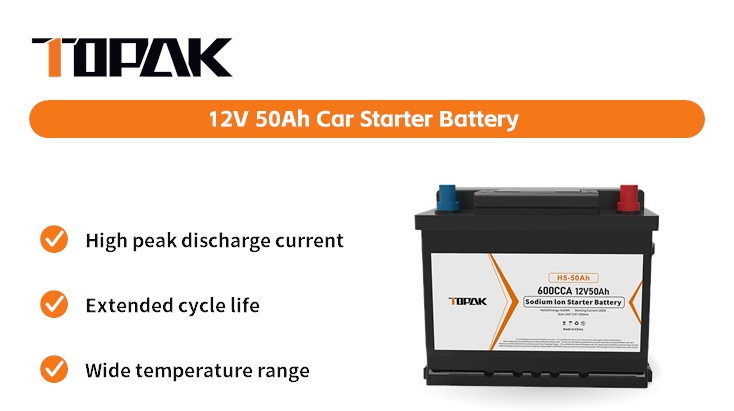
Understanding the Core Features of a 12V 50Ah Car Starter Battery
Voltage and Capacity Fundamentals
The normal power of 12V (or 12.2V–12.8V for lithium versions) is the same as what is used in most cars around the world. The 50Ah number means that the 12V 50Ah Car Starter Battery should be able to provide 50 amps constantly for one hour before it runs out of power. In real life, this standard tells us how much energy is left over for extra systems like lights, electronics, and temperature control after the engine has been started. Our Model TP-NA1250 has a nominal voltage of 12.2V and a total energy output of 610Wh. It has strong power reserves that are much higher than those of traditional lead-acid batteries that are the same size (244mm x 176mm x 190mm).
Cold Cranking Amps and Starting Power
Cold starting amperage shows how much current the battery can provide at 0°F (-18°C) for 30 seconds while keeping the voltage levels below the minimum levels. Premium units can deliver 800A peak discharge in one-second bursts, which makes sure that the spark works reliably even when the engine oil is cold and thick. This metric is especially important for fleet managers who live in northern climates, where problems starting vehicles cost a lot of money in lost time. Our TP-NA1250 model can handle discharge temperatures from -40°C to 80°C, which means it can be used in a wide range of climates. It does better than AGM batteries, which have trouble below -20°C, and lead-acid batteries, which lose half of their capacity at freezing temperatures.
Reserve Capacity and Self-Discharge Characteristics
The reserve capacity tells you how long the battery can keep putting out 25A before the voltage goes too low to be useful. Premium lithium starter batteries stay 95% charged after being stored for a year, while lead-acid batteries lose 5 to 15% of their charge every month. This feature is very useful for seasonal equipment, backup vehicles, and inventory management, where batteries may not be used for a while. Our engineers made the TP-NA1250 with very low self-discharge rates so that it can be ready to use without needing to be charged again and again during long storage periods.
Critical Technical Dimensions Defining a Premium Battery
Advanced Chemistry and Construction Methods
Absorbed Glass Mat (AGM) and lithium iron phosphate (LiFePO4) technologies have replaced the old flooded lead-acid type of premium 12V 50Ah Car Starter Battery models. AGM batteries keep the electrolyte suspended in glass fiber mats. This lowers the chance of spillage and increases the battery's ability to withstand vibrations, making it suitable for use off-road and with heavy equipment. Lithium versions get rid of all the harmful lead while cutting weight by 60–70%. This makes them perfect for uses that need to save weight, like electric cars, boats, and military ground support equipment.
Our TP-NA1250 uses prismatic LiFePO4 cells and a rigid metal casing. This gives it mechanical strength that can handle noise and pressure much better than a glass mat could. The structure of the internal cells stays strong even after 6,000+ full charge-discharge cycles, while AGM batteries usually break down after 500–800 cycles in the same conditions.
Integrated Battery Management Systems
High-end car starter batteries have complex Battery Management Systems that keep an eye on each cell's voltage, make sure that the charge is spread out evenly, and protect against operating dangers. The BMS is like the brain of the battery; it constantly checks the temperature, current flow, and charge level. When factors move outside of safe limits, the BMS steps in to limit current, disconnect loads, or send warnings to the people driving the car.
TOPAK's own BMS system is the result of 17 years of improvement since the company was founded in 2007. Our tech team is in charge of all the protection routines, which makes sure that cells work together perfectly even when they are under a lot of stress. When alternators break down, the system protects against overcharge damage, deep discharge that breaks down cell chemistry, and short-circuit currents that could start fires. Traditional lead-acid batteries don't have this much built-in intelligence; they rely on an outside charging system to keep them in balance.
Safety Certifications and Compliance Standards
Good batteries go through a lot of tests, like UN38.3 for safety in transportation, UL1973 for fixed energy storage, and IEC 62619 for industrial battery systems. These certificates show that the battery can handle changes in altitude, temperature, shaking, impact, and short circuits without overheating, exploding, or releasing harmful gases. It is important for procurement teams to make sure that sellers provide full certification documents instead of just hazy promises of "international standards compliance."
Our factory in Shenzhen uses ISO quality control systems and tests every batch of products in an environmental room, does a capacity fade analysis, and simulates mechanical stress. Because they are so thorough, TOPAK batteries are used in mission-critical situations in more than 15 countries, where the costs of failure are much higher than the cost of replacement.
Comparing Premium 12V 50Ah Starter Batteries in the Market
Brand Reputation and Manufacturing Heritage
Manufacturers that have been in business for ten years or more show stability, which is important for multi-year supply agreements for the 12V 50Ah Car Starter Battery. Newer companies may have good prices, but they don't have a history of honoring warranties, providing consistent technical support, and making sure that quality is the same from batch to batch. Since it started in 2007, TOPAK has had almost twenty years to improve manufacturing, incorporate customer feedback, and mature the supply chain, all of which directly lead to reliable product delivery.
Regional dealers and wholesalers value suppliers that can ship products all over the world and offer technical help in their own language. Our 25,000㎡ Dalang factory has both large-scale automatic production lines and the ability to be customized in a number of ways. This means that we can quickly ship both standard stock items and engineered-to-order battery packs that are made to fit specific vehicle platforms or equipment needs.
Total Cost of Ownership Analysis
The purchase price only accounts for 20–30% of the lifetime costs of a battery when you consider how often it needs to be replaced, the work needed for upkeep, the time it takes to handle warranty claims, and the downtime caused by premature failures. A high-end lithium starter battery that costs three times as much as a lead-acid equivalent is cheaper when you compare its 6,000-cycle life to the lead-acid unit's 500-cycle limit. Over the course of ten years, the lithium option only needs to be bought once, while the other option needs to be replaced twelve times. This saves money on installation work, disposal fees, and downtime that would have been needed for twelve repairs.
Lifecycle cost modeling by fleet managers and OEMs regularly shows that premium batteries with better cycle life, temperature tolerance, and self-discharge characteristics have 40–60% lower total ownership costs, even though they cost more to buy. Because of this, the industry is moving toward lithium technologies for business uses where dependability has a direct effect on making money.
Warranty Terms and After-Sales Support
A warranty that covers everything for 3 to 5 years and is easy to use shows that the manufacturer is confident in the product's durability. Premium suppliers give technical information like installation instructions, BMS interface specifications, and troubleshooting protocols that make field service easier. Our engineering team at TOPAK helps OEM integrators by customizing BMS, providing system-level testing support, and giving application-specific advice that cuts down on the time it takes to make a product.
Procurement managers should find out how quick a supplier is by asking technical questions before the sale. They should look at how clear the communication is, how deep the engineering is, and whether the supplier is willing to give samples or facility tours. Instead of pushing generic catalog items, suppliers who take the time to understand your unique application needs usually offer better long-term partnerships and custom solutions that perfectly meet business needs.
Maintenance, Testing, and Lifespan Optimization for 12V 50Ah Car Starter Batteries
Voltage and Capacity Testing Protocols
Professional maintenance plans include using calibrated digital multimeters to check the voltage every three months. If you check the voltage of a lithium 12V 50Ah Car Starter Battery 12 hours or more after the last charge or discharge, it should be between 12.6V and 12.8V, which means it is fully charged. Voltage below 12.0V means there is a partial discharge, which means the charging system or a parasitic drain from the vehicle's electronics needs to be looked into.
To test a capacitor's capacity, it is managed to discharge at set rates while keeping an eye on the voltage drop and the total number of ampere-hours supplied before the cutoff voltage is reached. This process, which is done once a year, finds the slow loss of capacity that happens normally over thousands of rounds. If the delivered capacity falls below 80% of the stated specs, planning to replace the battery should start, even if it still starts easily. Unexpected field failures during busy times can be avoided with proactive repair.
Environmental Storage Conditions
Extreme temperatures speed up the rates of chemical breakdown and self-discharge. The best places to store things are out of direct sunlight and away from heat sources where the temperature stays between 15°C and 25°C. Batteries that are stored at high temperatures (above 30°C) age faster and lose 2 to 3 percent of their capacity each year, compared to 0.5 to 1 percent when kept in the right conditions.
For long-term keeping, the state of charge needs to be kept between 50 and 60%, not full or empty. Batteries that are fully charged have more internal stress, while batteries that are almost empty risk voltage drops and cell imbalance. Our TP-NA1250 model can go 12 months without being charged for maintenance, but for critical backup applications, it's still a good idea to check the voltage every three months. Rotation systems for warehouse inventory make sure that older stock runs out before it reaches its expiration date.
Common Operational Mistakes to Avoid
When you put batteries of different ages or technologies next to each other in line, the charging isn't fair. The stronger batteries overcharge, while the weaker ones stay empty. This practice drastically cuts life expectancy and increases the chance of safety issues. When parallel configurations are available, always replace whole battery banks at the same time with models that are exactly the same and come from the same production batch.
Another common mistake is using the wrong charging profiles. When charging lithium batteries, they need constant-current/constant-voltage (CC/CV) with 14.6V bulk limits. Lead-acid chargers, on the other hand, often have desulfation modes and equalization steps that hurt lithium BMS components. Check to see if the charger works with lithium starter batteries before connecting them to an existing charging system, or buy charging equipment that is specifically made for lithium batteries.
Procurement Strategies for Securing Premium 12V 50Ah Car Starter Batteries
Supplier Evaluation and Selection Criteria
Check out suppliers by doing building audits, making sure they can meet your output needs, and reviewing their quality systems. Ask for technical data sheets for each cell that show the internal resistance uniformity, voltage matching tolerances, and processes for measuring capacity. When premium makers choose cells, they make sure that the difference in internal resistance stays within 0.3mΩ and the difference in voltage stays below 5mV between cells. This makes sure that the 12V 50Ah Car Starter Battery works evenly throughout its life.
Order Logistics and Bulk Purchasing Advantages
By scheduling large orders, you can save money on each item by taking advantage of volume savings and shipping that works more efficiently. Setting up yearly contracts with delivery plans every three months strikes a mix between the costs of keeping inventory and the benefits of volume prices. Standard configurations usually have lead times of two to four weeks, while custom-engineered solutions need six to eight weeks for prototyping and testing before they can go into production.
Shipping lithium batteries internationally needs UN38.3 certification and special treatment for dangerous goods, which makes operations more difficult and expensive. Using providers who have shipped batteries internationally before makes clearing customs faster and lowers the risk of damage during transport by making sure the batteries are properly packaged and paperwork is filled out. TOPAK's global distribution network makes it easy to send goods quickly and efficiently across North American markets. It does this by working with established shipping partners to make sure that orders are filled correctly and on time.
Building Long-Term Supplier Partnerships
When you work together with battery makers, you get more benefits than just buying batteries. Aligning technical roadmaps lets you plan for next-generation products, get early access to new technologies, and work together to create solutions that are tailored to specific applications. Sharing failure analysis and field performance data helps suppliers make better product designs and shows that you are committed to quality partnerships.
Clear communication about expected volumes, changes in seasonal demand, and budget cycles helps suppliers plan production more efficiently and keep enough inventory on hand. This teamwork cuts down on expedite fees and stock-out risks, and it makes your company a valued customer who gets extra attention when supplies are low.
Conclusion
The lithium iron phosphate chemistry, integrated Battery Management Systems, and extreme temperature tolerance of premium 12V 50Ah Car Starter Batteries make them a big step forward in technology compared to standard lead-acid designs. The TP-NA1250 type has these qualities: it can handle 800A peak discharge, has a lifespan of 6,000+ cycles, and can work in temperatures ranging from -40°C to 80°C. It also comes in a small 8kg box. To do strategic buying, you need to look at the total cost of ownership instead of just the purchase price. You should also choose sellers with a history of making good products and a wide range of support services. Using the right maintenance and testing methods will extend the life of your equipment and keep it from breaking down too soon. Premium batteries have real benefits in terms of reliability, weight reduction, and cost-effectiveness over their entire lifetime that make them worth the extra money.
FAQ
Can I connect multiple lithium starter batteries in series configuration?
Most professional lithium starter batteries can connect in series up to 48V (4S configuration) and in parallel up to 4P, as long as the Battery Management System can sync up to four parallel connections. In series lines, the voltage goes up while the capacity stays the same. In parallel setups, the capacity goes up while the voltage stays the same. Before making multi-battery systems using a 12V 50Ah Car Starter Battery, you should always make sure that the BMS is compatible. If the protection algorithms aren't right, the systems could fail early due to uneven charging.
What charging protocols do lithium starter batteries require?
Constant-current/constant-voltage (CC/CV) chargers with 14.6V bulk charge limits and temperature-compensated charging methods are needed for lithium car batteries. You should not use traditional lead-acid chargers that have desulfation bursts or normalization modes because they can damage lithium BMS electronics. When charging in cold weather, extra care needs to be taken because lithium chemistry doesn't like it when it's below 0°C, unless the battery has heating films inside that warm the cells before charging starts.
How long do premium lithium starter batteries last in real-world applications?
At an 80% depth of discharge, good lithium iron phosphate starter batteries can be charged and discharged 3,500 to 5,000 times before their capacity drops to 80% of their original rate. This means that they can be used in most cars for 10 years or more. The actual lifespan depends on the operating temperature, the rate of charging and discharging, and how well the battery is maintained. Batteries that are constantly deep discharged or exposed to high temperatures age faster than batteries that are kept at a normal state of charge in climate-controlled areas.

Partner with TOPAK for Reliable 12V 50Ah Car Starter Battery Solutions
TOPAK New Energy Technology makes industrial-grade lithium battery systems and has been making them well for 17 years, and has its own BMS research team. The TP-NA1250 12V 50Ah Car Starter Battery for sale has a high discharge capacity of 800A and a durability rating of 6,000+ cycles. It comes in a light 8 kg size and performs better than other options. For OEMs, fleet operators, and industrial equipment makers, we offer custom solutions, fast delivery, and full technical support. We are a well-known manufacturer with large-scale automated production lines and global distribution across 15+ countries. Get in touch with our engineering team at B2B@topakpower.com to talk about your specific needs and find out how our premium battery systems can lower your equipment's maintenance costs and make it more reliable over its entire lifecycle.
References
1. Battery Council International. "Technical Service Manual for Automotive Battery Testing and Maintenance Procedures." 2022 Edition. Published by Battery Council International Standards Committee.
2. Society of Automotive Engineers. "SAE J537: Storage Batteries for Off-Road Work Machines." SAE International Ground Vehicle Standards, 2020.
3. Institute of Electrical and Electronics Engineers. "IEEE 1725: Standard for Rechargeable Batteries for Cellular Telephones and Mobile Devices." IEEE Standards Association, 2021.
4. International Electrotechnical Commission. "IEC 62619: Secondary Cells and Batteries Containing Alkaline or Other Non-Acid Electrolytes - Safety Requirements for Secondary Lithium Cells and Batteries for Use in Industrial Applications." 2022.
5. United Nations Economic Commission for Europe. "UN Manual of Tests and Criteria, Part III, Section 38.3: Lithium Metal and Lithium Ion Batteries." United Nations Publications, 2021.
6. Underwriters Laboratories. "UL 1973: Standard for Batteries for Use in Stationary, Vehicle Auxiliary Power and Light Electric Rail Applications." Underwriters Laboratories Standards Department, 2022.