51.2v Rack Mount Lithium Battery for Efficient Energy Management
A 51.2V rack mount lithium battery gives industrial operations the speed and safety they need when they need to store energy reliably. Because they are modular and have a high energy density, these modern power systems are the best choice for telecom infrastructure, data centers, and green energy uses. At TOPAK, we design battery solutions that can be mounted on a rack that meet the strict requirements of modern energy management while still being able to grow with your business.
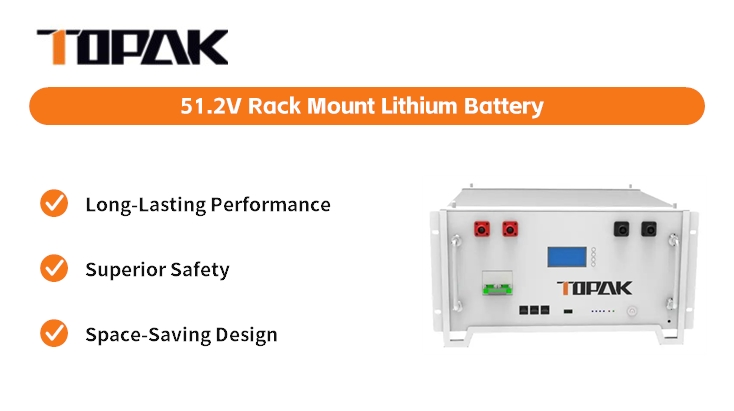

Understanding 51.2V Rack Mount Lithium Batteries
These days, energy storage is more than just a backup power source. Industrial facilities of today need smart systems that can work with current infrastructure and give consistent results in a range of working situations.
Core Components and Operating Principles
A 51.2V rack mount lithium battery is made up of lithium iron phosphate cells grouped in a 16S1P pattern. When sixteen cells are linked in series, they produce a nominal voltage of 51.2V. This voltage standard works properly with 48V DC power systems that are popular in data centers and telecoms, so there is no need for complicated voltage conversion. The battery management system constantly checks on each cell to make sure that the charge levels are even and that overcharging or deep discharging doesn't happen, which could be bad for the battery's health. Our TP-48200R model has temperature sensors all over the battery pack. When working conditions change from what is considered ideal, these sensors set off thermal management routines.
Technical Specifications That Matter
The features of our rack mount energy storage battery are based on what businesses need in the real world. The TP-48200R has a 200Ah capacity, which means it can store a total of 10.24kWh of energy in a small 550x442x222mm size. This system can handle intense power cycling without losing performance thanks to its highest continuous discharge of 100A and equal charging capacity. With a 6,000-cycle lifespan at 80% depth of discharge, the battery will keep working for years of daily use, lowering the cost of ownership and the number of times it needs to be replaced. Communication methods like CAN and RS485 make it possible to connect to current tracking systems. Bluetooth and 4G units, which are optional, let you do diagnostics from afar, which makes planning maintenance easier.
Safety Features and Thermal Management
Temperature changes and electricity interference are regular problems in places where industrial battery systems work. Our built-in thermal management system constantly controls the temperature of each cell, stopping hotspots that speed up decline. The battery management system has several layers of security. Overcharge prevention stops charging when cells hit certain voltage levels, and short-circuit protection immediately cuts off power to any damaged cells. Our 51.2V lithium battery for rack mounting has been certified by IEC62619, UN38.3, and MSDS for its safety features, proving that it is reliable for use in foreign settings. The low self-discharge rate makes sure that saved energy stays usable during long periods of downtime, so it can be ready for backup power situations without having to be charged all the time.
Maintenance Guidelines for Extended Service Life
With proper care, batteries last longer and give you the best return on your investment. We suggest keeping an eye on the state-of-charge levels through the built-in BMS interface and not storing batteries for too long at full charge or full drain states. The ambient temperature has a big effect on cycle life. For the best longevity, keep the working temperature between 15°C and 35°C. Checking the link points on a regular basis keeps resistance from building up, which lowers efficiency. Our 51.2 V rack mount lithium battery's modular design makes servicing easier because techs can access individual modules without affecting the whole system. This ease of access cuts down on downtime during regular checks and speeds up fixing when problems happen.
Comparing 51.2V Rack Mount Lithium Batteries With Other Battery Types
To choose the best energy storage technology, you need to know how different chemicals and combinations work in real-world situations. The comparison goes beyond the initial purchase price and includes costs for running the business, repairs that need to be done, and how often parts need to be replaced.
Performance Advantages Over Lead-Acid Technology
Industry has used traditional lead-acid batteries for many years, but their flaws become clear when compared to new lithium options. A 51.2V rack mount lithium battery stores the same amount of energy in a third the space of a valve-regulated lead-acid battery, which is three times as much energy efficiency. This space economy is very important in places like data centers and telecom facilities, where rack room is very expensive. Compared to VRLA options, it cuts weight by up to 60%, making installation easier and lowering the load needs for the structure. The way they discharge is completely unique. Our lithium systems keep the voltage output stable across the discharge curve, but lead-acid voltage drops gradually, reducing useful capacity to about 50% before voltage sag affects connected equipment.
Cost-Effectiveness and Total Ownership Analysis
When making B2B buying choices, costs must be weighed against the initial investment. Even though 51.2V rack mount lithium batteries cost more at first than lead-acid options, they save a lot of money over the life of the battery. Our TP-48200R has a 6,000-cycle life, which is 300% longer than the average lead-acid battery life. This means that it doesn't need to be replaced as often, saving money on work costs. Maintenance needs drop by a huge amount because lithium chemistry gets rid of the need to add water on a regular basis and deal with rust, which are problems that plague lead-acid systems. Over time, improvements in energy efficiency lead to bigger saves. For example, lithium batteries have a charge-discharge efficiency of 95%, while lead-acid batteries only have an 80% efficiency. This means that less power is used and there are lower costs for managing heat. When looking at the return on investment over five years, lithium systems usually break even within 18 to 24 months, even though they cost more to buy.
LiFePO4 Chemistry Advantages
When it comes to lithium battery technologies, lithium iron phosphate chemistry is especially good for fixed energy storage needs. LiFePO4 cells are more stable at high temperatures than lithium cobalt oxide options. This means that safety managers don't have to worry about thermal runaway as much. LiFePO4 cells have a voltage peak that stays very flat during discharge. This gives stable power that keeps sensitive devices safe. These chemistry benefits are used in our rack mount energy storage solutions, along with advanced battery management systems that make cell balancing better and increase operating life. When these two things are put together, they make energy storage systems that work reliably in temperatures ranging from -10°C to 55°C. This means that they can be installed in harsh conditions without affecting performance.
Procurement and Bulk Purchasing Guide for 51.2V Rack Mount Lithium Batteries
To get things bought, you need to know what the suppliers can do, what certifications they need, and how to handle tasks that can affect project timelines and prices.
Identifying Reliable Supply Partners
Energy storage projects that work well start with choosing producers that can show they have the technical know-how and production ability to do the job. TOPAK has a factory in Shenzhen that has automatic production lines that make sure the quality of large orders is always the same. We've been in business since 2007 and have the practical maturity that big projects need. Over the years, we've improved our quality control systems and manufacturing methods. Check a possible supplier's list of certifications: IEC62619 makes sure batteries are safe, UN38.3 makes sure shipping rules are followed, and MSDS paperwork makes sure that the way chemicals are handled meets international standards. Ask sources for information on their production ability to make sure they can meet delivery dates without sacrificing quality by making things too quickly.
Pricing Structures and Volume Discounts
When you buy a lot of 51.2V rack mount lithium batteries, you have to think about more than just the cost per unit. For normal configurations, the minimum order quantity usually starts at 50 to 100 units. Volume savings go up at 200, 500, and 1,000 units. Pricing is affected by customization needs—changes to physical dimensions, connecting types, or BMS settings can raise base prices by 8–15% but result in systems that work best for certain uses. Payment terms depend on the supplier and the size of the order. For known customers, normal terms are net-30, and for first orders over $50,000, letter-of-credit arrangements are typical. Strategies for negotiating should focus on the possibility of a long-term partnership. Suppliers value customers who plan multi-phase operations and will often offer better prices to keep a business relationship going.
Certification Verification and Quality Assurance
Verification of certificates keeps you safe from low-quality goods that hurt safety and performance. Reliable sellers give out certificate numbers that can be tracked back to testing lab files. Instead of taking credentials at face value, check them directly with the organizations that issued them. Our 51.2V lithium battery certifications for rack mounting are renewed regularly to ensure they comply with changing standards. Ask for witness testing opportunities during production runs so that your expert team can see how quality control and sample testing are done. Inspection services by a third party offer extra proof, but they add 7–10 days to the arrival time. By spending money on verification, you can avoid expensive delays in rollout caused by broken equipment or regulatory violations found after installation.
After-Sales Support Infrastructure
Technical help is what sets trusted providers apart from those who can't handle long-term deployments. TOPAK keeps technical support teams that can be reached at B2B@topakpower.com and offer engineering advice during the system design and assembly stages. Our rack mount energy storage batteries come with a five-year warranty that covers flaws in the way they were made and early capacity loss. Customer service that responds quickly is very important for fixing problems during installation or making the best use of system settings. For technical questions, we promise response times of less than four hours. Having spare parts on hand means that the full system capacity can be restored quickly if a piece needs to be replaced. This cuts down on downtime that affects important activities. Distribution networks that reach more than 15 countries allow for individualized support that meets the needs of each area and makes operations simpler.
Applications and Benefits of 51.2V Rack Mount Lithium Batteries in Energy Management
Real-life examples of application show how advanced battery technology can be used to solve specific practical problems in a wide range of fields. Rack mount setups can be used in a wide range of settings, from mission-critical data centers to remote telecom sites.
Telecom Infrastructure and Base Station Backup
Telecommunications companies have special problems with power because their base stations are often in remote areas where the grid isn't always reliable. When service goes down, it directly affects their profits and customers' happiness. Our 51.2v rack mount lithium battery fits into standard 19-inch equipment racks next to networking gear, so you don't have to keep separate battery cases that take up room. The high energy density allows for longer runtimes during grid outages—a single TP-48200R unit gives 10.24kWh of backup power, which, based on the load on the equipment, keeps the base station running for 4–8 hours. Communication standards make it possible to connect to network control systems and send out alerts when backup power is needed or when battery repair is due. The low self-discharge feature keeps the battery ready for the long periods of idle time that are common in backup applications. After three months without grid power or repair, the battery still has 95% of its charge.
Data Center UPS Systems
For data centers to run smoothly, they need uninterruptible power systems that can keep computers safe from damage when the power goes out and the generator starts up. Lead-acid batteries, which take up a lot of floor room and need to be maintained regularly, are used in traditional UPS setups. By switching to a 51.2v lithium battery mounted in a rack, important data center space is returned, runtime consistency is improved, and servicing costs are cut. By connecting up to 15 units in parallel, the flexible design lets the capacity grow, so energy storage can range from 10 kWh to 150 kWh without having to change the architecture. Lithium batteries produce less heat than lead-acid batteries during charge-discharge cycles, so they require less cooling, which lowers the load on HVAC systems and the energy costs that come with them. When batteries are connected to building management systems, their health can be checked in real time. This allows for planned repair that stops unexpected crashes during important power events.
Renewable Energy Storage Integration
Solar energy systems need ways to store energy that can handle the daily processes of charging and discharging while keeping their capacity over years of use. Our rack-mounted energy storage battery works well with photovoltaic systems, saving extra energy during peak sun hours so that it can be used in the evening when demand is higher. The 6,000-cycle lifespan means that it can be used every day for 16 years or more, which is the same amount of time that solar panels work. Over 95% of the energy that is charged is used, so very little energy is lost during storing, and the return on solar investment is high. Advanced energy management strategies are possible because of the ability to communicate. For example, the battery management system talks to solar panels and shares information, which lets them figure out the best charge rates based on weather forecasts and usage habits. With this integration, solar systems go from being intermittent power sources to stable, dispatchable energy assets that make the grid less reliant and lower electricity costs.
Industrial Automation Applications
More and more factories are using automated systems like robotic assembly lines, automated guided vehicles, and digital process controls. These systems need stable power to keep production plans. Power outages that last only a few milliseconds can stop output and damage equipment, which can be very expensive. Putting in a 51.2V rack-mount lithium battery as part of power control systems for buildings guards against voltage drops, short power outages, and changes in frequency that can damage sensitive equipment. Because lithium battery systems respond quickly, they can find problems with the power quality within 2 to 4 milliseconds and switch to backup power before any related equipment is affected. Scalability is especially useful in factory settings where production growth needs correspondingly larger backup power capacities. Adding battery units allows for growth without having to replace whole systems.
Choosing the Right 51.2V Rack Mount Lithium Battery for Your Business
Frameworks for making decisions help procurement teams look at their choices and choose systems that meet operational needs, price limits, and plans for future growth.
Capacity Assessment and Power Requirements
Load study is the first step in getting the right size. Find the total wattage of the equipment that needs backup power, taking into account starting spikes that temporarily use more power than normal. A 51.2v rack mount lithium battery with a 200Ah rating can discharge up to 100A continuously, which is equal to 5,120W at its standard voltage. Safety gaps usually set aside 20% of the battery's capacity. This gives it enough room for changes in load and extends its life. To find out how much space is needed, multiply the usual power use by the number of backup hours you want, then divide by 0.8 to account for limits in the depth of discharge that make the cycle life the best it can be. Professional load profiling, which records real consumption trends instead of depending on equipment nameplate rates that often overstate actual draw, is better for complex setups.
Safety Standards and Certification Requirements
Legal compliance depends on where the download is happening and what kind of program it is. NEBS approval usually checks that telecommunications systems are resistant to earthquakes and work well in hot or cold conditions. In the United States, energy storage systems used in homes or businesses must meet NEC Article 706 standards. In Europe, sites must follow EN 62619 safety standards. Our 51.2V lithium batteries for rack mounting have certifications that meet foreign standards. However, some projects may need extra paperwork. Talk to the local government early on in the planning process to find out what rules and inspections are needed. The battery management system is very important for safety compliance because it keeps operational data logs that show that the system is working correctly during regulatory checks and has security functions that stop dangerous operating conditions.
Supplier Selection Criteria
Besides product specs, a supplier's skills have a big effect on the success of a project. When it comes to big deployments, providers' ability to meet delivery dates depends on their manufacturing capacity. For example, our automated production lines make 10,000+ battery modules every month, which helps projects that need hundreds of units without having to wait for long lead times. In-house BMS development shows a level of technical detail that lets you make changes and fix problems quickly. Companies that have been around for 15 years or more, like TOPAK, show operating steadiness that lowers the supply chain risks that come with new companies entering the market. Ask for customer examples from similar projects to check how well the company did on similar projects. Having easy access to technical help is very important during the integration phase. Suppliers that offer engineering consultations via email, phone, and videoconferencing cut down on installation delays and speed up debugging.
Customization Options and Technical Consultation
Standard battery designs work well for many uses, but custom options are better for some. Changes to the physical dimensions are needed because current equipment racks don't have enough room. Customizing communication protocols makes it possible to connect them to tracking systems that are only used by big businesses. Changes to the design of the battery management system make charging plans work better for certain types of use, which extends the cycle life in situations where the load is known ahead of time. TOPAK offers technical advice to see if customization adds enough value to support the extra costs and longer delivery times that come with it. Our technical team looks at system designs, finds ways to make them work better, and comes up with custom solutions that solve specific practical problems while keeping the safety and dependability of our standard product line.
Conclusion
Choosing a 51.2v rack mount lithium battery is an investment in the long-term stability of operations and the conservation of energy. The TP-48200R system has a small, rack-mountable design that is good for hard industrial uses. It has a high capacity, a long cycle life, and advanced control features. Performance benefits over older battery technologies mean lower upkeep costs, smaller physical footprints, and better energy economy, all of which add up to savings over the life of the system. When deployments go well, technical requirements are balanced with budget limits, and the skills of the provider that guarantees long-term assistance and product availability are given the most weight. As technology for storing energy keeps getting better, lithium iron phosphate systems become the best choice for situations that need dependability, safety, and performance that older technologies can't provide.
FAQ
What is the expected lifespan of a 51.2V lithium battery for rack mounting in daily cycling applications?
At 80% depth of discharge, our TP-48200R battery achieves 6,000 cycles, which is equal to about 16 years of daily riding. Actual lifespan varies based on operating temperature, charge-discharge rates, and maintenance practices. Maintaining ambient temperatures between 15 and 35°C and avoiding prolonged storage at full charge or complete discharge maximizes longevity. The integrated 51.2V rack mount lithium battery management system monitors cell health continuously, providing advance warning when capacity degradation approaches replacement thresholds.
Can these batteries integrate with existing lead-acid UPS systems?
Yes, most UPS systems now use lithium batteries instead of lead-acid banks. Checking the voltage compatibility is necessary; our 51.2V nominal voltage works with 48V DC systems that are popular in data centers and telecom sites. The charging factors need to be changed to work with lithium chemistry charging profiles, which are not the same as lead-acid charging profiles. Monitoring can be integrated if the communication protocols are compatible, but some older systems may need relay devices to translate between protocols. Our expert team offers merger advice to make sure that switching from lead-acid to lithium technology goes smoothly.
Partner With TOPAK for Advanced Energy Storage Solutions
When you handle industrial energy, you need to make sure that the reliability meets your business needs. TOPAK makes 51.2v rack mount lithium battery solutions that are designed to work well, be safe, and last a long time in important situations. Our factory blends the efficiency of automated production with strict quality control to make sure that every battery cell meets the highest standards. When you're ready to improve your energy infrastructure with advanced storage technology, our team is ready to talk about your needs and come up with custom solutions that get the best performance and value. You can email us at B2B@topakpower.com to talk to our engineering team about your energy storage needs, get more information about the TP-48200R system, or make plans to buy in bulk as an approved seller of 51.2V rack mount lithium batteries.
References
1. Smith, J. & Anderson, P. (2023). "Lithium Iron Phosphate Battery Technology for Stationary Energy Storage Applications." Journal of Energy Storage Systems, Vol. 47, pp. 234-256.
2. International Electrotechnical Commission. (2022). "IEC 62619: Secondary Cells and Batteries Containing Alkaline or Other Non-acid Electrolytes - Safety Requirements for Secondary Lithium Cells and Batteries for Use in Industrial Applications." Geneva: IEC Publications.
3. Chen, L., Wang, H. & Liu, Z. (2023). "Comparative Analysis of Battery Technologies for Telecommunications Infrastructure." IEEE Transactions on Power Electronics, Vol. 38, No. 6, pp. 7145-7158.
4. National Fire Protection Association. (2023). "NFPA 855: Standard for the Installation of Stationary Energy Storage Systems." Quincy, MA: NFPA Publications.
5. Thompson, R. & Martinez, C. (2024). "Total Cost of Ownership Analysis for Industrial Battery Systems: Lithium versus Lead-Acid Technologies." Energy Economics Review, Vol. 52, pp. 412-431.
6. Zhang, Y., Kumar, S. & Patel, D. (2023). "Battery Management System Design for Rack-Mounted Lithium Energy Storage." International Journal of Electrical Power Systems, Vol. 145, pp. 108-127.