Best 12V 50Ah Car Starter Battery Manufacturer Guide
Selecting a reliable 12V 50Ah car starter battery manufacturer directly impacts vehicle performance, operational uptime, and long-term cost efficiency. Whether you're an industrial equipment manufacturer, OEM partner, or global distributor, the choice of battery supplier determines not only product quality but also consistency in critical applications like automotive starting systems, emergency power, and hybrid energy storage. This guide evaluates technical specifications, supplier credentials, and procurement strategies to help B2B decision-makers identify manufacturers that deliver superior performance, safety, and value in the competitive automotive power market.
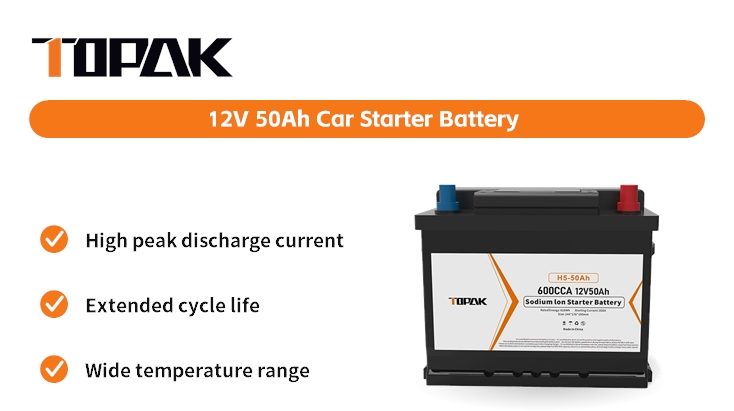
Understanding the 12V 50Ah Car Starter Battery
A 12V 50Ah Car Starter Battery is a medium-sized energy storage device made to provide a high current for starting the engine quickly while keeping the voltage stable during discharge cycles. The standard voltage for this setup is usually between 12.2V and 12.8V, and the 50Ah capacity means that the battery can possibly provide 50 amps for one hour or proportionally higher currents for shorter periods of time. In industry and vehicle settings, these batteries can be used instead of regular Group 24 lead-acid batteries. When made with advanced chemicals, they have big benefits.
Core Specifications and Automotive Applications
There are three important technical factors that determine the quality of a starter battery: its stated capacity, its cold starting amps, and its discharge temperature range. Our Model TP-NA1250 performs at a professional level, with 610Wh of nominal energy, 800A of peak discharge current in one second, and reliable operation from -40°C to 80°C. These specs make it possible for the engine to start consistently in all kinds of weather, from subzero winters in the Nordic countries to temperatures in the desert that are over 50°C. This thermal resilience is good for industrial fleets, farm equipment, boats, and backup power systems. It comes in small sizes (244mm x 176mm x 190mm) that fit in standard automotive battery trays.
Cold Cranking Amps: The Performance Benchmark
Cold Cranking Amps check how well a battery can keep at least 7.2 volts while starting an engine at 0°F (-18°C) for 30 seconds. When electrical loads are competing during ignition, high CCA ratings are very important. For example, diesel engines with compression heaters, cars with high-end sound systems, and equipment that works in cold storage facilities all need batteries with 800A or higher CCA ratings. In these situations, traditional lead-acid batteries lose voltage, but lithium iron phosphate alternatives keep their discharge curves flat, giving steady power until 90% depth of discharge. This feature gets rid of the annoying slow-crank situations that happen with regular batteries in the winter.
Advantages Over Traditional Battery Technologies
Modern car starter batteries made with LiFePO4 chemistry solve problems that have plagued the lead-acid business for decades. The biggest benefit right away is that lithium variants are lighter—about 8 kg compared to 18–22 kg for similar lead-acid models. This means that they use less fuel and are easier to install. Cycle life increases greatly from 300–500 cycles to over 6,000 cycles at 80% depth of discharge. This means that they can be used for 10 years instead of 3–4 years like regular batteries. Getting rid of sulfation, acid stratification, and gassing hazards makes things safer and requires less maintenance, which is especially helpful for fleet owners who have to manage hundreds of vehicles in different places.
Key Criteria to Choose the Best 12V 50Ah Car Starter Battery Manufacturer
When analyzing battery makers, people who work in procurement have to find a balance between technical performance measures and business dependability factors. The decision framework should put measurable requirements at the top of the list while also looking at less tangible factors like engineering support and supply chain stability. A good evaluation process checks candidates for both product capabilities and organizational maturity. This makes sure that suppliers can grow with your business.
Battery Performance Indicators and Testing Standards
Checked cycle life data, real versus claimed CCA ratings, and internal resistance readings are some of the most important performance measures. Reliable makers give third-party test certificates that show their goods meet the safety standards for UN38.3 transport, UL1973 fixed storage, and IEC 62619 industrial use. During supplier audits, ask for proof of cell consistency grading—differences in internal resistance should not be more than 0.3mΩ and differences in voltage should not be more than 5mV between cells. Temperature cycling tests from -20°C to 60°C prove that the product is thermally stable, and MIL-STD-810G vibration resistance tests make sure that the structure is strong enough for mobile use. When manufacturers are open about these standards, it shows that they care about quality more than just what they say in their ads.
Certifications and Regulatory Compliance
For 12V 50Ah car starter battery to be sold in international markets, they need to have the right safety certifications. Getting ISO 9001 certification for quality management means that processes are controlled in a planned way, and getting ISO 14001 certification for environmental responsibility means that factories are run in a responsible way. Different certificates are needed for different markets. For example, a product needs a CE mark to be sold in Europe, RoHS compliance to follow rules about dangerous substances, and local certifications for use in telecommunications or marine uses. If you're looking for producers in North America, make sure they know about the DOT shipping rules and the UL listing rules. These certificates are more than just paper work; they show that your batteries have been tested and proven to be of high quality, which protects your brand's image when they are put to use.
Production Capacity and Supply Chain Robustness
The size of a factory has a direct effect on prices, lead times, and the ability to make changes. Automatic production lines make sure that big orders are all the same, and they also cut down on mistakes made by people when putting together cells and integrating BMS. Our Dalang facility has 25,000㎡ of automated manufacturing space, which lets us quickly increase production in response to changes in seasonal demand or urgent replacement orders. When looking at potential suppliers, check to see how many different places they get their raw materials. If they only get lithium salts or cathode materials from one place, you could be vulnerable if there is a supply disruption. Manufacturers who have strategic inventory buffers, multiple transportation partners, and regional delivery networks are ready for the unstable supply chain that has made global buying difficult since 2020.
Technical Support and Engineering Collaboration
Plug-and-play ease doesn't usually lead to battery connection. For some charge controllers, OEM uses need special voltage settings, mounting brackets, or BMS programming. When it comes to compatibility issues, manufacturers who create their own BMS, like TOPAK's own battery management systems, are better than providers who rely on third-party BMS vendors. Check how quickly the company responds to technical questions about charging methods, the limits of series and parallel connections, and explanations on environmental ratings before the sale. After the sale, there should be installation help, commissioning help, and failure analysis in the field. When suppliers put technical resources into the success of each customer instead of taking each deal as separate, they build long-term relationships.
Comparing Top 12V 50Ah Car Starter Battery Manufacturers and Brands
There are both well-known multinational brands and smaller, specialized lithium manufacturers in the global automotive battery market. Because they focus on different technologies, set different prices, and aim for different uses, each provider has its own market position. When procurement teams understand these competitive dynamics, they can better match the strengths of each manufacturer with the needs of the business.
Performance Analysis Across Leading Manufacturers
Traditional battery giants have added lithium versions to their product lines. They bring decades of distribution infrastructure, but they aren't always ahead of the curve when it comes to new advanced chemicals. Bosch batteries use their connections with automakers to offer easy integration for European car systems and strong warranty networks. Optima's AGM spiral-cell designs are aimed at hobbyist markets that value vibration resistance, but their high prices represent their high status. Exide stays cost-competitive by having factories all over the world, which makes it appealing to fleet operators who care about prices.
Lithium manufacturers that only work with LiFePO4 technology are able to get longer cycle lives and lighter batteries. TOPAK is a leader in this field, having been making lithium batteries since 2007 and offering industrial-grade solutions with 800A peak discharge and 6,000+ cycle ratings. When it comes to voltage configurations, BMS feature sets, and mechanical adaptations, these manufacturers usually offer more customization options than diversified battery conglomerates. Their engineering teams know more about lithium-specific uses, like connecting batteries in series up to 48V or integrating them with solar charge controls.
Warranty Terms and Long-Term Value
How warranties are set up shows how confident the maker is in the product's longevity. Standard car batteries come with free replacement warranties for 24 to 36 months. Premium lithium batteries, on the other hand, come with covering for 5 to 10 years with reduced capacity promises. Check the warranty's restrictions carefully. Some companies don't cover series connections, marine use, or business use, even though they market their batteries for these uses. Actual field performance data is more important than extended warranties. Ask for case studies or customer references that show successful multi-year deployments in environments that match your application profile.
Procurement Options and Pricing Models
When you buy directly from the manufacturer, you can get volume discounts and customization options that you can't get through distributors. For standard setups, the minimum order quantity is usually between 50 and 100 units. For known accounts, it drops to 10 to 20 units. When you work with an OEM, you can co-brand, get custom specs, and use trade inventory programs that make payment terms fit with production processes. When buying in bulk, prices tend to stay the same. Base models cost around $180 to $250 per unit for 500 or more, while higher-end models with advanced BMS or longer temperature ratings cost around $280 to 350. When comparing quotes, you should figure out the total cost of ownership, which should include shipping, any duties or taxes that might apply, warranty service, and how often the item needs to be replaced based on real-life data.
Maintenance, Testing, and Maximizing the Lifespan of 12V 50Ah Car Starter Batteries
Taking care of 12V 50Ah car starter battery correctly can make them last longer and keep them from breaking down too soon, which can affect the supply of tools. Industrial users should set up routine maintenance plans that cover how to store things, how to charge them, and how to check on their performance on a regular basis.
Best Practices for Storage and Charging
Lithium iron phosphate batteries can handle being stored longer than lead-acid batteries, but they still work best in controlled settings. To keep calendars from going bad too quickly, store units at 40 to 60% of their full charge in a temperature-stable area between 10 and 25°C. Do not store fully charged items above 30°C, as this speeds up the breakdown of electrolytes and the loss of capacity. CC/CV (Constant Current/Constant Voltage) chargers set to 14.4V to 14.6V bulk voltage limits are needed for charging protocols. Chargers that use lead acid and have desulfation pulses or equalization modes can hurt lithium BMS circuits. Charging in cold weather can be tricky. Our batteries can safely discharge to -40°C, but charging below 0°C can cause lithium plating if the units don't have built-in heating films. Always make sure the charger works with the new batteries before connecting them.
Testing Techniques for Quality Verification
Controlled discharge testing should be done during the incoming check to make sure that the real capacity matches what the manufacturer says it is. Connect the batteries to electronic loads that have been calibrated. Discharge the batteries at a rate of 0.2C (10A for 50Ah batteries) until the voltage drops to 10.0V. Then, count the number of amp-hours that were delivered. When new, good units give 95 to 100 percent of their rated power. Using milliohm meters to test the internal resistance helps find bad cells. Readings above 8mΩ at 1kHz point to problems with the manufacturing process or damage during shipping. Using thermal imaging during a high-current discharge shows that cells are not balanced; temperature differences of more than 5°C between parts show that the BMS is not balanced properly. Keep track of how much each battery has lost over time by writing down the initial measurements for each serial number.
Recognizing Early Signs of Battery Degradation
Unexpected downtime can be avoided by proactively finding failures. Batteries that need more than 6 hours to fully charge at a 0.3C rate may have high internal resistance, so keep an eye out for them. A voltage drop during cranking attempts, especially below 11.5V when the load is on it, means that the capacity has been lost or there are problems with the BMS. When the case is inspected physically, it should show any signs of growth, corrosion at the terminals, or odd heat during charging cycles. Many more complex BMS systems keep error codes that can be accessed through diagnostic interfaces. These logs should be looked at every three months to catch balancing failures, over-temperature events, or safety circuit activations before they lead to full failures.
How to Procure 12V 50Ah Car Starter Batteries: Best Practices and Supplier Recommendations
Strategic sourcing means choosing the right outlets, negotiating good terms, and setting up quality testing systems that keep low-quality goods from getting into your supply chain.
Direct Manufacturer Versus Distributor Purchasing
Having direct ties with battery makers has many benefits, not just lower prices. With engineering access, you can change the specifications to fit your needs, like adding telemetry units or changing the BMS settings for certain charge controllers. When orders go around wholesaler inventory rounds, lead times are shorter. This is especially helpful for seasonal businesses that need to ramp up production. When you talk to production engineers about quality problems instead of distributor sales reps who aren't as technical, the problems get fixed faster. However, direct sourcing comes with a higher minimum order quantity and the responsibility of managing operations such as freight forwarding, customs clearing, and tax payment.
Bulk Procurement Advantages
When you make a volume promise, you can access different pricing levels, customization choices, and special treatment when there aren't enough allocations. If you place more than 500 units a year, you should ask for dedicated account management, consignment inventory programs, and business reviews every three months that keep track of quality metrics. When you buy from fewer sellers, you have more bargaining power and less vendor control work to do. When making mass deals, make sure they include ways for specifications to change, for demand forecasts to be updated, and for prices to stay the same or go up only if the cost of raw materials changes.
Selecting Verified, Trusted Manufacturers
Due diligence keeps you safe from fake goods, sources you can't trust, and specs that aren't what they seem to be. Factory audits check the claimed production capacity, the level of automation, and the quality control systems. Ask for customer references from people in the same industry as you, and then call those people to find out how well the supplier does at meeting deadlines, providing technical support, and handling warranty claims. Financial stability checks, such as those offered by Dun & Bradstreet, show which sellers may have problems with their businesses. Manufacturers that have been in business for 15 years or more and have a history of exporting to developed markets show that they are reliable and dependable. Since 2007, TOPAK has been in more than 15 countries, which is an example of a global reach that helps build trusting, long-term relationships.
Conclusion
To find the best car starter battery manufacturer, you have to weigh technical requirements, source skills, and pricing. High-performance units with 800A cold cranking amps, 6,000+ cycle life, and the ability to work in extreme temperatures are clearly better than older technologies. When it comes to buying things, the best tactics focus on companies that have a history of reliability, build their own business management systems (BMS), have automated production infrastructure, and have global service networks. Purchasing professionals find battery solutions that improve equipment reliability while lowering the total cost of ownership over multiple years by using structured evaluation frameworks that include performance testing, certification verification, and supply chain assessment.
FAQ
Can 12V 50Ah lithium batteries connect in series for higher voltage applications?
Professional 12V 50Ah Car Starter Batteries can be set up in both series and parallel configurations up to 48V (4S) when they have BMS systems that are rated for high-voltage synchronization. Before joining, check the manufacturer's instructions, as some consumer-grade units don't have the right balance circuits for strings with more than one battery. All units in a series connection must have the same internal resistance. If the variation is more than 0.5mΩ, the charge will be uneven and the connection will fail early.
What charging protocols work with lithium starter batteries?
These batteries need CC/CV chargers that can handle 14.4V to 14.6V and charge at a maximum rate of 0.3C to 0.5C. Damage will be done to lithium BMS circuits by lead-acid chargers with desulfation modes or equalization voltages above 15V. In cold weather, things need to be handled differently. Charging below 0°C (32°F) can cause lithium plating if the batteries don't have built-in heating elements. Always make sure the charger works before connecting it for the first time.
How do lithium and lead-acid 12V 50Ah batteries compare?
Lithium versions weigh 60% less (8 kg vs. 20 kg), last 8 to 10 times longer (6,000+ cycles vs. 500 cycles), and keep their voltage curves flat during discharge. Lead-acid costs less up front ($80–120 vs. $220–300), but it needs to be replaced three to four times more often. Even though it costs more at first, lithium has a lower total cost of ownership in situations where weight savings, longer cycle life, and less maintenance are important.
Partner with TOPAK for Premium 12V 50Ah Car Starter Battery Solutions
TOPAK New Energy Technology has industrial-grade 12V 50Ah Car Starter Batteries ready to meet your car's power needs. These batteries are made to handle tough conditions. We've been providing custom energy storage solutions since 2007 by combining our own BMS technology with precise automated manufacturing and the ability to ship to over 15 countries around the world. Our Model TP-NA1250 has a -40°C to 80°C operating range, a high discharge current of 800A, and a longevity rating of 6,000+ cycles. These specs meet the strictest fleet and OEM standards. You can email our engineering team at B2B@topakpower.com for technical help, bulk pricing, or to ask for samples. As a reputable 12V 50Ah Car Starter Battery maker, we can give you the dependability, customizable options, and technical complexity that your buying strategy needs.
References
- Battery Council International. (2023). "Technical Manual for Automotive Starting Batteries: Performance Standards and Testing Protocols."
- Society of Automotive Engineers. (2022). "SAE J537: Storage Batteries for Off-Road Work Machines—Specification and Testing."
- International Electrotechnical Commission. (2021). "IEC 62619: Secondary Cells and Batteries Containing Alkaline or Other Non-Acid Electrolytes—Safety Requirements for Industrial Applications."
- U.S. Department of Transportation. (2023). "Pipeline and Hazardous Materials Safety Administration: Lithium Battery Transportation Guidelines."
- National Renewable Energy Laboratory. (2022). "Life Cycle Cost Analysis of Advanced Battery Technologies for Automotive and Industrial Applications."
- IEEE Standards Association. (2021). "IEEE 1725: Standard for Rechargeable Batteries for Cellular Telephones and Mobile Devices—Adaptation for Automotive Starting Systems."