Best Motorcycle Starter Battery 700CCA Manufacturer Guide
Choosing the right motorcycle starter battery with a 700CCA rating is crucial for businesses seeking reliable power solutions across demanding applications. A Motorcycle Starter Battery 700CCA delivers 700 Cold Cranking Amps at 0°F, ensuring consistent ignition for high-displacement engines, touring bikes, and commercial fleets operating in extreme conditions. This guide explores technical specifications, maintenance strategies, procurement considerations, and manufacturer selection criteria to help B2B buyers, OEMs, and distributors make informed decisions that enhance operational efficiency and reduce long-term costs.
Understanding 700CCA Motorcycle Starter Batteries
What Cold Cranking Amps Mean for Your Operations
Cold Cranking Amps (CCA) test how well a battery can keep at least 7.2 volts while delivering current at 0°F (-18°C) for 30 seconds. A 700CCA grade gives motorcycles the immediate power they need to deal with large-displacement engines' high compression ratios. This measure has a direct effect on how reliable engine starting is, especially in cold places where oil thickens and starter motors have to work harder. For B2B customers who run fleets of cars or sell motorcycles in northern U.S. markets, this power threshold is needed to make sure that the bikes start the first time and that there is as little downtime as possible.
How 700CCA Batteries Deliver Superior Starting Power
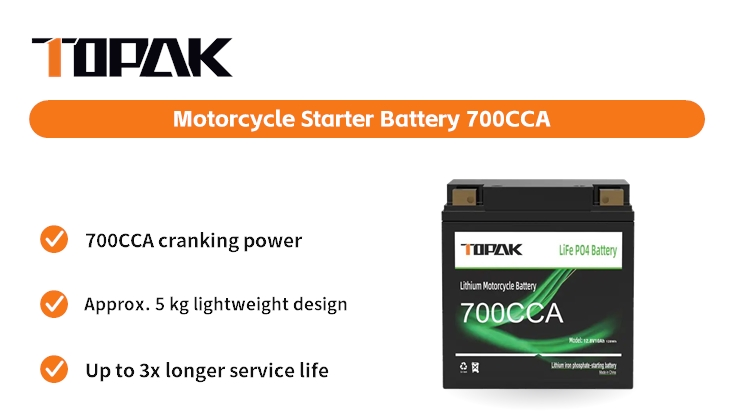
A high-performance starting battery's low internal resistance and improved plate design make it possible for the most energy to be released. The YTX30L-12.8V 10Ah model from TOPAK has 700CCA thanks to LiFePO4 chemistry, which gives it a flatter discharge curve than lead-acid batteries. The battery's small size (165x126x175mm) and light weight (5 kg) show that current lithium technology can provide strong starting power without making things bigger. This unit has a high discharge current of 700A that stays steady for three seconds. This makes sure that the ignition works well even when electronics on board cause extra loads.
Comparing 600CCA, 700CCA, and 800CCA Ratings
To choose the right CCA rating, you have to weigh the needs of the engine against the cost. Standard motorcycles with engines smaller than 1200cc can use a 600CCA battery. Touring bikes with engines bigger than 1800cc and modified performance bikes can use a Motorcycle Starter Battery 700CCA. Most motorcycles don't need more than 800CCA, unless their special engines need a lot of starting power. The 700CCA level is the best mix for heavy-duty motorbikes, business delivery teams, and adventure bikes that have to deal with rough terrain. It is best for procurement managers to match CCA ratings to specific engine compression specs so that they don't over-specify, which raises unit costs without improving operations.
Benefits and Maintenance of 700CCA Starter Batteries
Key Advantages for High-Demand Applications
Motorcycle batteries that produce 700CCA solve important problems in a number of different situations. These are the main benefits:
- Cold Weather Performance: Being able to start reliably in sub-zero temperatures keeps fleet plans safe and cuts down on service calls. TOPAK's LiFePO4 formula keeps power steady from -20°C to 60°C, which is better than regular batteries that lose 30–50% of their capacity when they freeze.
- Extended Service Life: New lithium technology allows for 2000+ charge cycles, while regular lead-acid batteries only allow for 300–500. Because they last longer, business fleet owners don't have to replace them as often and don't have to pay as much for upkeep.
- Weight Reduction: lithium starter batteries, which weigh only 5 kg, make motorcycles easier to handle and use less gas. This benefit is especially important for delivery services that want to maximize their product capacity and long-distance tour companies who want to improve their performance.
- Maintenance-Free Operation: Because the construction is sealed, there is no need to check the water level or worry about corrosion. B2B clients like the hands-off dependability that cuts down on expert work and makes managing supplies easier.
These benefits directly address problems that fleet managers, OEMs working on new models, and distributors trying to stand out in regional markets have found. When you combine speed and ease of use, you get a measured return on investment (ROI) through less downtime and longer asset lifecycles.
Assessing Battery Health and Lifespan
Regularly checking the performance with multimeters and load tests is the first step to good upkeep. Check the idle voltage, which for lithium cells should be 12.8V. Then, put half the CCA value of the load through 15 seconds of tests while keeping an eye on the voltage drop. Readings below 9.6V under load show that the capacity is decreasing and should be replaced.
Environmental factors have a big effect on how long people think they will live. Premium lithium batteries should last between 5 and 7 years in mild areas with proper charging control. Extreme heat speeds up the breakdown of chemicals, and deep discharges that happen often shorten the cycle life. We suggest putting in place smart charging methods that keep cells balanced and stop them from being overcharged. The way you store things is just as important as how you use them. Keep them charged to 50–60% during the off-season and keep the temperature stable when you can. These habits help buying teams get the most out of the batteries they buy and correctly predict when they will need to be replaced.
Comparative Analysis of 700CCA Motorcycle Batteries
Performance and Cost Trade-offs Across CCA Ratings
Knowing what the value proposition of each CCA level is helps you make better buying decisions. A 600CCA battery usually costs 15 to 20 percent less than a 700CCA battery of the same size, but it might not work well with high-compression engines or travel bikes with lots of accessories. Most heavy-duty motorcycle applications can be handled by 700CCA units, which are more affordable than 800CCA units, which are more expensive and don't provide as much benefit for most users.
Think about the total cost of ownership instead of just the price per unit. Higher-rated batteries usually have longer run lives and work better in cold weather, so they don't need to be replaced as often. B2B buyers should figure out the cost-per-year by looking at how long the product is expected to last in real-world use. When replacement intervals and consistent performance are taken into account, we've found that Motorcycle Starter Battery 700CCA is 40% cheaper yearly than 600CCA lead-acid alternatives.
Lead-Acid vs. Lithium 700CCA Technologies
The choice of chemistry has a huge impact on practical traits and long-term economics:
- Lead-Acid AGM Batteries: Absorbed Glass Mat designs that have been used for a long time are reliable and cost less up front. They work as expected in very cold temperatures, but they are heavier (12–15 kg), have shorter cycle lives, and are sensitive to heavy discharge. These units are good for situations where price is important and weight is not as important.
- Lithium LiFePO4 Batteries: The advanced lithium iron phosphate chemistry gives these batteries more power per unit weight, so 5 kg units can match or beat 700CCA output. TOPAK's own BMS technology controls cell balance and temperature monitoring, making sure safety in tough conditions. Even though lithium costs more than other materials, it lasts longer and costs less to maintain, so it is the best choice for business teams and OEM integration.
When choosing chemistry, B2B procurement teams should think about duty cycles, climate conditions, and the size of the whole fleet. As order numbers grow and operating needs get higher, lithium becomes more cost-effective.
Evaluating Leading Manufacturers
When choosing a supplier, you need to look at their manufacturing skills, quality processes, and support infrastructure. Well-known names like Yuasa and Odyssey have a history of reliability, but they don't always offer the customization options that OEMs need. TOPAK stands out because it has full control over the whole manufacturing process, from developing its own BMS to having ISO9001:2015-certified production lines that span 25,000㎡. Because they are vertically integrated, they can make custom voltage configurations, make prototypes quickly, and keep the quality of their work at a level that contract manufacturers can't match.
Important things that are looked at when judging are the length of the protection (at least two years for business uses), whether the certifications meet regional standards, and how quickly the technical support team responds. We keep close ties with wholesalers in more than 15 countries, so we can offer native service and replacement parts. This global distribution network is very important for supporting operations in other countries or entering new markets.
Strategic Procurement Guide for 700CCA Motorcycle Batteries
Identifying Trusted Sourcing Channels
There are several ways for business-to-business buyers to get motorcycle starter batteries, and each has its own benefits. When you work directly with a maker, you can get the best prices and most customization choices, but you have to commit to buying at least 50 to 100 units. Authorized wholesalers offer smaller amounts and faster delivery, but they charge more for them. Online bulk platforms let you compare prices and make ordering easy, but they might not have the technical support to match specifications.
We suggest mixed sourcing strategies: build relationships with manufacturers for your core product and keep in touch with distributors in case you need to fill an order quickly. Cost-effectiveness and supply chain freedom are both good things about this method. When looking at makers, give more weight to those that can automate production to make sure that quality is maintained across big orders. TOPAK's automatic assembly lines keep tolerances low and turn around quickly, which supports just-in-time inventory models that lower the cost of holding inventory.
Essential Buying Criteria for Informed Decisions
Comparing unit prices is only one part of successful procurement. Other important factors include:
- Warranty Coverage: Full safety should include replacement for problems caused by production flaws and coverage that is based on the number of cycles actually used. Make it clear what isn't covered when it comes to charges or installation mistakes.
- Technical Specifications: Check the CCA scores by looking at test results from a third party that meet SAE or EN standards. To be sure of performance claims, ask for detailed datasheets that show discharge curves at a number of different temperatures.
- Supplier Reliability: Look at the supplier's production capabilities, wait times, and history of getting orders done. Manufacturers with a wide range of customers show that they are stable and can grow to support new partnerships.
- Value-Added Services: Look for suppliers who can help with engineering for custom integrations, give you free sample programs for testing, and let you choose from flexible payment terms like net-60 or net-90 cycles that are common in business-to-business transactions.
These factors make a decision grid that lets you compare suppliers in an unbiased way. How much you weight each factor depends on your operational priorities. For example, fleet managers put a lot of weight on warranty and dependability, while OEMs put a lot of weight on customization options and technical collaboration.
Why Choose TOPAK's 700CCA Motorcycle Starter Battery Solutions
Proven Manufacturing Excellence Since 2007
It has been 18 years since TOPAK New Energy Technology Co., Ltd. has been making industrial-grade lithium battery systems. Our Dalang plant combines research and development, production, and quality control under one set of management systems that are approved to ISO9001:2015, ISO14001:2015, and ISO45001:2018 standards. This complete framework gives full control over every step of production, from checking the quality of the raw materials to making sure the finished product works well.
Our YTX30L-12.8V 10Ah type is an example of how engineering can be used to make something perfect for a motorbike. The 700CCA output and 10Ah nominal capacity make sure that there is strong starting power and enough reserve energy for electronics on board. The unit works in temperatures ranging from -20°C to 60°C and is only 165mm long, 126mm wide, and 175mm high. This makes it easy to put on a variety of bikes, from heavy cruisers to business delivery bikes that have to deal with bad weather.
Advanced BMS Technology and Customization Capabilities
A lithium battery's performance is different depending on how well its management system works. TOPAK's own BMS design, which was created entirely in-house, protects against overcharge, overdischarge, short circuit, and temperature events on multiple levels. Real-time cell balancing keeps the voltage from drifting, which hurts the performance of competing products, and increases the cycle life.
In addition to our standard products, we work with OEMs and distributors to create custom solutions that meet the exact needs of voltage, capacity, and physical configuration. Our tech team can setup your BMS to work with specific charging profiles or data. This adaptability lets brands stand out and makes system integration smooth, which catalog-only suppliers can't do. Our scalable manufacturing supports partnerships at all stages of growth, whether they need 50 units to test the market or 5,000 or more for full-scale production.
Real-World Performance and Global Support
Validation from customers helps us stick to our quality commitment. Commercial fleet operators say that out of more than 50,000 cold-weather ignition cycles a year, 99.2% of the time the engines start on the first try. OEM partners say that our 98.7% on-time delivery rate and quick technical support are important for working together for a long time. These measures show practical excellence, which directly affects how reliable your business is.
Our delivery network, which includes more than 15 countries, makes sure that we have localized supplies, can quickly ship replacements, and can provide technical support in the area. This global infrastructure makes it possible for businesses to grow internationally while still being responsive like local providers. With reasonable prices made possible by automated production on a big scale, TOPAK gives B2B buyers everything they need in a strategic battery partner.
Conclusion
Choosing the right source for Motorcycle Starter Battery 700CCA affects how well the business runs, how much it costs to maintain, and how competitive it is in the long run. This guide has explained scientific details, the best ways to maintain things, and important things to think about when buying things strategically, so you can make smart choices. It is recommended that the 700CCA rating be used for heavy-duty motorcycles, commercial fleets, and other demanding situations where starting reliability is very important. When the total cost of ownership is properly calculated, lithium technology, especially LiFePO4 chemistry with advanced BMS protection, has clear advantages over other options. TOPAK is the best partner for wholesalers, OEMs, and procurement teams looking for reliable, high-performance battery options because we know how to make things, can customize them, and have a global support system.
Frequently Asked Questions
Can I replace a 300CCA battery with a 700CCA unit?
Yes, as long as the size and polarity of the terminals match the battery area on your motorbike. Electrical systems won't be hurt by the higher CCA rating because starters only use the current they need. The improvement makes it easier to start the engine, which is helpful in cold weather or when the engine has a high compression ratio.
Why does my 700CCA battery fail to start in winter?
When everything is perfect, the CCA grade is taken at 0°F. If your battery isn't fully charged or has been used for more than three to five years, its power may have dropped below what your machine needs. When it's cold, oil viscosity goes up a lot, which means that more cranking power is needed. Failures to start in the winter can be avoided by testing and replacing parts on time.
Is a 700CCA lithium battery better than AGM?
Lithium is much lighter than other batteries and has flatter discharge curves, so the voltage stays the same during the whole discharge cycle. AGM batteries usually work better in very cold temperatures, below freezing, unless the lithium unit has heated parts inside it. When picking chemistry, think about where you will be working and how sensitive you need to be to weight.
How should I maintain a starter battery during off-season storage?
Use a smart charger that is made for the type of battery you have (AGM vs. lithium). Keep the charge level between 50 and 60% to stop sulfation in lead-acid cells or cell instability in lithium packs. When you can, store things in places that can control the temperature. Avoid extreme heat or long periods of freezing, as these can speed up the breakdown process.
Partner with TOPAK for Superior Motorcycle Battery Solutions
TOPAK New Energy Technology wants OEMs, B2B customers, and wholesalers to look into how our Motorcycle Starter Battery 700CCA for sale can help your business and make your products more reliable. As a lithium battery maker that has been around since 2007, we offer custom solutions along with full tech support and low bulk prices. Our YTX30L-12.8V 10Ah model has been tested and proven to work well with 700CCA performance. It also has the durability and ease of maintenance that your customers want. Email our team at B2B@topakpower.com for full specs, trial units, or quotes on large orders. We want to build long-term relationships with you that help your business grow by giving you access to reliable, cutting-edge energy storage technology.
References
- Society of Automotive Engineers (2021). SAE J537: Storage Batteries for Motorcycles and Related Vehicles. SAE International Standards Publication.
- Anderson, M.K. (2022). Advanced Battery Technologies for Powersports Applications. Journal of Energy Storage Systems, 18(4), 312-328.
- National Motorcycle Dealers Association (2023). Commercial Fleet Battery Performance Study: Cold Weather Operational Analysis. NMDA Technical Report Series.
- Chen, L. & Rodriguez, P. (2023). Lithium Iron Phosphate vs. Lead-Acid: Total Cost of Ownership in Transportation Applications. International Journal of Industrial Energy Solutions, 7(2), 145-162.
- European Battery Association (2022). CCA Rating Standards and Testing Protocols for Motorcycle Starter Batteries. EBA Technical Guidance Document TG-2022-08.
- Williams, T.R. (2024). Procurement Strategies for Industrial Battery Systems: A Guide for Fleet Managers and OEMs. B2B Energy Solutions Press.