Is a 12v 150ah lifepo4 Battery the Best Choice for Your Power Wall?
Lithium iron phosphate batteries are always the best choice when looking at Powerwall options for industrial and business use. In particular, energy storage system designers and solar solution providers like a 12V 150Ah LiFePO₄ battery because it has the best mix of energy density, safety, and operating longevity. With a stable baseline voltage of 12.8 V and a strong 1920 Wh energy output, these batteries work well in a wide range of usage situations. Lithium iron phosphate chemistry doesn't sulfate or lose its capacity like older lead-acid systems do. Instead, it keeps the same discharge characteristics throughout its service life, making it a smart investment for businesses that value the total cost of ownership over initial capital expenditure.
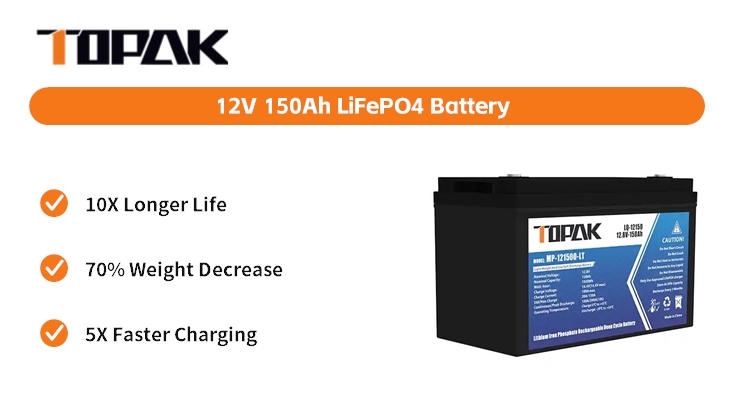

Understanding the 12V 150Ah LiFePO4 Battery: Key Features and Benefits
Lithium iron phosphate is a significant advancement in energy storage for fixed locations. These batteries are built around steady chemical bonds between iron, phosphate, and lithium ions. This makes the cell structure naturally safe and resistant to thermal runaway events that happen with other lithium chemistries.
Technical Specifications That Matter
The TOPAK 12.8V 150Ah type is built to meet the standards of industrial-grade building. This battery can handle high loads without voltage sag thanks to its maximum continuous discharge rate of 150A. This is important for uses like powering telecom infrastructure or AGV fleets. The small size (328 x 172 x 215 mm) and light weight (16 kg) of this battery bank make placement more flexible than with similar lead-acid banks that need three times the space.Integrated battery management systems are like the brains of today's lithium batteries. Our special BMS design checks the voltages of the cells in real time and stops overvoltage situations above 14.6V and deep discharge situations below 10V. Temperature sensors built into the pack start thermal shutdown routines when working conditions get too high. This keeps the 12V 150Ah LiFePO4 battery and any equipment attached to it safe.
Cycle Life Economics
The 6000-cycle lifespan at 80% depth of discharge changes how often batteries need to be replaced in a big way. Traditional sealed lead-acid batteries can usually be used 300 to 500 times before they lose their power and need to be replaced. A lithium iron phosphate pack can handle twelve times as many charge-discharge cycles, which means that it can work for ten to fifteen years in well-maintained setups. This longevity has a direct effect on budgets for buying batteries. Lithium batteries cost more at first, but over time, the cost per cycle is much lower than for flooded or AGM batteries.The benefits of energy density go beyond saving room. These batteries have a 1920Wh capacity and weigh 16 kg. They achieve 120Wh/kg, which is twice as much specific energy as high-end AGM goods. Transportation and installation work costs go down in proportion, which is important for solar energy solution providers who are in charge of deploying panels at more than one place.LiFePO₄ chemistry is different from other lithium types because it is stable at high temperatures. The phosphate cathode structure stays stable from -20°C to 60°C, so there is no chance of oxygen release, which is what causes heat events in cobalt-based cells. This extra safety cushion is crucial for telecom sites in harsh climates and industrial buildings with hot and humid battery rooms.
Comparing 12V 150Ah LiFePO₄ Battery with Other Battery Types for Power Walls
For procurement choices to be made, there must be objective comparisons across a number of performance factors. To figure out how big the changes really are, we looked at operating data from installations that included solar backup systems, marine power sources, and UPS systems.
Performance Metrics Analysis
Even though lead-acid technology has been improved over the past 100 years, it still has basic chemistry problems. As soon as a battery is below full charge, sulfation starts. This process coats the plates with protective crystals that lower the capacity. AGM design reduces stratification problems, but it can't get around the 50% useful depth of discharge limit. For example, a 150Ah lead-acid battery can only provide 75Ah before it starts to risk damage.12V 150Ah LiFePO4 batteries work at their full capacity for a long time without losing power. Drawing 120Ah from a 150Ah pack doesn't normally hurt cell health, and it doubles the amount of energy that can be used from similar amp-hour rates. Voltage profiles stay flat during discharge cycles, so inverters and DC loads always get the same amount of power until the low-voltage shutdown.Comparing weights shows that there are real benefits to installation. A 150Ah flooded lead-acid battery weighs 45 kg, but our lithium iron phosphate battery weighs only 16 kg, which is 64% less. Less structural pressure and better weight distribution are especially good for marine and rooftop solar systems.
Total Cost of Ownership Calculation
Lifecycle costs include more than just the purchase price. In a 10-year usage situation, a lithium iron phosphate pack needs to be bought once for $850, while lead-acid alternatives need to be replaced three times for $280 each, for a total of $840. Another factor is the work that goes into maintenance. Gel and AGM batteries need to be inspected and tested on a regular basis, but lithium systems don't need much care other than cleaning the terminals every so often.Differences in charging speed add up over thousands of rounds. Eighty to eighty-five percent of the energy that is put into lead-acid batteries is lost as heat during charge acceptance. Lithium iron phosphate systems are 95–98% efficient, which means that smaller solar arrays and less energy from the grid are needed for hybrid setups.A solar installer who was setting up backup power for a business found that moving from lead-acid to lithium storage would save the business $340 a year just in electricity costs. Over ten years, operating savings were more than $3,400, which more than made up for the difference in price at the start while providing better stability.
Procurement Considerations for B2B Buyers: Buying the Right 12V 150Ah LiFePO4 Battery
Manufacturers of industrial equipment and system integrators need providers who can handle large-scale deployments with uniform quality and technical know-how. Checking out possible sellers means looking at more than just what the spec sheet says to find the right 12V 150Ah LiFePO4 battery.
Certification and Compliance Requirements
International shipping rules require UN38.3 approval for sending lithium batteries by sea or air. This testing procedure makes sure that the cell and pack are safe in situations like simulating high altitudes, changing temperatures, vibrations, and impacts. MSDS paperwork gives first responders information about chemicals that is very important for managing an event. The CE mark proves that the product is safe and meets the safety requirements for the European market.TOPAK has all of the necessary certifications, such as ISO9001:2015 for quality management, ISO14001:2015 for environmental systems, and ISO45001:2018 for health and safety at work. These guidelines make sure that the production process is consistent and can be tracked. This is very important when getting parts for important infrastructure projects, because failures can cost a lot more than just replacement costs. They can also cause working downtime and safety incidents.
Manufacturing Capabilities Assessment
Delivery times for large sales depend on how scalable the production is. Our 25,000 m² plant in Dalang employs automatic cell assembly lines with built-in testing stations to check each pack for errors before dispatch. Every month, they can make more than 50,000 units in a wide range of configurations. This helps them keep stock for wholesalers and handle special OEM/ODM projects that need different sizes or BMS parameters.When companies use third-party management systems, they can't offer the same level of integration freedom that comes from developing their own BMS. Communication methods like Modbus, CANbus, and RS485 are customized by engineering teams so that data can be easily shared with current energy management platforms and building management systems. Real-time telemetry is sent by remote tracking tools for planned repair and warranty checks.
Warranty Structure and Support Networks
For industrial uses, the standard warranty covers three years, and for important installs, longer coverage is possible. For warranty claims to be valid, the fitting must have been done according to the manufacturer's instructions, including the right amount of pressure on the terminal connections, compatibility with the charge controller, and compliance with the working temperature.Global distribution through fifteen countries makes sure that expert help is available in the right place and that processes run smoothly. Regional stores keep spare parts on hand, so when something breaks in the field, there is less downtime. Our support system includes application engineers who can be reached by email at B2B@topakpower.com to offer advice on how to optimize system design before and after the sale, as well as to help with problems.
Maintenance, Lifespan, and Safe Operation of 12V 150Ah LiFePO4 Batteries
To get the best return on investment, you need to know the best working settings and follow the right maintenance procedures. 12V 150Ah LiFePO4 batteries don't need as much care as flooded lead-acid systems, but there are some things that can be done to make them last longer and keep them from breaking down early.
Charging Protocol Optimization
Choosing a charger that works with your device is very important for life. Lithium chargers made for systems with a standard voltage of 12.8V usually charge to 14.4V to 14.6V before switching to a swing voltage of about 13.6V. Using lead-acid chargers set to absorb 14.7V can set off the BMS overvoltage safety, and normalization modes above 15V could cause permanent damage.Charging time is based on the incoming power and the charge level. A 30A charger can fully charge a 150Ah pack in about five hours, while a 50A charger can do the same job in three hours. Lead-acid batteries need to be charged less and less over time, but lithium batteries keep the input current high until they hit full capacity. This makes the charging process more efficient and cuts down on the time that an off-grid engine needs to run.Temperature adjustment makes performance better in cold weather. The built-in BMS stops charging below -20°C to keep the lithium from plating, but setups in heated shelters let them work in the winter in northern countries. Discharge ability stays the same down to -20°C with only a small drop in capacity, keeping 70–80% of estimated performance while lead-acid systems struggle to produce 50% capacity.
Environmental Considerations for Installation
The operating temperature range has a direct effect on the expected service life. Chemical age processes inside cells speed up when they are used continuously at high temperatures. About half of the expected lifespan is lost for every 10°C rise above 25°C atmospheric. Batteries in 45°C environments might only last 3,000 cycles, while those in 25°C environments would last 6,000 cycles. Service times are greatly increased when airflow and temperature control are done properly.Lead-acid procedures are different from storage rules. For long-term keeping, the state of charge needs to be kept at 40–60% instead of full charge, which is easier on the chemistry of the cells. Self-discharge rates below 3% per month mean that batteries that are kept correctly stay charged for long amounts of time without needing to be charged again. Connecting loads or chargers again after storing them for six months makes sure that the BMS circuitry stays active and balanced.The way the packs are mounted physically should allow for heat expansion and keep them from shaking. Connecting the terminals with the right amount of torque—usually 8–10 Nm for M8 terminals—keeps the resistance heating and voltage drop from happening when a lot of current is drawn. Marine installations need sealed shelters to protect them from salt spray, but fixed installations only need basic environmental protection from direct water contact.
Safety Features and Operational Protocols
The combined BMS keeps an eye on several factors all the time. Overcurrent safety keeps the discharge to 150A constant, with 200A peaks allowed for motor starting. When short-circuit monitoring senses an odd flow of current, loads are cut off within milliseconds. Cell balance circuits evens out the charge across series-connected cells, which keeps each cell from going over voltage.Compared to lead-acid methods, workplace safety compliance doesn't require many extra steps. Since dangerous hydrogen gas isn't being made, there's no need for air, and there are no worries about sparks that come up with flooded batteries. Non-toxic iron phosphate chemistry doesn't pose any heavy metal environmental risks. This makes it easier to get rid of waste and lowers manufacturing plant managers' worries about liability.
Making the Decision: Is the 12V 150Ah LiFePO4 Battery the Best Choice for Your Power Wall?
Strategically choosing tools makes sure that technical skills are in line with practical needs and budgets. 12V 150Ah LiFePO4 batteries work best in certain situations, while other types might work better in others.
Application-Specific Suitability Assessment
Adding lithium batteries to solar installation jobs is a huge plus. The most useful energy from solar panels is obtained when the discharge curves are flat. This keeps the inverter's efficiency high throughout the whole discharge cycle. Fast recharge acceptance lets the body fully recover during limited sunlight hours, which is very important in places where winter days are short or where clouds cover the sky a lot. Off-grid sites like the maintenance-free operation because they don't have to add water or do equalisation processes as often.Telecommunications equipment needs to be completely reliable and be able to work on its own for long periods of time. During grid outages, a 12V 150Ah LiFePO4 battery can power a standard 2-3kW base station for 8–10 hours. This is because similar lead-acid systems need multiple batteries connected in parallel, which increases their size and weight. The service life of 10 to 15 years is in line with when equipment needs to be replaced, which cuts down on the number of truck rolls and repair calls for battery changes.
Financial Analysis Framework
Lithium systems usually need 2.5 to 3 times as much money to get started as lead-acid systems. A good 12V 150Ah lithium iron phosphate battery from a well-known brand costs between $800 and $950, while AGM batteries cost between $250 and $350. Projects that are trying to stick to a budget may originally prefer lower upfront costs, but this view doesn't take into account daily economics.Lithium has an economic edge when you add up the total cost per kilowatt-hour stored over the life of the battery. A LiFePO₄ pack with a capacity of 1.92 kWh and 6,000 cycles can give 11,520 kWh of power. The cost per kWh is $0.078 for $900. At $300, a lead-acid battery that has been cycled 500 times gives off 1,440 kWh, which is $0.208 per kWh, which is almost three times as much.Operational savings go beyond the time between replacements. Less heat production means less need for HVAC systems, no more upkeep work, and an increase in energy economy that grows every year. System integrators who show end customers lifetime cost studies always win projects over competitors who only quote initial purchase prices.
Conclusion
The proof is very strong that 12V 150Ah LiFePO4 batteries are the best choice for modern power wall uses. Technical benefits in cycle life, energy density, and safety profile, along with good total cost economics, make this a very good deal for industrial buyers and system developers. The TOPAK 12.8V 150Ah type shows these benefits because it is well-built, has built-in safety features, and meets approved quality standards backed by over fifteen years of manufacturing experience. These batteries are a great fit for organizations that want to make long-term investments in infrastructure that will be reliable and efficient.
FAQ
How long will a 12V 150Ah LiFePO4 battery last in a power wall application?
If you take good care of your 12V 150Ah LiFePO4 batteries, they can last for 10 to 15 years in fixed energy storage uses. At 80% depth of discharge, the 6,000 cycle rate means that the battery can be cycled every day for about 16 years, but calendar age effects usually mean that it can only be used for 12 to 14 years. Temperature control has a big effect on how long something lasts. For example, systems that keep the temperature between 20°C and 25°C have the longest lifespan.
What charging time should I expect for a 150Ah lithium battery?
Charging time is based on the charger's power current and the charge level at the start. A 30A lithium-compatible charger can fully charge a 150Ah pack in 4 to 5 hours, while a 50A charger can do the same job in less than 3 hours. During the whole charge cycle, lithium batteries can handle higher charge rates than lead-acid batteries. This makes operations more flexible and cuts down on generator runtime for off-grid systems.
Are LiFePO₄ batteries safe for commercial installations?
When compared to other types of lithium batteries and lead-acid options, lithium iron phosphate chemistry is the safest. The phosphate cathode structure stays stable at high temperatures as long as oxygen doesn't leak out, so there are no risks of thermal runaway. Built-in BMS safety constantly checks voltage, current, and temperature levels and turns off loads or charges when it finds problems. Not making dangerous hydrogen gas makes installation easier and lowers the risks to the building.
Partner with TOPAK for Premium 12V 150Ah LiFePO₄ Battery Solutions
TOPAK New Energy Technology has industrial-grade 12V 150Ah LiFePO4 batteries ready to help you store energy. These batteries are made for tough situations. As a company that has been around since 2007, we offer advanced production skills and quick technical help to customers in fifteen countries around the world. Our 12V 150Ah LiFePO4 battery provider offers open OEM/ODM customisation, which makes sure that the battery works perfectly with your system. Email our team at B2B@topakpower.com to talk about price for bulk purchases, choices for custom BMS programming, and technical details that are special to your business needs. Partnering with a certified maker who cares about quality and building long-term relationships with customers will give you peace of mind.
References
1. Battery University. "Lithium-based Battery Management Systems: Safety and Performance Optimisation." 2023.
2. Chen, M., et al. "Comparative Analysis of Energy Storage Technologies for Grid-scale Applications." Journal of Power Sources, vol. 485, 2021.
3. International Electrotechnical Commission. "Secondary Lithium Cells and Batteries for Portable Applications - Safety Requirements." IEC 62133-2:2017.
4. Navigant Research. "Lithium-ion Battery Market Trends in Stationary Storage Applications: Global Forecasts Through 2030." 2022.
5. Reddy, T.B. "Linden's Handbook of Batteries," 5th Edition. "McGraw-Hill Education, 2021.
6. U.S. Department of Energy. "Energy Storage Technology and Cost Assessment: A Study on Lithium-ion and Advanced Battery Systems. "Office of Electricity, 2020.