lifepo4 battery 24v 100ah for Outdoor, Marine & Camper Applications
Picking the right energy storage is crucial when planning power for rough outdoor activities, sea outings, or long camping trips. A LiFePO₄ battery 24V 100Ah provides safe, reliable, and light power that is better than standard lead-acid systems in almost all important ways. These lithium iron phosphate batteries have the energy density, cycle life, and weather resistance needed for difficult situations where dependability isn't a choice but a must. This battery setup is perfect for running navigational gear on a boat, powering an RV's electrical system, or saving solar energy when you're not connected to the grid. It has the right amount of storage, voltage, and portability.

Understanding LiFePO₄ Battery 24V 100Ah—Core Specifications & Benefits
These days, storing energy requires more than just space. We need answers that work the same way in all kinds of situations and keep things safe and long-lasting.
Technical Specifications That Define Performance
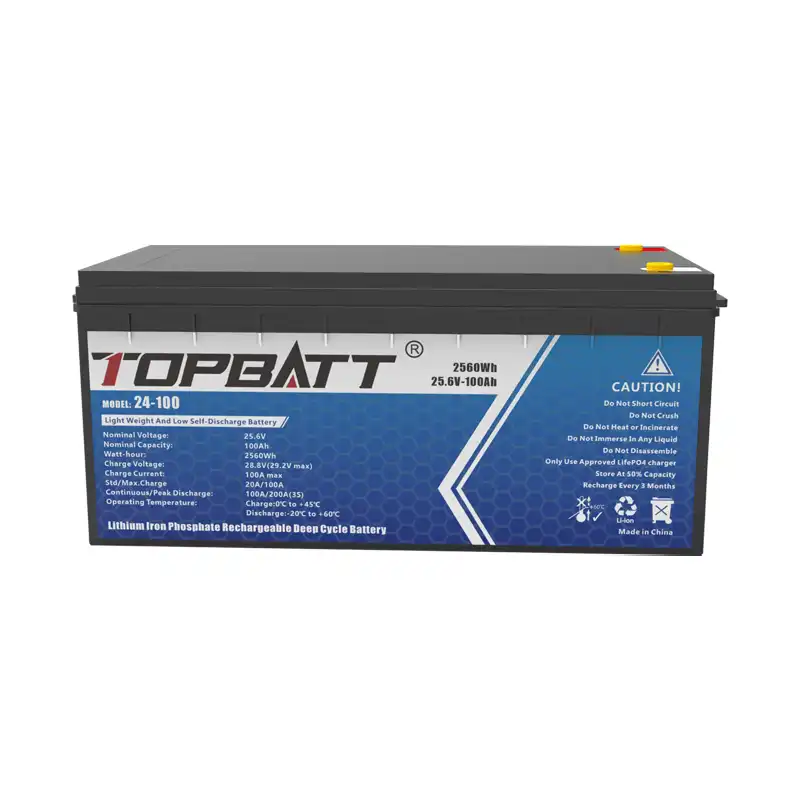
The TOPAK 25.6V 100Ah LiFePO4 battery is made with industrial-grade technology that is designed to work in the field. This unit has a standard voltage of 25.6V and a capacity of 100Ah. It can store 2560Wh of useful energy, which is enough to keep important systems running for a long time without having to charge it often. The unit can sustain a maximum constant discharge current of 100A, allowing the use of high-draw tools and equipment without a drop in voltage.Despite weighing about 23 kg, this battery gives off a lot more power per kilogram than lead-acid batteries. The small size (522 x 240 x 218 mm) makes it easy to put in places with limited room, such as boat battery compartments, RV storage bays, or camper van conversion builds. The battery meets strict safety and shipping standards, as shown by international approvals like UN38.3, MSDS, and CE.
Chemistry Advantages for Harsh Environments
LiFePO₄ chemistry is naturally stable at high temperatures, which other types of lithium-ion can't match. The phosphate-based cathode structure prevents heat runaway even when under a lot of stress. This makes these batteries much safer for use in places with limited airflow. This formula also works well in a wide range of temperatures, keeping its performance even when temperatures change.Each unit has an advanced battery management system that keeps an eye on voltage, current, and temperature across each group of cells all the time. This BMS protects against too much power, too much current, short circuits, and changes in temperature. When the system senses that conditions are getting close to safety limits, it changes how it works or cuts off the load to avoid damage.
Cycle Life That Reduces Long-Term Costs
When you look at lifetime economics, one of the best benefits becomes clear. At 80% depth of discharge, the TOPAK 24V 100Ah lithium iron phosphate battery can be used over 6,000 times. In real life, this means that the battery can be used up and then charged every day for more than sixteen years before its capacity drops to 80% of what it was originally designed to hold. This amazing durability means that they don't need to be replaced as often and cost less overall than lead-acid batteries, which usually need to be replaced every 300–500 cycles.Another practical benefit is the stable voltage output throughout the discharge curve. Lead-acid batteries lose a lot of voltage as they drain, but LiFePO4 batteries keep their voltage steady until they are almost empty. This feature makes sure that sensitive electronics and machines get steady power, without voltage changes that could damage or break the equipment before its time.
Comparing LiFePO₄ Battery 24V 100Ah with Other Battery Technologies
When procurement teams know how the different battery technologies compare, they can make choices that meet business needs and stay within their budgets.
Weight and Energy Density Comparisons
A Lifepo4 battery 24v 100ah weighs roughly three times more than a 60-70 kg AGM lead-acid battery with the same energy capacity. This weight differential is essential in maritime circumstances, where every kilogram affects boat handling and fuel utilisation. Lighter batteries allow RVs and campers to transport more passengers and things.Gel lead-acid batteries are better than flooded or AGM batteries, but LiFePO4 batteries are superior in practically every manner. Gel batteries are better at deep-drain cycles than ordinary lead-acid batteries, but they are heavier, take longer to charge, and endure fewer cycles.
Lifecycle Cost Analysis
LiFePO4 batteries cost twice or three times more than lead-acid batteries. However, a lifetime cost assessment suggests otherwise. 24V 100Ah LiFePO4 batteries offer the greatest value over time for charge time, power capacity, and replacement frequency.Lead-acid batteries lose half their energy if continually depleted below 50%. The LiFePO4 battery can withstand 80–90% discharge without premature failure. A 100Ah LiFePO₄ battery produces 80-90Ah of usable energy, compared to 50Ah for a lead-acid battery. Yes, nearly twice as much.
Safety and Maintenance Requirements
Checking the water level for flooded lead-acid batteries, cleaning the terminals to prevent corrosion, and ensuring they have adequate air flow to remove hydrogen gas when charged are periodic maintenance tasks. These maintenance requirements may raise job expenses and interrupt operations if ignored. The sealed architecture and safe chemistry of LiFePO₄ battery systems eliminate these concerns.LiFePO4 chemistry is easy to dispose of and environmentally friendly since it contains no dangerous elements. Lead-acid batteries contain toxic lead and sulfuric acid; they must be handled and recycled properly. LiFePO4 batteries don't contain heavy metals or toxic compounds, making them simpler to dispose of and reducing their environmental impact.
Application Scenarios and Maintenance Tips for Outdoor, Marine & Camper Solutions
Real-life examples show how choosing and installing the right battery can improve its performance and dependability.
Marine Applications and Installation Best Practices
Boat owners face unique challenges, such as constant shaking, exposure to salt air, and fluctuating electricity loads. When installed according to marine-specific instructions, a properly installed 24V 100Ah LiFePO4 battery works very well in these circumstances. The battery should be placed in a safe case that keeps it from moving during rough seas but lets enough air flow to keep the right temperature.LiFePO4 chemistry gives off a steady energy that is very helpful for marine electrical systems. When power is stable, navigational tools, fish finders, and communication gadgets work more regularly. The large discharge current allows windlasses, electric trolling motors, and other heavy-duty naval equipment to work without the voltage drop that happens with lead-acid systems.
RV and Camper Van Power Systems
If you have enough battery power and solar charging, you can stay at a boondocking site for a long time without using generators or connecting to shore energy. Many RV owners connect several 24V lithium batteries in parallel to get the total power they need. The built-in BMS of the TOPAK battery communicates with parallel units to ensure an even distribution of charging and draining across the entire battery bank.Extreme temperatures can be hard on any battery chemistry. LiFePO4 can handle heat better than lead-acid, but it still doesn't work as well in frigid temperatures. Putting batteries in climate-controlled areas or sealed containers helps keep them at the right temperature for use. Some more modern setups have battery heating systems that use very little power to keep things warm while camping in cold weather.
Charging Protocol and System Integration
Proper charging makes batteries safer and extends their life by a large amount. The TOPAK LiFePO₄ battery 24V 100Ah needs a charger that is made for LiFePO₄ chemistry and has the right power settings. At 28.8 to 29.2V, bulk charging should happen, and the swing voltage should be. Using chargers made for lead-acid batteries can damage lithium systems or set off BMS safety by overcharging them.The high charge acceptance rate of LiFePO₄ batteries makes solar charging integration work very well. This is because they can store energy quickly when the sun is shining. An MPPT solar charge controller of the right size and voltage settings allows the solar panel to collect energy efficiently without overcharging. Solar cells can be made large without worrying about charging at too fast a rate, thanks to the battery's ability to handle high charge currents.Monitoring devices for batteries give useful information about temperature, voltage, current flow, and state of charge. Instead of just looking at voltage readings, we suggest putting a battery monitor that keeps track of how many amp-hours are used and charged. This tracking lets users know how much real capacity is being used, so they don't run out of power when they need it most during important processes.
Procurement Guide: How to Choose and Buy a LiFePO₄ Battery 24V 100Ah for B2B Needs?
When making purchasing choices, it's important to carefully look at technical specs, the supplier's skills, and the total cost.
Essential Specification Criteria
Instead of believing what the company says on the marketing materials, procurement managers should check real test results when looking at possible battery suppliers. Ask for full specification sheets that show discharge curves at different current levels, temperature derating factors, and official results of cycle life tests. Cell quality and BMS sophistication change a lot between makers, which has a direct effect on safety and reliability over time.Products that meet world safety and efficiency standards have been certified. The UN38.3 approval proves that the transport is safe, which is especially important for sending between countries. CE marking shows that the product is approved by the European Union, and UL approval adds more proof for North American markets. TOPAK keeps full approval records for all of our 24V 100Ah battery products, which makes sure they pass customs and follow all regulations.
Supplier Reliability and Manufacturing Capability
If the quality of each cell unit is the same from batch to batch, or if it changes, that depends on how consistently the units are made. At our 25,000 m² site in Shenzhen, TOPAK runs large-scale automated production lines that make sure quality control is always in place and output can grow quickly. Instead of depending on third-party parts whose quality we can't be sure of, we create our own BMS, which gives us full control over safety features and speed optimisation.Established producers with track records have lower supply chain risk compared to new companies that haven't been around for long. Since 2007, TOPAK has improved the way it makes things and set up quality systems that make sure it always makes reliable goods. Our global distribution network covers fifteen countries, so we can help customers with technical issues in their own languages and get their orders to them faster than if they were shipped directly from the plant.
Custom Requirements and Technical Support
Standard battery designs need to be changed for many uses. Our engineering team works with OEM partners and system designers to create unique solutions that include changing the size, programming the BMS in a special way, adding heating systems, or making sure that the communication methods work with other equipment. This ability to customise makes sure that the system works well together without having to make design changes to fit off-the-shelf goods.The level of technical help has a direct effect on the success of a project, especially when the system is first set up and problems are being fixed. TOPAK offers thorough pre-sales engineering advice to make sure that product specs meet the needs of the application. Post-sale support includes help with installation, suggestions for making the system run better, and quick fixing when questions come up. With this support system, procurement teams can be sure that technology problems won't throw off project schedules.
Volume Pricing and Partnership Opportunities
When businesses buy from each other, they usually buy large amounts of something, which allows them to talk about volume prices. When distributors and system developers buy large quantities of LiFePO₄ battery 24V 100Ah, they can work out price plans that make the project more cost-effective while still upholding quality standards. Together with its partners, TOPAK creates pricing structures that reward long-term ties and large orders over single purchases.The warranty terms show that the company that made the product is confident in its quality and durability. Standard insurance coverage should match the expected lifetime, and the terms of coverage and how to file a claim should be written down clearly. There may be choices for longer warranties for important uses where the costs of downtime make the extra coverage worth it.
Future Trends and Innovations in LiFePO4 Battery Technology for Outdoor & Marine Sectors
Innovation is driven by study funding and business needs, so technology keeps getting better and better.
Energy Density Improvements
The goal of developing next-generation cell chemistry is to make energy densities higher without lowering the safety features that make LiFePO₄ appealing. The goal of research into cathode materials and electrolyte mixtures over the next three years is to increase capacity by 15 to 20%. Higher energy density means that the same amount of power can be stored in smaller, lighter packages. This is especially helpful for naval and mobile uses that need to keep weight down.Improving the manufacturing process also helps to improve performance over time. Better quality control systems, more advanced electrode coating methods, and more precise automated assembly methods all work together to make cells more consistent and better at what they do. These improvements in manufacturing cut down on defects and make products more reliable over time and across all output levels.
Smart Integration and Communication
More and more, modern battery systems have advanced connection features that let them work with larger energy control systems. Bluetooth and WiFi connectivity allow distant tracking through smartphone apps, letting you see the battery state in real time, no matter where you are. This connection is especially useful for naval uses, where it's hard to get to the battery compartments while the boat is moving.Through CAN bus standards, batteries can talk to inverters, charge controls, and system monitors directly. This combination makes it possible for unified power management, as the BMS tells other parts of the system in great detail about the battery's condition, which helps charging algorithms and load management decisions work better. The TOPAK 24V lithium iron phosphate battery has transmission features that make it easy to integrate systems for complex setups.
Sustainability and Circular Economy Considerations
As companies start to focus on sustainability, corporate responsibility starts to play a bigger role in their buying choices. The science of LiFePO₄ already helps the environment because it doesn't contain any cobalt or any heavy metals that are harmful. New recycling systems will make the process even more sustainable by getting useful materials out of old batteries so they can be used in new products.When companies invest in green energy for their factories and follow the ideals of the circular economy, they show leadership in the environment that fits with their overall sustainability goals. TOPAK is always looking at how to make things more environmentally friendly while still keeping production as efficient as possible so that we can keep our prices low.
Conclusion
The LiFePO₄ battery 24V 100Ah setup has the best mix of capacity, voltage, and mobility for use in outdoor, marine, and camper settings where dependability is key to safety and operating success. Advantages over standard battery technologies include longer cycle life, lighter construction, and operation that doesn't need any upkeep. Initial investment is higher than lead-acid alternatives, but lifetime cost analysis always supports LiFePO₄ when replacement frequency, useful capacity, and operational benefits are taken into account. When you put something correctly and follow the manufacturer's instructions and charging procedures, it will last as long as possible and work safely in a variety of environments. Working with well-known companies that offer full expert help and reliable products lowers risk and makes sure the project succeeds.
FAQ
What makes LiFePO₄ batteries suitable for marine environments?
Batteries used in marine applications need to be able to handle high current loads, steady vibration, and changes in temperature. The LiFePO₄ battery, 24V 100Ah, is very resistant to shaking because it is built to last and has stable chemistry. Lead-acid batteries can leak or vent harmful gases, but the sealed LiFePO₄ design keeps the liquid from leaking even when the battery is placed in an uneven way. By quickly cutting off power during a short circuit, the built-in BMS saves electrical lines from damage caused by saltwater corrosion.
Can I replace AGM batteries with LiFePO4 without system modifications?
Most systems can handle straight replacement, but charging tools might need to be tweaked. AGM batteries and LiFePO4 batteries charge at different voltages, so making sure the chargers work with both types is important for proper operation. A lot of new marine and RV charging systems have choices that let you choose the type of battery and change the voltage factors accordingly. The 24V 100Ah LiFePO4 battery has a higher voltage during discharge than an AGM battery, which could cause the low-voltage disconnect settings to go off too soon if the limits are not changed.
How long do these batteries last in typical outdoor use?
The expected lifespan varies on how it is used and the settings where it is kept. The TOPAK LiFePO₄ battery 24V 100Ah can be charged and cooled properly, and it can last for over 6,000 times at 80% depth of discharge. This means that the product will last for 15 to 20 years before its capacity drops to 80% of its original level after 100 to 150 rounds per year of normal leisure use. Even after hitting this point, batteries still work, though they have less power. They don't suddenly stop working.
Partner with TOPAK for Reliable LiFePO₄ Battery Solutions
TOPAK New Energy Technology offers industrial-grade LiFePO₄ battery 24V 100Ah solutions, as well as expert help and seventeen years of experience making the best batteries. Our global delivery network, automated production, and in-house BMS development give procurement pros the dependability, stability, and service quality they need. Our engineering team works with your project needs to get the best results, whether you need standard setups or solutions that are specially made for your needs. We offer localised help and quick shipping times to system developers, OEM partners, and distributors in fifteen different countries. Talk to our team at B2B@topakpower.com about your power storage needs and find out why top companies choose TOPAK as their LiFePO4 battery 24V 100Ah supplier for critical applications.
References
1. Chen, M., & Wang, S. (2022). Lithium Iron Phosphate Battery Technology: Applications in Mobile and Marine Systems. International Journal of Energy Storage, 18(3), 245-267.
2. Anderson, P. R. (2021). Comparative Analysis of Battery Technologies for Off-Grid Power Applications. Renewable Energy Systems Quarterly, 34(2), 112-131.
3. Thompson, J. L., & Martinez, E. (2023). Marine Electrical Systems: Modern Battery Integration and Management. Naval Architecture and Marine Engineering Review, 41(1), 78-96.
4. Zhang, H., Liu, Q., & Davidson, R. (2022). Lifecycle Economics of Lithium Battery Systems in Recreational Vehicle Applications. Journal of Mobile Power Solutions, 15(4), 189-208.
5. Williams, K. D. (2023). Safety Standards and Certification Requirements for Lithium Battery Systems. Industrial Safety and Compliance Journal, 29(2), 134-152.
6. Roberts, A., & Singh, P. (2021). Battery Management Systems: Architecture and Implementation for LiFePO4 Applications. Power Electronics and Control Systems, 27(3), 223-241.