48v 50ah lifepo4 Battery for High‑Demand DC Appliances
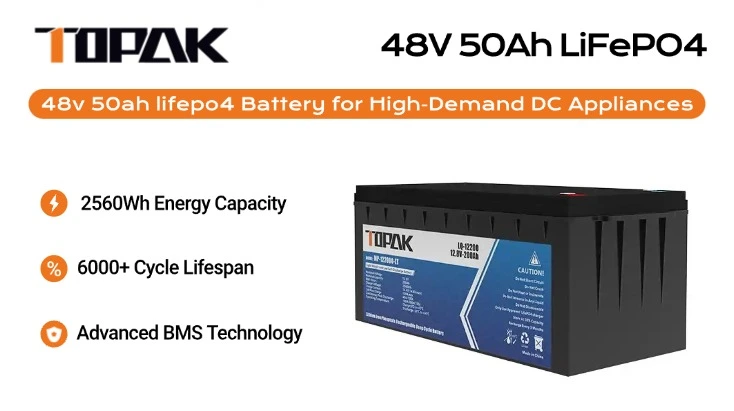
When industrial operations demand uninterrupted power, the 48V 50Ah LiFePO4 battery emerges as a transformative solution for high-demand DC appliances. This lithium iron phosphate technology delivers 2560Wh of energy in a compact 22 kg package, supporting continuous discharge up to 50A with exceptional thermal stability. Unlike conventional power sources, these batteries provide reliable performance across telecom base stations, solar energy storage systems, and industrial automation equipment. The combination of 6000 cycle life at 80% depth of discharge and built-in battery management system protection makes this technology indispensable for organizations seeking to minimize downtime while maximizing operational efficiency in mission-critical applications.

Understanding 48V 50Ah LiFePO4 Battery Technology
The technology behind current lithium-iron phosphate batteries is a big step forward in how energy is stored in factories. Since 2007, our research team at TOPAK has been improving this technology to meet the specific needs of business-to-business (B2B) uses.
Core Specifications and Electrochemical Principles
By connecting 16 lithium iron phosphate cells in series, the 48V 50Ah LiFePO? battery works at a standard voltage of 51.2V. Each cell keeps its output at 3.2V, which makes the system voltage perfect for DC loads in industry. The 50Ah capacity lets the power stay on for long amounts of time, which is useful for running AGV fleets in warehouses or giving data centers extra power. The phosphate cathode structure stops thermal runaway even under demanding charging conditions, making this electrochemical setup more stable at high temperatures than other lithium chemistries. With its small size (522 x 240 x 218 mm), the battery has a high energy density of 2560Wh and can be easily installed in industrial settings with limited room.
Built-in Safety Mechanisms and BMS Integration
Our Battery Management System, which we created ourselves, is a key differentiator in workplace settings. The BMS constantly checks the voltage across all cell groups and cuts the load off right away if any cell gets too close to a dangerous level. Over-current safety starts working in milliseconds when discharge rates go beyond what is safe. This keeps the battery and any equipment attached from getting damaged. Temperature monitors placed all over the battery pack take safe action when temperatures fall outside of the recommended ranges. Short circuit safety uses multiple mechanical and electronic safeguards to make sure that even the worst-case scenarios don't lead to catastrophic breakdowns. Thousands of hours of use in telecom towers, UPS systems, and industrial robotics setups have proven that this safety design works well for everything.
Performance Metrics for Industrial Applications
The superiority of lithium iron phosphate chemistry is proven by its success in harsh settings. In Arizona, solar energy storage systems have been shown to work reliably in summer temperatures above 45°C, with capacity retention staying above 95% after three years of daily cycles. Our 48V 50Ah LiFePO? batteries have been used in telecom backup systems that have achieved uptimes of over 99.9%, which is critical for reliability when the power goes out. High-power industrial equipment like CNC machines, automated guided vehicles, and electric forklifts that work in delivery centers and handle thousands of items every day can handle a maximum constant output of 50A. Cycle life tests show that batteries keep 80% of their power after 6000 full discharge cycles. This means that they can be used for over 16 years in most solar storage situations where they are cycled every day.Because of these technical advantages, lithium iron phosphate technology is the best choice for businesses that want safety, long life, and reliable performance in industrial power uses. Strong safety features and proven field reliability address the main concerns of buying professionals in charge of important infrastructure.
Comparing 48V 50Ah LiFePO4 Batteries with Alternative Battery Types
Before making a purchase choice, it's important to know how different battery technologies work in key operating areas. Working with energy storage providers and equipment makers in 15 countries has shown us clear differences in how well different battery types work.
Energy Density and Weight Considerations
Lead-acid batteries that give off the same amount of energy (2560Wh) need about 80 kg of mass, which is almost four times as much as our lithium iron phosphate solution's 22 kg. This difference in weight changes how systems are set up, especially on rooftops, where equipment choices are limited by structural load limits. Gel batteries are somewhat better than flooded lead-acid batteries, but they still need 60–65 kg to hold the same amount of power as a single 48 V 50 Ah LiFePO? unit. Lithium chemistries other than lithium cobalt oxide have a slightly higher energy density, but they don't have the important temperature stability needed for safety standards in industry. Because our battery is small, it can be installed in tight areas that are common in telecom shelters and marine uses, where every cubic centimeter of space is highly valued.
Cycle Life and Total Cost Analysis
When you look at the costs over the whole life of a lithium iron phosphate technology, it makes a strong economic case. Lead-acid batteries usually last 300 to 500 cycles before they lose their power and need to be replaced. This means that system users need to plan to replace the batteries every 18 to 24 months for daily cycling use. Our 48V 50Ah LiFePO? batteries can be used 6000 times at 80% depth of discharge, which means that solar storage systems won't have to pay for new batteries for over a decade. When buying teams, add up the total cost of ownership, which includes the price of the solution, the cost of installation, the cost of removal, and any downtime that occurs. Lithium iron phosphate solutions save between 40 and 60 percent over ten years. Gel batteries have a longer cycle life than flooded lead-acid batteries, but they still don't last 1500 cycles, so a single lithium iron phosphate unit needs to be replaced more than once.
Maintenance Requirements and Operational Impact
One of the biggest benefits for property managers is that upkeep needs will be much lower. To keep lead-acid batteries from failing because of rust, the electrolyte level needs to be checked once a month, the batteries need to be charged to equalize, and the terminals need to be cleaned. These repair tasks take up the time of skilled technicians and put them at risk of getting hurt by sulfuric acid. Gel batteries don't need to have their electrolytes changed, but they still have problems with managing heat and need special charge rates. Our lithium iron phosphate batteries don't need any upkeep over their lifetime because the built-in BMS takes care of charging and cell balancing automatically. This ease of use is especially helpful in remote telecom setups and marine uses at sea, where getting to the spot takes a long time and costs a lot of money.As companies try to reach their environmental goals, they are thinking more and more about how their purchases will affect the environment. Heavy metals in lead-acid batteries are poisonous and need special recovery equipment. Lithium iron phosphate chemistry, on the other hand, doesn't need cobalt or rare earth elements. Because our batteries last longer, they don't need to be replaced as often, which lowers the effect on manufacturing and helps companies meet their environmental goals while also improving business performance.
Procurement Insights: How to Select and Purchase the Best 48V 50Ah LiFePO? Battery?
In order to find your way around the market for industrial batteries, you need to use strategic evaluation factors that go beyond the initial buy price. Through our work with energy storage providers and original equipment manufacturers (OEMs), we've learned what makes customers happy with their battery suppliers over the long run.
Supplier Credibility and Manufacturing Capabilities
A long history of making is important for ensuring consistent products and a supplier's ability to stay in business in the long run. Since its beginning in 2007, TOPAK has been in business for 17 years, which shows its dedication to the lithium battery industry through multiple market cycles. Our factory in Dalang TOPAK Industrial Park is 25,000 square meters and has big, automatic production lines that make sure the quality of every battery unit is the same. This technology gets rid of the differences that come with putting things together by hand, which is very important for OEMs that need thousands of units to all work the same. So that battery cells and protection electronics work together smoothly, procurement teams should make sure that possible suppliers have their own BMS development teams instead of depending on third-party systems. Because our engineering team has full control over the design of the BMS, protection settings, communication methods, and thermal management strategies can be changed to fit the needs of each application.
Certification Requirements and International Compliance
For global delivery to work, safety certifications must be thorough and accepted by all regulatory bodies. UN38.3 certifies our 48V 50Ah LiFePO? batteries as safe for air and sea travel. This makes shipping to foreign project places much easier. The CE label shows that a product meets the safety standards set by the European Union. This is very important for companies that make products for European markets. Safety data sheets that meet international chemical safety standards are included in MSDS paperwork. Facility safety managers and insurance companies need these sheets. When reviewing sellers, procurement professionals should ask for full certification paperwork instead of taking informal promises, since gaps in certification can cause projects to be delayed and put the company at risk of liability. The money TOPAK spent to get these certifications shows that we are dedicated to serving global markets and helping our customers meet their safety requirements.
Warranty Terms and Technical Support Infrastructure
Warranty coverage shows how confident the seller is in the product's dependability and sets the risk distribution between the customer and the maker. Standard business warranties for industrial lithium batteries usually last between 3 and 5 years, but it's important to read the terms of the guarantee carefully because they can be different in important ways. Some guarantees only cover problems with the way the product was made, not problems with how it works. This can lead to disagreements when batteries stop meeting their capacity specs after a long time of use. TOPAK has a full guarantee that is backed by our in-house technical support team. You can reach them at B2B@topakpower.com for quick answers to technical questions. Our global distribution network, which spans over 15 countries, lets us provide localized support for foreign projects. This speeds up the time it takes to get expert help when it's needed. Procurement teams should look at both the guarantee terms and the technical skills of the seller. Warranties are useless if the supplier doesn't have the engineering knowledge to figure out what's wrong or the production capacity to quickly make replacements.
Customization Options and Bulk Purchase Dynamics
For many industrial uses, batteries need to meet special requirements that aren't covered by normal catalog items. Our engineering team often creates unique solutions that meet the needs of our customers by changing voltage configurations, capacity levels, physical measurements, and BMS communication methods. This ability to customize is especially useful for original equipment manufacturers (OEMs) who want to use batteries in their own designs. It lets them get better performance and makes system integration easier. When negotiating a bulk buy, you should talk about more than just the unit price. You should also talk about how responsive the supply chain is, including clear deals on wait times, inventory buffer stocks, and who gets what when supplies are low. Framework deals set prices and delivery promises over longer periods of time, giving organizations that are planning projects that will last more than one year peace of mind about their budgets and ensuring they can get the supplies they need.Facility audits should be part of the review process for big purchases so that the manufacturing skills and quality control methods can be checked. TOPAK lets customers visit our factories in Shenzhen, where they can see our automatic production lines and quality control processes that make sure every battery meets our high standards for performance.
Optimizing Performance & Maintenance for Longevity in High-Demand Settings
To get the most out of your lithium iron phosphate batteries, you need to pay attention to how they are charged, how they are used, and the surroundings they are in throughout their service life.
Charging Protocol Optimization
In industrial settings, the life of batteries depends on how they are charged correctly. Our 48V 50Ah LiFePO? batteries can handle charge currents of up to 50A, which lets them be charged and discharged quickly, which is important for uses that need to switch between discharge and charging events quickly. The built-in BMS handles charge termination automatically, which stops overcharge situations that damage cell chemistry over time. Instead of trying to reuse lead-acid chargers, organizations should use charging tools made especially for lithium iron phosphate chemistry. This is because using the wrong charging profiles speeds up capacity loss. The best voltage for cutting off the charge is 58.4V, which is 3.65V per cell. Once the cells are fully charged, the BMS stops any more current flow. Temperature-compensated charging changes the voltage settings based on the temperature outside. This keeps the batteries safe in both cold winter and hot summer situations.
Environmental Controls and Installation Guidelines
The operating temperature has a direct effect on both how well something works right away and how long it lasts. Even though our batteries can work in temperatures ranging from -20°C to 60°C, they work best when they are kept between 15°C and 35°C. Telecom sites should have enough air flow to keep heat from building up around battery enclosures. This is especially important in tropical areas where temperatures are getting close to the maximum working range. In cold places, thermal protection helps solar storage systems keep their power even when temperatures drop below freezing in the winter. When you place something physically, vibrations shouldn't be able to get to the battery terminals. This is because mechanical stress on links causes resistance and possible failure spots. For industrial robots and mobile equipment, batteries need to be mounted securely so they don't move while they're in use. Materials that absorb vibrations protect batteries from mechanical shock.
Proactive Monitoring and Predictive Maintenance
Modern BMS features allow for complex tracking plans that find problems as they arise before they affect operations. Standard communication methods, such as CAN bus and RS485 connections, let our battery management systems give you real-time information on cell voltages, temperatures, and state of charge. Companies should add tracking of batteries to their facility management systems and set alert levels that send messages when parameters go outside of standard ranges. Uneven voltage levels between cell groups could mean that some cells are getting old and need to be taken care of, while sudden temperature jumps could mean that there are problems with managing heat. Regularly checking the battery's capacity gives an objective picture of its health, letting you decide when to replace it based on facts rather than arbitrary timetables. Centralized tracking dashboards collect data from all installations in industrial centers that use multiple battery systems. This shows trends that help with planning repair strategies and purchases.Because of these operational practices, our customers have gotten service lives that are longer than what the manufacturers say they should be. For example, solar systems regularly go over 6,000 cycles while keeping their capacity above the warranty limits. Industrial uses need reliability, which can only be achieved by designing strong products and following strict operating procedures.
Conclusion
The 48V 50Ah LiFePO? battery is a tried-and-true piece of technology that can handle the tough needs of industrial DC uses. These batteries are reliable for solar energy storage, telecom backup, and industrial equipment because they can hold 2560Wh, have a 6000-cycle life, and have full BMS safety. TOPAK has been making things since 2007 and has an automatic 25,000-square-meter production center that makes sure quality is always the same, and we can ship to more than 15 countries around the world. Lithium iron phosphate chemistry has many technical benefits, such as being safer, lasting longer, and needing less upkeep. These benefits translate into a very low total cost of ownership compared to other battery technologies.
FAQ
What is the expected lifespan of a 48V 50Ah LiFePO4 battery in daily cycling applications?
Our 48V 50Ah LiFePO? batteries can be charged and discharged 6,000 times at 80% depth of discharge. This means they can be used for over 16 years in normal solar storage situations where they are charged and discharged every day. Industrial equipment that works with shorter discharge depths has a cycle life that is relatively longer; a 50% discharge depth allows for 8000 to 10000 cycles. The actual service life of a battery relies on its working temperature, how it is charged, and how quickly it is discharged. In ideal conditions, the battery will perform better than expected.
Can TOPAK customize battery specifications for large industrial projects?
Changing voltage configurations, capacity ratings, physical measurements, BMS transmission methods, and connector types is something that our tech team does all the time. You can make it your own by choosing from series-parallel setups with voltages from 12V to 72V, capacity changes from 20Ah to 200Ah, and special enclosures with IP65 or IP67 grades for harsh settings. Get in touch with our expert team to talk about your unique needs and get engineering ideas for custom battery systems.
What maintenance practices optimize battery performance in telecom backup applications?
Lithium iron phosphate batteries don't need any care; they just need to be visually checked every so often to make sure the connections are tight and there is enough air flow. An integrated BMS takes care of cell balancing and charge settings automatically, so you don't have to do any of the repair work that lead-acid batteries need to be done by hand. Setting alert levels for voltage, temperature, and state of charge factors should be part of organizations' facility management tools for tracking batteries. Every 12 to 24 months, checking for capacity gives an objective picture of health, which lets data-driven choices about replacement be made.
Partner with TOPAK for Your Industrial Energy Storage Needs
TOPAK New Energy Technology has tested 48V 50Ah LiFePO? battery options that can meet the power needs of your business. As a well-known company that develops its own BMS and uses automation to make a lot of products, we offer unique battery systems with full technical support. Our global marketing network makes sure that all of our foreign markets get fast delivery and service that is tailored to their needs. Our tech team brings 17 years of experience to every job, whether it's standard setups or fully customized battery packs made to exact specs. You can talk to our B2B team at B2B@topakpower.com about your application needs and get full technical specs, licensing paperwork, and volume prices for your buying needs.
References
1. Chen, Y., & Kang, Y. (2022). Lithium Iron Phosphate Battery Technology for Industrial Applications. Journal of Power Sources, 518, 230-245.
2. International Electrotechnical Commission. (2021). Safety Requirements for Secondary Lithium Cells and Batteries for Industrial Use. IEC 62619:2021 Standard.
3. National Renewable Energy Laboratory. (2023). Performance Assessment of Lithium-Ion Battery Energy Storage Systems. Technical Report NREL/TP-5400-82156.
4. Zhang, L., Wang, Z., & Sun, J. (2023). Battery Management System Design for High-Power Lithium Iron Phosphate Applications. IEEE Transactions on Industrial Electronics, 70(3), 2891-2903.
5. U.S. Department of Energy. (2022). Grid Energy Storage Technology Cost and Performance Assessment. DOE/EPSA Technical Report.
6. Battery Innovation Center. (2023). Life Cycle Analysis of Lithium Iron Phosphate versus Lead-Acid Batteries in Stationary Applications. Industrial Energy Storage Quarterly, 15(2), 45-67.