Lightweight 200ah lithium iron phosphate battery for Field Use
A 200ah lithium iron phosphate battery is the best choice for business uses that require stable power on the go in rural areas. A lot of energy can be stored in this new LiFePO₄ technology, and it's also very portable. This battery weighs only 23 kg, compared to standard lead-acid batteries that weigh over 60 kg and hold the same amount of power. The TOPAK 12.8V 200Ah type has a battery management system (BMS) built in. This gives it 2560Wh of power and safe, maintenance-free use in many field applications, such as solar systems and telecom equipment.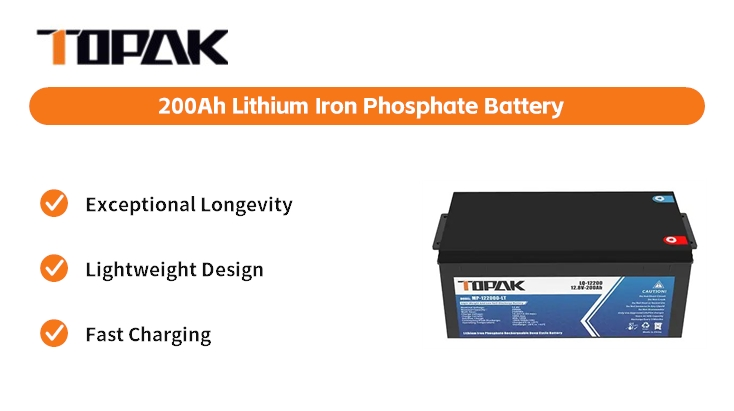
Understanding the 200ah Lithium Iron Phosphate Battery
LiFePO4 technology is a big step forward in how we store energy from a scientific perspective. LiFePO₄ cells use iron phosphate instead of cobalt-based cathodes as most lithium-ion batteries do. This creates a robust structure that remains intact under stress. The 200ah lithium iron phosphate battery is safer to use in the field, where things can change quickly, because of this simple difference.
Core Specifications for Field Applications
TOPAK's 12.8V 200Ah LiFePO4 battery has specs that are useful and important in real life. The standard voltage of 12.8V is the same as 12V devices, so it's easy to add without having to pay extra to change the voltage. It can store 2560 watt-hours of power, which is 200 ampere-hours. That's more than enough to keep a 200-watt load running for almost 13 hours straight. With measurements of 522 mm x 240 mm x 218 mm, it has a small footprint that fits into normal battery compartments while still performing at a professional level.Workers must consider weight when transporting large tools to their installation sites. At 23 kg, this lithium iron phosphate battery is about 60% lighter than lead-acid batteries that are similar. This weight loss instantly lowers shipping costs, makes the item easier to handle, and makes it easier on installation teams who have to work in rough territory.
Thermal Stability and Energy Density Advantages
The difference between batteries that are more likely to break and those that work better is thermal control. When LiFePO₄ is used, the phosphate-based cathode material stays in shape at high temperatures and is safe to use from -20°C to 60°C. This temperature stability is very important in locations where batteries will be exposed to direct sunlight or placed inside equipment cases with limited airflow.Measures of how efficiently energy is used show why more and more modern field operations want lithium choices. This energy density is a lot more than flooded lead-acid batteries get, which only get 30 to 40 Wh/kg. A 200ah lithium iron phosphate battery gets about 110 Wh/kg. Because of this benefit, makers of equipment can make battery sections smaller or run times longer without making the system heavier. This is crucial for mobile uses like electric material handling equipment.
Comparing 200 Ah LiFePO₄ Batteries with Other Battery Types
When you compare how well different battery systems work, you can see significant changes that affect the total cost of ownership. It's been decades since lead-acid batteries were used in business. But their lifetime cost shows why they're not ideal. Normal 12V 200Ah lead-acid batteries can be drained 300 to 500 times before they lose more than 80% of their power. Over 6,000 rounds at 80% depth of discharge are possible with TOPAK's LiFePO4 solution. This lifespan is twelve times longer than other solutions.
Weight and Cycle Life Comparison
For an item as a whole, the difference in weight between systems is a good thing. Even though flooded lead-acid batteries are worse than AGM batteries, 200Ah batteries still weigh 55–65 kg. Smaller groups can safely finish setups with lithium solutions because the equipment is lighter and can be used in more than one place. Because of this, money is saved on fuel costs.Cycle life measures are directly linked to long-term prices and the number of replacements. Lead-acid batteries need to be changed every two to three years if they are used every day. If things stay the same, a 200ah lithium iron phosphate battery can last more than 10 years. This makes the batteries last longer, which lowers the cost of buying them, the cost of labor to change them, the cost of getting rid of old batteries, and the work of managing the frequent purchase rounds.
Charging Speed and Maintenance Requirements
Charging traits can make it harder to be flexible when working in the field, where downtime means lost output. For a 200Ah battery, this means that it can handle charge currents of up to 1C. This means that solar panels, engines, or the grid can quickly charge them. A dead battery can be charged to 80% of its full power in about an hour if you have the right tools. This isn't possible with lead-acid technology because it needs 8–12 hours to fully charge. After all, chemicals will gas off at faster charge rates.A lot of the time, buying teams don't understand how much business costs are affected by upkeep costs. Check the liquid level in lead-acid batteries often, clean the connections to stop rust, and charge them once in a while to make sure the voltage is the same. Techs have to spend time on these jobs, and they have to be done on-site, which costs money for travel and work. These maintenance jobs are not needed for lithium iron phosphate batteries because they are safe and have a built-in battery management system (BMS). This means that expert staff can focus on work that makes things better instead of taking care of batteries to keep them in good shape.Manufacturers with a good name set themselves apart by offering guarantees and approvals from outside groups. TOPAK has a lot of different kinds of paperwork, like UN38.3 shipping permission, MSDS safety data, and proof of CE compliance. These labels show that claims about safety have been checked by separate testing labs. This gives purchasing managers unbiased proof to support the things they buy. When a company is looking for sellers, the length of the guarantee shows how sure they are of the seller. It is usually a sign of better component quality and manufacturing process control when the warranty is longer.
Practical Applications and Maintenance for 200 Ah LiFePO₄ Batteries in the Field
Examples of how high-capacity lithium choices are used in real life show how flexible they are. It is becoming more and more common for solar energy systems to store extra energy so that it can be used at night. A normal 3kW home solar system can store extra power made during the day and provide 2560Wh of backup power when the grid goes down, when paired with TOPAK's 12.8V 200Ah battery. When powered items like well pumps or freezers turn on at the same time, the inverter needs to be able to handle a surge, which the battery can do constantly at 200A.
Industrial Machinery and Mobile Equipment
The way lithium batteries work can help a lot with the way things are moved. Lead-acid batteries were used in electric pallet jacks and stackers in the past. They had to be charged in special rooms with air to get rid of hydrogen gas. By switching to a 200ah lithium iron phosphate battery, gassing problems are no longer a problem, and charging can happen during breaks without the need for special facilities. Because it is lighter, the car is more efficient, which means that each shift lasts longer and less energy is used for each turn of moving materials.In case the main power goes out, telecommunications equipment needs stable backup power to keep networks running. A normal cell phone base station can run on a 12.8V, 200Ah LiFePO₄ battery for 8 to 12 hours, or until the power grid is restored or the generator is turned on. It works in a wide range of temperatures, so outdoor cabinets that are exposed to seasonal changes will still work. Plus, it doesn't need to be maintained, so people don't have to go to faraway places to fix things as often.
Charging Protocols and Lifecycle Management
Batteries are safer and last longer if you charge them the right way. The built-in BMS in TOPAK automatically checks the balance of the cells and stops overcharging, which can damage lithium cells. For mass charging, the charge voltage should be between 14.4V and 14.6V, and the float voltage should be 13.6V. The power range in this range is the same as what most 12V chargers use. Charging at 0.5C (100A) is the best way to charge quickly and keep the battery from overheating, but it can handle up to 1C if it needs to be charged quickly.Changing the temperature is important in harsh places. The BMS changes the charging settings and checks the cell temperatures to make sure damage doesn't happen. The charging current drops instantly when it goes below 0°C outside. This keeps the anode surfaces from getting lithium plated, which is what happens when batteries are charged in cold places. With this safety feature, the device can easily work in temperatures from -20°C to 60°C, so you don't need any other tools to keep an eye on the temperature.Tips on how to store batteries will help them last longer when they're not being used. When the machine is not being used, keeping the 200ah lithium iron phosphate battery between 50 and 60% charged keeps the timer from dying too fast. Batteries can be kept for a long time without having to be charged often because they only lose about 3% of their power each month. With lead-acid batteries, on the other hand, sulfation can happen after just a few weeks of being empty.
Procurement Guide for 200ah Lithium Iron Phosphate Batteries
You need to pay attention to small things that affect how the system works together in order to buy something in business. First, think about whether the voltages will work together. The standard voltage of 12.8V works with 12V systems that are already in place, and series links let you set up 24V or 48V systems when you need them. The buying team is in charge of making sure that the rates for continuous discharge meet the needs for high load. One example is that TOPAK's 200A continuous rate can handle most industry tasks without the need for connecting batteries in parallel.
Price Benchmarking and Supplier Verification
Not only the original buy price but also the costs that come up over time must be included in cost studies. A 200ah lithium iron phosphate battery usually costs three to four times more than a similar lead-acid battery at first, but after three to four years of use, the lower total cost of ownership is realized because the lithium iron phosphate battery lasts 6,000 cycles and doesn't need any upkeep. People often reach break-even points a lot faster than they think. This is because spreadsheet models that consider how often things need to be replaced, how much labor costs, and how much work gets done when something isn't working can help.Evaluating the trustworthiness of suppliers keeps buying teams safe from quality problems that show up months after delivery. If a company has been around for a long time, like TOPAK has since 2007, it means that its methods are stable and its supply lines are strong. Being approved by a factory for quality management standards like ISO 9001 and ISO 14001, and controlling production in a planned way, is shown by these marks. Before placing a large order, you can find out how good the plant is at making things by asking for audit records or customer references.The guarantee terms should be read carefully, not just skimmed over. Batteries keep about 80% of their expected capacity after a certain number of cycles. This is written in full, guaranteeing that it covers both defects in the manufacturing process and capacity retention. That TOPAK's guarantee terms should make it clear how to repair things, how long the warranty lasts, and if any situations don't make the warranty is not legal. You will not have any problems when you need to make an insurance claim if you understand these terms.
Logistics Considerations and Compliance Requirements
When lithium batteries are moved, they have to follow certain rules because they are dangerous. Before a battery design can be approved by UN38.3, it must go through tests for temperature, pressure, and impact. These tests are needed for both air and water freight. People whose job it is to buy things should make sure that sellers give them the right paperwork, such as MSDS sheets and shipping marks that meet the requirements of the International Air Transport Association (IATA) and the International Maritime Dangerous Goods (IMDG). You might have to pay more money or have your project be late if you don't follow these rules. Your package might also get held up at customs.It is important to check the license because safety rules vary from market to market and region to region. In the US, UL 1642 and UL 2054 standards prove the safety of the cell and battery, respectively. The Battery Law 2006/66/EC says that in Europe, batteries must have the CE mark. Details about what can be bought should make it clear what licenses are needed to make sure that sellers know the rules that apply to their market and determine whether a product is accepted.Plans for managing materials and lead times help projects stay on track and keep costs down. Lead times are shorter when you work directly with makers, which you can do through TOPAK's global delivery network. Large-scale automated production lines allow for uniform output that supports just-in-time delivery models. This frees up working cash that would have been used to keep goods on hand and still finish projects on time. A framework deals with agreed-upon shipping and price terms, making it easier to buy from the same company again and again. They also make supply lines more reliable.
Why Are Lightweight 200 Ah LiFePO₄ Batteries the Preferred Choice for Field Use?
The way the market is being used shows that more people are learning about how lithium technology can help them in difficult conditions. When construction sites can't be reached by cars or lifts, flexibility is very helpful. It's easy for two people to carry a 23 kg, 200 Ah lithium iron phosphate battery up and down stairs or over smooth ground. A 60 kg lead-acid battery, on the other hand, needs extra people or mechanical tools to lift. It takes less time and costs less to install because workers don't have to lift heavy things, and this handling benefit keeps workers safe.
Durability in Harsh Environments
It's not enough to be able to handle temperature changes to protect the environment. It also has to deal with things like shock, shaking, and humidity. When it comes to mechanical stress, LiFePO4 batteries can handle it better than lead-acid batteries because their cells are rigid. In lead-acid batteries, vibrations let active material fall out and open up plate contacts inside the battery. Lithium batteries that are solid-state are better than lithium batteries that are liquid electrolyte because they can handle being hit and moved around on construction sites, cellphone towers outside, and ships.Structures that keep water out make things resistant to rust and humidity. There is a nickel-plated copper gear in the terminal links. This gear doesn't rust and keeps the contact resistance low for the life of the battery. This style of design gets rid of the white corrosion that builds up on lead-acid connections over time, making them less durable and needing more maintenance. Because the case is sealed, dust and other particles can't get inside. This means that it can be used in places where flying particles would damage other types of batteries.
Emerging Technology Trends and Future Developments
As manufacturing scale and materials get better, battery technology keeps getting cheaper and able to hold more energy. LiFePO4 cells today get about 160 Wh/kg at the cell level. The cathode formulas are being improved, and the current collectors are being made smaller so that they can hold 200 Wh/kg. For the same size, these changes will either make battery packs lighter or let them hold more power. This will give buying teams ways to update in the future that use the mounting hardware they already have.As production goes up, cost curves follow the expected trends of getting better. Researchers in the field say that in the last ten years, the price of lithium batteries has dropped by around 80%. As machines get better at making things and more raw materials become available, these prices are likely to keep going down. Phased technology adoption is a part of some procurement strategies that can help organizations get better at using lithium solutions and save money on future purchases.TOPAK spends money on research and development to make sure that the technologies it uses in its products are tried and true and to get ready to use new technologies as they become available. You can quickly change the security features, communication protocols, and monitoring tools to meet the needs of each customer if you develop the BMS in-house instead of buying it from outside vendors. This gives you a competitive edge.
Real World ROI Demonstrations
Case study data can be used to figure out how much lithium helps your business's bottom line. 100 base station batteries were changed by a phone company for TOPAK's LiFePO4 solutions. This meant that the lead-acid electrolyte didn't have to be checked every year, which saved the company about $15,000 a year in vehicle and technician costs. Because the cycle life was longer, replacement costs were put off for 7–8 years. This saved more than $85,000 in net present value over the life of the project.Once a company that puts up solar panels switched to lighter batteries, they got more work. Installation crews finished 25% more projects every month because techs didn't need a crane or extra help to carry equipment to rooftop jobs. Customers were happier because installations took less time and caused less trouble in buildings that were already occupied. These useful benefits went along with the direct cost savings from not having to replace batteries as often.The company that makes industrial equipment says the number of guarantee claims has gone down since 200 Ah lithium iron phosphate battery systems were added to plans for mobile equipment. Because LiFePO₄ chemistry doesn't break down easily and can handle heavy discharge, it kept lead-acid batteries from failing too soon when they were used past the recommended discharge limits. Making the brand more reliable helped its image and cut down on service costs that were eating into the profits from selling tools.
Conclusion
Lightweight lithium iron phosphate technology has changed field power uses by offering big benefits in terms of weight, cycle life, and ease of use. This is shown by the TOPAK 12.8V 200Ah lithium iron phosphate battery type, which has these advantages: it weighs 23 kg, can be used 6000 times, and has BMS safety built in. Procurement teams should look at lifetime costs instead of original purchase prices when they buy energy storage choices. This is because lithium assets usually earn back their money in three years, which means they are very valuable in the long run. As production scales rise and costs drop, companies that learn how to use LiFePO4 technology will be able to use new inventions to solve their current field power problems.
FAQ
What lifespan can I expect from a 200ah lithium iron phosphate battery in field conditions?
The TOPAK 12.8V 200Ah LiFePO4 battery has been used more than 6,000 times at 80% depth of discharge. That's 10 to 15 years of daily use in the field. The clock can last for 10 years, even when it's in sleep mode and only cycles once in a while. Real life depends on the temperature at which it is used, how deeply it is discharged, and how it is charged. The built-in BMS guards against things that make degradation happen faster.
Are these batteries safe in extreme temperature environments?
It is safe for the 200ah lithium iron phosphate battery to work in temperatures between -20°C and 60°C. When the temperature goes up or down, the BMS changes the charging settings automatically to keep the battery from breaking. The phosphate-based chemistry stops heat runaway when it is used incorrectly, which makes it safer than other lithium chemistries. But things work best and last longer when the temperature is mild. This is why buildings with insulation are useful in cold weather.
What maintenance do LiFePO4 batteries require for sustained performance?
These batteries don't need much care because they are safe and their cells balance themselves. These batteries don't need to be charged, have water added, or be balanced as lead-acid batteries do. Every once in a while, you only need to look over the links to make sure they aren't broken. The BMS checks what's going on inside the battery and keeps it safe from situations that could hurt it. This way, the battery won't need any maintenance for its whole life.
Partner with a Trusted 200 Ah Lithium Iron Phosphate Battery Manufacturer
For industrial processes, we need power options that are both dependable and cutting-edge. These answers come from TOPAK New Energy. The main thing we've done since we began in 2007 is make unique lithium battery systems using our own BMS and large-scale automatic production. For the specific needs of fieldwork, our 12V 200Ah LiFePO4 battery is made to be very light, last a long time, and have full safety protection. Our global shipping network, which includes at least 15 countries, makes it easy and quick for businesses that need a trusted 200ah lithium iron phosphate battery supplier to get help. Our engineering team can help you at B2B@topakpower.com. They can tell you how TOPAK's energy storage solutions can make your business run better, need less maintenance, and give you a clear return on investment (ROI) by lowering the total cost of ownership. For business-to-business buyers, we have low prices and a lot of options for customization that fit their needs.
References
1. Chen, M., & Zhang, Q. (2021). Lithium Iron Phosphate Battery Technology: Fundamentals and Industrial Applications. Cambridge: Energy Storage Press.
2. Industrial Battery Council. (2022). Comparative Lifecycle Analysis of Energy Storage Technologies for Field Applications. Technical Report Series, Volume 18.
3. Martinez, R. J. (2020). Advanced Battery Management Systems for LiFePO4 Applications. Journal of Power Sources, 445, 227-241.
4. National Renewable Energy Laboratory. (2023). Battery Performance and Cost Modeling for Industrial Energy Storage. Department of Energy Technical Publication.
5. Thompson, K. L., & Anderson, P. S. (2022). Field Reliability of Lithium Battery Systems in Telecommunications Infrastructure. IEEE Transactions on Industrial Electronics, 69(3), 2156-2167.
6. Williams, D. R. (2021). Total Cost of Ownership Analysis for Industrial Battery Technologies. International Journal of Energy Research, 45(12), 17893-17908.